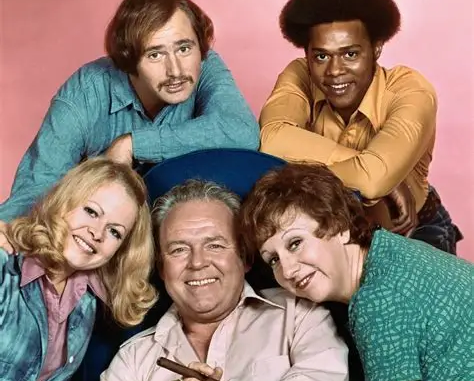
Few television shows have left a cultural imprint as bold and lasting as All in the Family. Premiering in 1971, the series didn’t just entertain—it challenged, provoked, and redefined what sitcoms could be. At the heart of it all was the unforgettable Bunker family, whose raw, unfiltered dynamics forced America to confront topics that had long been considered off-limits for prime-time TV.
The Bunkers: A Family Like No Other
At the center of the show was Archie Bunker, portrayed masterfully by Carroll O’Connor. Archie was loud, opinionated, and unapologetically bigoted—a character who, in any other context, might have been irredeemable. But O’Connor infused him with just enough humanity to make audiences laugh, cringe, and reflect all at once.
Opposite him was Edith Bunker, played by Jean Stapleton, whose gentle demeanor and unwavering kindness provided a stark contrast to Archie’s harsh worldview. Edith wasn’t just comic relief—she was the emotional anchor of the show, often revealing truths that Archie refused to see.
Their daughter Gloria, brought to life by Sally Struthers, represented a younger, more progressive generation. She frequently clashed with Archie, particularly over issues like women’s rights and social equality. And then there was Mike “Meathead” Stivic, Gloria’s husband, portrayed by Rob Reiner—a liberal college student whose debates with Archie became some of the show’s most iconic moments.
Breaking Barriers on Television
What made All in the Family revolutionary wasn’t just its characters—it was its willingness to tackle real-world issues head-on. Racism, sexism, politics, religion, and even topics like menopause and sexual assault were brought into American living rooms with a candor that was unheard of at the time.
The show’s creator, Norman Lear, deliberately used humor as a vehicle for social commentary. By making Archie both the source of laughter and the embodiment of outdated beliefs, the show encouraged viewers to question their own perspectives.
Changing the Sitcom Landscape
Before All in the Family, sitcoms largely avoided controversy, opting instead for safe, idealized portrayals of family life. The Bunkers shattered that illusion. They argued, they disagreed, and they reflected the messy reality of American households.
The show paved the way for future series to explore deeper, more complex themes. Without it, we likely wouldn’t have seen the rise of socially conscious comedies that blend humor with meaningful discourse.
Why the Cast Still Matters Today
More than five decades later, the performances of O’Connor, Stapleton, Struthers, and Reiner still resonate. Their chemistry felt authentic, their conflicts felt real, and their stories still feel relevant in today’s divided world.
The Bunkers didn’t just change television—they changed how audiences engage with it. They proved that comedy could be uncomfortable, that laughter could spark conversation, and that even the most flawed characters could hold up a mirror to society.
In the end, All in the Family wasn’t just a sitcom. It was a turning point—one that continues to influence television storytelling to this day.