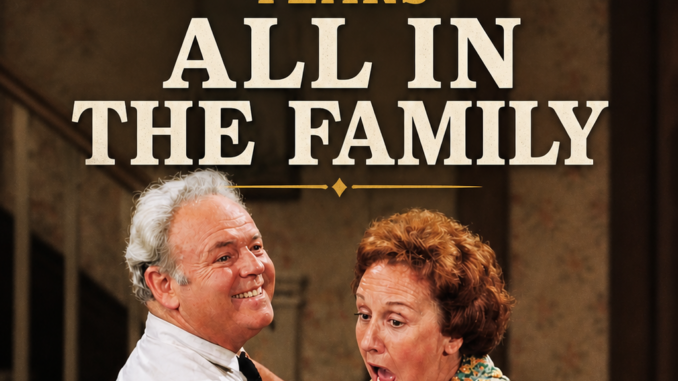
When All in the Family premiered in 1971, few could have predicted that it would become one of the most influential television series of all time. What seemed, at first glance, like a simple family sitcom quickly evolved into something far more daring—a cultural lightning rod that challenged norms, sparked national conversations, and permanently altered the DNA of television comedy.
Fifty years later, its legacy isn’t just intact—it’s impossible to ignore.
A Sitcom That Refused to Play It Safe
Before All in the Family, most American sitcoms leaned toward comfort. Families were polished, conflicts were light, and controversial issues were carefully avoided. But under the vision of Norman Lear, that formula was completely dismantled.
Lear didn’t just want to make people laugh—he wanted them to think.
Set in a working-class home in Queens, the show centered around a family that felt startlingly real. Arguments weren’t neatly resolved in 22 minutes. Tensions lingered. Opinions clashed. And most importantly, the show wasn’t afraid to say what many Americans were already thinking—but rarely heard on television.
The Characters Who Carried the Revolution
At the core of the show was Archie Bunker, brought to life by Carroll O’Connor. Archie was not your typical TV protagonist. He was stubborn, politically incorrect, and often offensive. Yet somehow, he became one of the most iconic characters in television history.
What made Archie compelling wasn’t just his flaws—it was how those flaws were exposed. Through humor and confrontation, the show forced audiences to grapple with uncomfortable truths about prejudice, generational divides, and social change.
Standing beside him was Edith Bunker, portrayed by Jean Stapleton. At first glance, Edith seemed soft-spoken and naive, but over time, her quiet strength became one of the show’s most powerful elements. She often delivered emotional clarity in moments when chaos threatened to take over.
Their daughter Gloria, played by Sally Struthers, embodied the shifting values of a younger America. She challenged her father’s beliefs and refused to accept outdated norms. Meanwhile, her husband Mike Stivic—nicknamed “Meathead”—was portrayed by Rob Reiner, whose sharp wit and liberal ideals made him the perfect foil to Archie’s worldview.
Together, they created a dynamic that felt less like scripted television and more like a real family navigating a rapidly changing society.
Confronting the Issues No One Else Would
What truly set All in the Family apart was its fearless storytelling. The show tackled topics that were considered taboo at the time—racism, sexism, politics, religion, LGBTQ+ issues, and more.
But it didn’t do so in a preachy or one-sided way. Instead, it used humor as a Trojan horse. Audiences would come for the laughs, only to find themselves reflecting on deeply serious issues.
This balance was delicate, and not without controversy. Some critics worried that Archie’s views might reinforce harmful ideas rather than challenge them. But over time, it became clear that the show’s true power lay in its ability to spark conversation. It didn’t hand viewers easy answers—it forced them to think for themselves.
Redefining What a Sitcom Could Be
The impact of All in the Family extended far beyond its own episodes. It fundamentally changed what television comedy could achieve.
After its success, networks became more willing to take risks. Shows began exploring real-world issues with greater depth and authenticity. The “safe” sitcom era gave way to a new wave of storytelling—one that blended humor with social commentary in ways that had never been seen before.
In many ways, modern television owes a debt to the Bunkers. Without them, the path for bold, character-driven, and socially aware comedies might have taken much longer to emerge.
Why It Still Matters 50 Years Later
Half a century later, the themes of All in the Family remain strikingly relevant. The generational clashes, political divides, and cultural tensions that defined the show haven’t disappeared—they’ve simply evolved.
Watching it today feels less like revisiting history and more like holding up a mirror to the present.
And that’s the true mark of a classic.
The performances of O’Connor, Stapleton, Struthers, and Reiner continue to resonate because they tapped into something universal: the complexity of family, the challenge of change, and the difficulty of understanding perspectives different from our own.
A Legacy That Refuses to Fade
At 50 years old, All in the Family isn’t just being remembered—it’s being reexamined. Its boldness, its risks, and its willingness to challenge audiences have secured its place not just in television history, but in cultural history.
It proved that comedy could be more than entertainment. It could be a catalyst.
And perhaps that’s why its legacy endures. Because even today, in a world filled with endless content, few shows have managed to do what All in the Family did so effortlessly:
Make us laugh, make us uncomfortable, and most importantly—make us think.