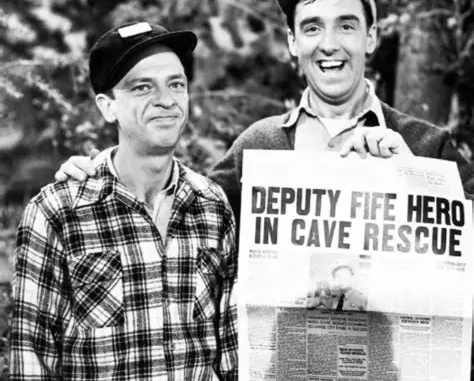
For decades, The Andy Griffith Show has been remembered as one of the most comforting shows in television history—a place where problems are small, people are kind, and everything somehow works out in the end.
But revisit it today, and one recurring joke hits… differently.
At the center of it is Barney Fife—the well-meaning but wildly incompetent deputy who somehow carries a badge, a gun (with only one bullet, kept in his pocket), and a level of confidence far beyond his actual ability.
Originally, Barney was comedic gold. His over-the-top reactions, his obsession with rules, and his constant need to prove himself made him one of the most memorable characters on television. Audiences laughed with him—and sometimes at him.
But here’s where things start to shift.
When you watch those same scenes through a modern lens, the humor takes on a different tone. What once felt like harmless exaggeration now raises uncomfortable questions about authority, responsibility, and accountability.
Why is someone so clearly unprepared allowed to hold power?
Why is his lack of judgment treated as funny instead of concerning?
And why does the system around him seem to depend entirely on one person—Andy Taylor—to quietly fix everything behind the scenes?
The joke, in essence, is that Barney shouldn’t be in charge—but somehow, he is.
And that’s funny… until you start thinking about it too seriously.
What makes this even more interesting is how the show handles the consequences. Barney rarely faces lasting repercussions. His mistakes are smoothed over, redirected, or gently corrected by Andy, who acts less like a boss and more like a safety net for the entire town.
Back in the 1960s, this dynamic felt reassuring. Andy represented stability. No matter what went wrong, someone wise and capable was there to make it right.
Today, that same dynamic can feel a little different.
It suggests a system that only works because one exceptional person is holding it together. Remove Andy, and the cracks might start to show.
Some fans argue that this interpretation is overthinking a simple sitcom. After all, Don Knotts built Barney as a comedic character first and foremost—his purpose was to entertain, not to make political or social commentary.
And they’re not wrong.
But great television has a strange quality: it evolves with its audience.
What we laugh at says a lot about what we value. And as those values change, so does the meaning behind the humor.
That’s why this particular joke feels so different today. It hasn’t changed. The writing is the same. The performances are the same.
But the context—the way we understand authority, competence, and responsibility—has shifted.
And suddenly, something that once felt light and simple carries a little more weight.
Yet, this doesn’t diminish The Andy Griffith Show. If anything, it makes the show more layered, more interesting, and more worth revisiting.
Because beneath the laughter, there’s a subtle truth:
The best shows don’t just reflect the time they were made.
They reflect every time they’re watched.
And sometimes, the biggest change isn’t in the joke itself—
It’s in the person hearing it.