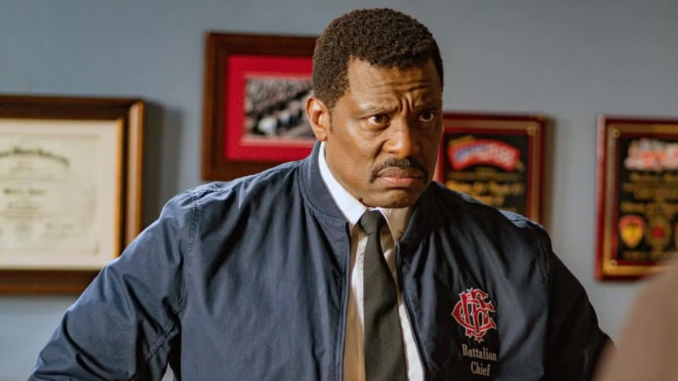
In the high-stakes world of procedural television, few shows have managed to capture the raw intensity and emotional depth of first responders quite like Chicago Fire. Since its debut in 2012, the series has become a cornerstone of the NBC lineup, anchoring the massive One Chicago franchise. While the show is famous for its explosive action sequences and rotating cast of heroic firefighters, one figure stood as the unwavering foundation of Firehouse 51 for over a decade: Chief Wallace Boden, portrayed with magisterial gravitas by the incomparable Eamonn Walker.
Watching Walker’s journey from the pilot episode to his recent departure from the series is nothing short of a masterclass in character evolution. When we first met Chief Boden, he was the stoic, gravel-voiced leader who carried the weight of the world on his shoulders. He was the man who had to make the impossible calls, the one who navigated the treacherous waters of department politics while ensuring his crew made it home alive. However, the transformation Eamonn Walker brought to the role wasn’t just about aging or changing uniforms; it was a profound shift in the soul of the character that mirrored Walker’s own growth as a veteran of the screen.
In the early seasons, Boden was often the “stern father” figure. He was formidable and sometimes intimidating, reflecting Walker’s ability to command a room without saying a word. This was a man defined by his scars, both literal and figurative. But as the years rolled by, Walker infused Boden with an unexpected and deeply moving vulnerability. We saw the Chief navigate the complexities of marriage, the joys and fears of late-life fatherhood, and the crushing grief of losing colleagues who were more like family. The stunning part of this transformation is how Walker managed to soften the character’s edges without ever losing his inherent strength. He moved from being a commander to being a mentor, and finally, to being the undisputed patriarch of the entire Chicago cinematic universe.
Physically, Walker’s presence on screen has only become more commanding. There is a certain dignity in how he carries the years, a silver-fox elegance that fans have noted with admiration. But the real “speechless” moments come from his performance. Walker has a unique ability to use his voice—a deep, resonant instrument—to convey a spectrum of emotion. In the later seasons, a simple nod or a quiet word of encouragement from Boden often carried more weight than a three-minute monologue from any other character. It is this subtle, nuanced acting that turned a standard “boss” role into a legendary television icon.
The impact of Eamonn Walker on Chicago Fire extends far beyond his own scenes. He set the tone for the entire set. Younger actors like Taylor Kinney and Jesse Spencer have often spoken about the “Walker effect,” where his professionalism and dedication raised the bar for everyone else. His transformation also saw him taking on more significant narrative burdens, often serving as the moral compass when the lines between right and wrong became blurred. Whether he was standing up to a corrupt commissioner or offering a shoulder to a distraught candidate, Walker’s Boden was the heartbeat of the show.
As news broke that Walker would be stepping back from a series regular role, the fan base felt a collective shock. It truly marks the end of an era. Looking back at his first appearance compared to his final scenes as Chief, the growth is staggering. He walked into Firehouse 51 as a man dedicated to the job, and he left it as a man who had redefined what leadership looks like in the modern age. He showed us that true power lies in empathy, and that the strongest leaders are those who aren’t afraid to show their heart.
Eamonn Walker’s legacy on Chicago Fire is etched in the soot and ladders of every episode. His transformation from a hardened veteran to a soulful, wise elder statesman of the CFD is a testament to his incredible range as an actor. While the sirens will continue to wail in the streets of Chicago and new faces will inevitably fill the halls of 51, the vacancy left by Wallace Boden will be impossible to truly fill. We have watched a man grow, lead, and inspire for twelve years, and the result is a performance that will be studied and celebrated for decades to come. Walker didn’t just play a firefighter; he became the fire that kept the show burning bright.