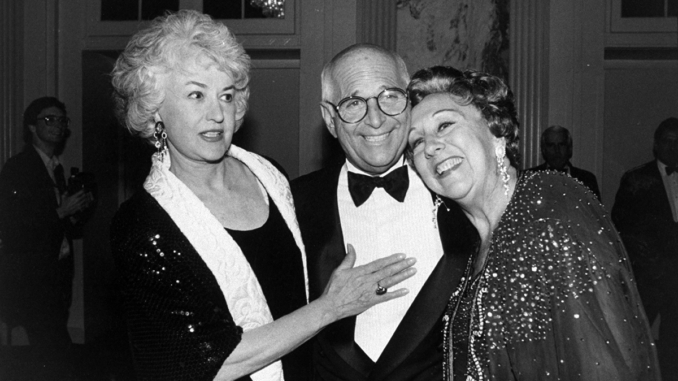
When you consider the television series created by Norman Lear, one tends to focus on the humor that pushed every envelope it could find, the exploration of previously taboo subjects and theme songs that resonate to this day. But a true groundbreaking element was the creation and development of empowered female characters who were both extremely complex and deeply human.
Whether you’re talking about the quiet wisdom and warmth Jean Stapleton brought to Edith Bunker on All in the Family, to Isabel Sanford’s Louise Jefferson on The Jeffersons or Bonnie Franklin as Ann Romano on One Day at a Time, TV’s first divorced single mother, these characters were allowed to struggle, grow and challenge the status quo.
While Tripp Whitesell’s biography, Norman Lear: His Life and Times, is devoted to the man who changed television, the following exclusive conversation looks beyond the shows and Lear himself, focusing largely on those groundbreaking women on TV.
Woman’s World (WW): What motivated you to write about Norman Lear?
Tripp Whitesell: A couple of things. Like many people, I grew up in the 1970s watching his shows, and they were very special to me. In fact, a book I wanted to write about All in the Family, back when publishers were doing those standalone books—like the ones St. Martin’s Press put out in the 1980s. I actually tried to write that book years ago, but it never materialized.
However, over the years, I had the opportunity to write about Norman Lear as an entertainment journalist, and I’ve also been teaching a class on him at Emerson College in Boston, where I’m on the affiliated faculty. The way this book came about, in a roundabout way, was through that class. My agent sold it to Applause Books based on my work teaching about Lear. Norman even participated in my class a couple of times over Zoom. I also interviewed him for the 40th anniversary of All in the Family for TV Guide, and he was featured in my last book about the Improv Comedy Club, which I co-wrote with Bud Friedman.
WW: Has your perspective of him changed?
TW: I definitely learned a lot. He wasn’t always a perfect person—he had flaws, like anyone else. Sometimes he didn’t give enough credit to the people who worked with him, and that was something multiple people I spoke with observed about him. Not that it was a major flaw, but it was a pattern. That said, my admiration for him didn’t change. He was still a personal hero of mine, and the more I learned, the more I respected what he accomplished.
WW: CBS underwent the “rural purge” in the early 1970s, getting rid of shows like Green Acres and Mayberry RFD. How fortuitous was it for Norman Lear that they were making room for series like The Mary Tyler Moore Show, MASH and, of course, All in the Family?
TW: It was a prime example of him being in the right place at the right time. That shift at CBS created the perfect environment for All in the Family to finally get on the air. As you know, from a TV historian’s perspective, it took him multiple attempts to make that happen.
He originally sold the pilot to ABC in 1968 after his movie The Night They Raided Minsky’s, but there were two different versions with two different sets of kids, and neither went anywhere. ABC got cold feet after some controversy over Turn-On, the short-lived show from George Schlatter. So, All in the Family didn’t get off the ground. It took Lear a long time, but the rural purge certainly worked in his favor.
WW: People today don’t realize how revolutionary All in the Family was. It was like flipping a light switch on television.
TW: Totally. It was such a radical departure from anything that had been done before. The Smothers Brothers Comedy Hour was probably the closest thing, but that show was canceled in 1969 amid controversy. They claimed it was due to turning in an episode late, but in reality, there was a political element to its cancellation. That was a wake-up call for CBS—it signaled that the time was right for more socially relevant programming.
Even though the rural sitcoms were still popular, their shelf life was running out. The paradox is that many of those shows were still getting great ratings, but CBS was looking to reshape its brand.
WW: It took time for America to really embrace All in the Family, didn’t it?
TW: Yes, it did. Norman had a few things working in his favor, though. CBS really wanted the show, and he had Fred Silverman, who was determined to take the network in a new direction alongside Bob Wood. That played a huge role in getting the show on the air.
But another major factor was Lear’s deal with CBS—he had a guarantee of 13 first-run episodes and 13 repeats, which was unheard of at the time. That gave him room to push the envelope harder and harder, even though it took a while for All in the Family to find its audience.
WW: Why did CBS give Norman that agreement?
TW: I think they wanted All in the Family so badly that they were willing to take that gamble. I never found any official explanation for why they did it, and Lear himself never really talked about it. But Freddy Silverman and Bob Wood believed in the show so strongly that they were willing to take that risk.
When it first aired, it was a mid-season replacement for To Rome with Love and took over the time slot that had previously belonged to The Beverly Hillbillies. The irony is that it premiered right after Hee Haw!
WW: Let’s shift the conversation to the women of Norman Lear’s shows, beginning with All in the Family. Some might not immediately think of Edith Bunker as strong, but she absolutely was.
TW: She was strong, and she really kept Archie in line. She loved him, and Jean Stapleton—who was a feminist in real life—made a real effort as the show progressed to give Edith more of a voice. She wanted her to stand up to Archie more.
WW: In one episode she said to him, “You stifle!” and the audience went insane. What was it that made Edith so strong?
TW: She had a heart of gold. She was the glue that held the family together. I don’t think it’s ever been explicitly said or written this way before, but I believe Archie inherently knew that. He may not have admitted it, but deep down, he understood that Edith was the foundation of their home.
WW: She was also the gentle voice of reason in Archie Bunker’s life.
TW: Exactly. There’s that episode where they’re playing a board game with the Lorenzos—I don’t know if you remember that one. It was one of those 1970s pop-psychology games. She was explaining to Mike why Archie yelled at him, and it just made so much sense. Edith was a very wise woman, even if she didn’t always seem like it.
WW: Gloria is interesting, because she really evolved. Early on she was mostly saying, “Mike’s right, Daddy.”
TW: She was doing something no female character on television had really done before—she was a young married woman navigating her relationship with a left-wing, hippie husband, but she also brought her own point of view into that marriage. Before that, we had Mary Tyler Moore as Mary Richards, but she wasn’t married. And we don’t know for sure if she had been married before, the show never presented her as a divorcée.
Gloria, on the other hand, was one of the first female television characters to really take a stand on social issues within the context of marriage. She was learning as she went, which made her journey compelling.
Maude Findlay: TV’s fierce feminist
WW: And then there’s Maude!
TW: Absolutely. Maude was loosely based on Norman’s second wife, Frances, who was a feminist.
WW: What did Bea Arthur bring to the role?
TW: First of all, Bea Arthur was one of Norman Lear’s favorite actors to work with. They had known each other for years; he saw her in Broadway productions in the 1950s, and they worked together on The George Gobel Show. They were good friends.
Originally, Maude was only supposed to appear in one episode of All in the Family. Norman wanted someone who could go toe-to-toe with Archie and completely eviscerate him in an argument. Bea Arthur was the first person who came to mind. At first, she wasn’t interested. She was a stage actress, living in New York, and she wasn’t looking to do television.
WW: So how did he convince her?
TW: Her husband, Gene Saks, was directing the movie Last of the Red Hot Lovers, and he was going to be in California anyway. That played a role in her decision. Norman pitched her on the idea, saying, “Let me write something for you. If you don’t like it, we’ll get someone else.” That’s how she agreed to do it.
The episode aired, and Fred Silverman saw how powerful it was. Almost immediately, he said, “Get this woman her own show!” And that’s how Maude was born.
WW: Was Bea Arthur reluctant to do her own series?
TW: Once she saw the money and one thing led to another, she came around. Nobody else could have been Maude Finley, just like nobody else could have been Archie Bunker.
WW: Beyond Archie Bunker, what made Maude such an impactful character?
TW: It was all about timing. The show launched at the height of the feminist movement, and Maude was exactly the kind of character television needed. It was a reflection of the times—she was bold, opinionated, and outspoken, and that resonated with audiences.
WW: So did Adrienne Barbeau’s character—Carol, Maude’s daughter.
TW: Adrienne Barbeau was an incredibly talented actress. She had just won a Tony Award for playing Rizzo in Grease on Broadway before joining Maude. Carol was sharp, intelligent and never backed down from a debate with her mother.
WW: Moving on to Good Times and Esther Rolle as Florida Evans.
TW: From the moment she appeared on Maude, you could tell she was destined to lead her own show. There’s that second episode of Maude—”Maude Meets Florida”—where Florida really puts Maude in her place. She wasn’t one of those subservient maid characters you’d seen on television before. She stood her ground and gave Maude as much attitude as Maude gave Archie.
WW: Which is saying something! You wouldn’t think anybody could put Maude in her place and survive it.
TW: She did. And what made it even more interesting was how the show explored white liberal guilt at the time. It was a very relevant and funny theme in Maude.
Louise Jefferson: strength & grace on ‘The Jeffersons’
WW: Isabel Sanford as Louise Jefferson on The Jefferson, who had to deal with Sherman Hemsley’s George.
TW: Definitely. She had to deal with George, and she never let him steamroll her. She had a lot of moxie and wasn’t afraid to stand up to him. But at the same time, she loved him, and he loved her. That dynamic was what made them work as a couple.
WW: She was the one who kept him in check.
TW: It was a testament to the strength of these female characters—whether it was Edith with Archie, Florida with Maude, or Louise with George—they were the ones who made these men toe the line.
WW: What do you think Isabel added to Louise Jefferson?
TW: She was a wonderful actress with a strong Broadway background, like many of Norman Lear’s stars. He first took note of her when he saw her in Guess Who’s Coming to Dinner, where she played Tillie the maid. She had that great dialogue with Sidney Poitier in that movie, and it was clear she had incredible presence. That’s what she brought to The Jeffersons.
‘One Day at a Time’: a trailblazing look at single motherhood & sisterhood
WW: That led to One Day at a Time, a show that had three strong female characters, all evolving over the course of the series. Let’s start with Ann Romano and Bonnie Franklin.
TW: Well, Bonnie Franklin was fantastic. She was a terrific actress with a strong theater background, and she brought so much depth to the character. This was the first time we had really seen a divorced woman as the lead of a television show. There had been Fay, a short-lived show on ABC, but One Day at a Time was the one that really put that kind of character in the spotlight. Ann Romano was dealing with things that had never been addressed on television before.
WW: Bonnie Franklin certainly brought depth to Ann Romano.
TW: Oh, absolutely. That’s what made these shows work—the depth and richness of the writing and the incredible complexity of the characters.
WW: Then there’s Mackenzie Phillips as Julie Cooper and Valerie Bertinelli as Barbara Cooper.
TW: They were both strong teenage characters, and One Day at a Time was one of the first shows to realistically portray teenage issues on television. Good Times had already tackled a lot of this with Thelma Evans, but in terms of mainstream TV addressing things like underage sex, drugs, and alcoholism from a middle-class perspective, One Day at a Time was groundbreaking. These were the first TV kids who really dealt with those kinds of issues in a way that felt real. And, of course, Mackenzie Phillips had her own well-documented struggles.
Valerie didn’t deal with the same real-life issues that Mackenzie did, but as a character, Barbara Cooper still represented a realistic teenage experience.
Norman Lear’s television legacy
WW: Norman Lear eventually stepped away from television. Did that have more to do with his activism, or was that his shows stopped connecting with audiences?
TW: It was a mix of both. By the time he stepped away from weekly television, he had six shows on the air—he was great at delegating, so he wasn’t involved in every show day-to-day, but he was still overseeing them. One of his biggest strengths was hiring smart people to run his shows. You had Rod Parker running Maude, Mickey Ross and Bernie West as story editors on All in the Family, and great writers like Mel Tolkin and John Rich.
But as his shows started fading from popularity, he also became increasingly concerned with the state of the country. The rise of the Religious Right, figures like Jerry Falwell and the emergence of the Moral Majority really alarmed him. He channeled his energy into activism because he felt like that’s where he was needed most.
WW: How would you describe his legacy?
TW: I think his impact is that he changed television. He’s the guy who gets credit for revolutionizing the medium, because he was the first to bring real-life issues into sitcoms in a way that felt authentic.
That being said, he never set out to do that. He said many times in interviews that he wasn’t trying to change television—he was just writing about real people with real problems. People that audiences could identify with. It all happened naturally.
Even when he created All in the Family, it wasn’t some grand effort to redefine television. It was based on his own life—Archie reminded him so much of his father, Herman, who once called him “the laziest white kid he’d ever seen.”
WW: Despite his success, by the mid-80s it was pretty much over. What happened?
TW: Without drawing too much comparison, Lorne Michaels has always said, “You can’t fake originality.” People compare the original Saturday Night Live cast to later ones, but what they were doing at the time was so bold and different that nothing could compare to those first five golden years.
With Norman Lear, I think the novelty of his shows started to wear off. America was in an angry place in 1971 when these shows were first airing—you had the tail end of the civil rights movement, Vietnam, Watergate. His sitcoms captured the mood of the times. But by the mid-70s, things had shifted, and those kinds of shows weren’t as novel anymore. The sitcom landscape started to change. It wasn’t anything Norman did or didn’t do, it was a reflection of the times.