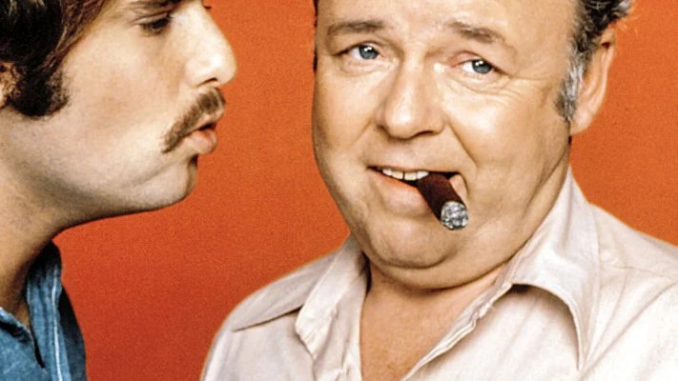
Few sitcoms in television history carried the emotional weight of All in the Family. While the series is often remembered for its sharp political commentary and explosive arguments, some of its most unforgettable moments came from something much quieter: raw human emotion.
One of those moments, according to Carroll O’Connor himself, was partly improvised.
In a later interview reflecting on the legacy of the show, O’Connor revealed that he and Rob Reiner ad-libbed part of one of the series’ deepest father-and-son scenes. For longtime fans, the revelation only made the moment more meaningful.
The scene centered on Archie Bunker and Michael “Meathead” Stivic — two characters constantly at war ideologically, emotionally, and culturally. Archie represented an older America rooted in tradition and stubbornness, while Michael embodied the younger generation questioning everything. Their clashes fueled countless episodes, but beneath the insults and political sparring was a complicated form of reluctant affection.
That hidden affection surfaced during a quieter exchange between the two characters, one that carried an emotional honesty viewers didn’t always expect from the show. According to O’Connor, parts of the dialogue were not strictly written as they appeared on screen. Instead, he and Reiner instinctively extended the moment naturally during filming.
The result was extraordinary because it didn’t feel “performed.” It felt real.
That authenticity became one of the defining strengths of All in the Family. Creator Norman Lear built the series around difficult conversations, but actors like O’Connor and Reiner gave those conversations emotional texture. They understood that beneath every political argument was a family trying — and often failing — to understand each other.
O’Connor, in particular, had an unusual ability to humanize Archie Bunker without excusing his flaws. Archie could be loud, offensive, and deeply stubborn, yet O’Connor consistently revealed moments of vulnerability hiding underneath the bluster. That balance is one reason the character remains one of television’s most studied performances decades later.
Reiner matched him perfectly. As Michael Stivic, he could move from fiery outrage to genuine compassion in seconds. Their chemistry worked because neither actor treated the arguments as simple comedy. They played them like emotional battles between people who, despite everything, were still family.
The improvised portion of that profound scene reportedly emerged because both actors instinctively understood the emotional truth of the moment. Rather than rushing to the next scripted line, they allowed silence, hesitation, and natural reactions to shape the exchange. Those tiny unscripted details created something audiences could immediately recognize as authentic.
Ironically, many viewers probably never realized the scene contained ad-libbed dialogue at all. That’s often the mark of great improvisation — it disappears seamlessly into the story.
Decades later, scenes like this continue to resonate because they reflect something timeless about family relationships. People argue. Generations clash. Beliefs collide. But underneath the conflict, connection still exists, even when characters struggle to express it directly.
That emotional complexity helped elevate All in the Family far beyond a traditional sitcom. The series didn’t merely aim for laughs; it explored loneliness, pride, fear, love, and generational change in ways television rarely attempted at the time.
And sometimes, the most unforgettable moments came not from the script itself, but from two gifted actors trusting each other enough to let the scene breathe naturally.
For fans revisiting the series today, knowing that part of one of Archie and Meathead’s most touching exchanges was improvised only deepens the legacy of Carroll O’Connor and Rob Reiner — two performers who helped transform sitcom television into something profoundly human.