The season finale of Chicago Fire didn’t just raise the stakes — it completely rewrote expectations. Packed with sudden reversals, emotional curveballs, and high-risk decisions, the episode delivered one of the most unpredictable endings the series has seen in years.
From the very beginning, the tone felt different. What started as a routine emergency quickly spiraled into a multi-layered disaster, forcing Firehouse 51 into a situation where every move carried consequences. But what truly set this finale apart wasn’t the fire itself — it was how the story kept flipping direction just when viewers thought they understood what was happening.
The first major twist came during what appeared to be a controlled rescue operation. Just as the team believed they had secured the building, a hidden structural weakness triggered a sudden collapse. This moment shifted the entire episode into survival mode, splitting the crew into separate high-risk zones and cutting off communication at the worst possible time.
Severide, often portrayed as steady under pressure, found himself facing a situation where logic alone wasn’t enough. His decisions became more instinct-driven, hinting at a deeper internal conflict that has been building throughout the season. Meanwhile, Kidd stepped into a leadership role that felt both natural and inevitable — a subtle but powerful shift that could signal long-term changes in the command structure.
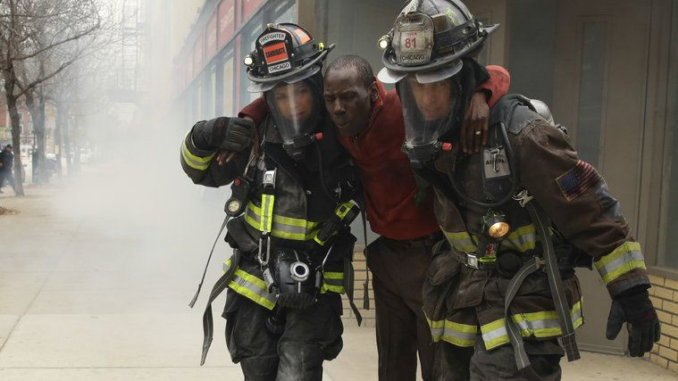
Another twist that caught viewers off guard involved a civilian rescue that turned emotionally complicated. What initially seemed like a straightforward evacuation revealed a hidden connection to one of the firefighters, adding a personal layer to an already dangerous situation. The show leaned heavily into this moment, blurring the line between professional duty and emotional vulnerability.
But the most talked-about twist came near the end.
Just as the fire was being brought under control, the episode pivoted away from action and into quiet tension. A conversation — brief but loaded with meaning — hinted that one key member of Firehouse 51 may be preparing to leave. The show never confirmed it outright, but the framing, the pauses, and the reactions from other characters made it clear that something major is about to change.
This kind of storytelling is what made the finale stand out. Instead of relying on a single shocking moment, the episode layered multiple twists — some explosive, others subtle — creating a sense of unpredictability that carried through to the final scene.
Visually, the episode reinforced this instability. Darker lighting, tighter camera shots, and abrupt transitions all contributed to a feeling that nothing was fully under control. Even when the fire was contained, the emotional fallout continued to unfold, leaving the audience with more questions than answers.
Fans quickly reacted online, calling it one of the most intense and unpredictable finales in recent seasons of Chicago Fire. Many praised the writers for taking risks, while others admitted the twists were almost too overwhelming — a sign that the show is pushing its boundaries in new ways.
What makes this finale particularly effective is how it sets up the future. Every twist feels like a setup rather than a conclusion. Leadership dynamics are shifting, relationships are evolving, and the possibility of major character changes looms over Firehouse 51.
In the end, this wasn’t just a finale — it was a turning point.
The fires may have been extinguished, but the uncertainty left behind burns even deeper. And if this episode proves anything, it’s that Chicago Fire is far from running out of ways to shock its audience.
Because in Firehouse 51, the most dangerous twists aren’t the ones you see coming — they’re the ones that change everything after the flames are gone.