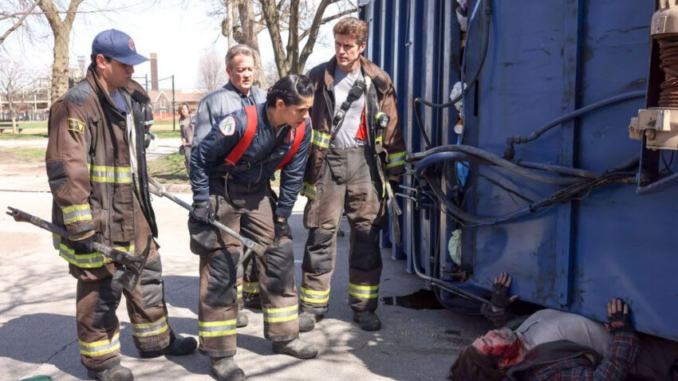
The season finale of Chicago Fire delivered everything fans have come to expect from the long-running drama — high-stakes rescues, emotional farewells, and a final sequence that left viewers questioning the future of Firehouse 51.
From the opening minutes, the episode set a tense tone. The team was immediately thrown into a large-scale emergency involving a multi-vehicle collision and a rapidly spreading fire in an industrial zone. What initially appeared to be a routine response quickly escalated into one of the most dangerous operations of the season, forcing the crew to make split-second decisions under extreme pressure.
As the chaos unfolded, the episode shifted its focus between multiple members of the team, highlighting not just the physical danger of the blaze, but also the emotional weight each firefighter carried into the call. Severide’s leadership was tested as conditions worsened, while Kidd’s instincts proved critical in preventing further casualties inside a collapsing structure.
Meanwhile, Herrmann and Cruz faced a separate rescue operation that took an unexpected turn when trapped civilians were discovered in an unstable section of the building. The tension in these sequences built steadily, with the show emphasizing the unpredictability of every decision made inside a burning structure.
However, the most emotionally charged moments of the finale came not from the fire itself, but from the quieter interactions between the characters. Longstanding relationships were placed under strain as the episode hinted at potential changes within Firehouse 51. Conversations between team members carried a sense of finality, as if everyone was aware that something was about to shift permanently.
By the final act, the fire was eventually contained, but not without consequences. The aftermath revealed both physical damage and emotional scars, with several characters visibly shaken by what they had experienced. The show deliberately slowed its pacing, allowing viewers to sit with the impact of the events rather than rushing into resolution.
The final minutes of the episode are what truly sparked discussion online. Instead of a traditional wrap-up, the finale leaned into ambiguity. A series of reflective moments showed the team regrouping, but the tone suggested uncertainty about what comes next. Key characters were shown making personal decisions that hinted at possible departures, changes in roles, or new directions for their futures.
For longtime viewers, this approach felt intentional. Rather than closing the chapter of Firehouse 51 neatly, the finale seemed designed to leave doors open — both emotionally and narratively. The sense of instability suggests that the next season may bring significant restructuring within the team.
Fans immediately took to social media after the episode aired, dissecting every line of dialogue and visual cue. Some believe the finale is setting up a major cast shift, while others argue it represents a thematic reset rather than literal departures. Either way, the uncertainty has only fueled anticipation for what comes next.
What remains consistent is the emotional core of Chicago Fire. Despite the danger, the losses, and the constant pressure, the bond between the firefighters remains the heart of the series. Even in its most intense moments, the finale reinforced the idea that Firehouse 51 is more than just a workplace — it is a family shaped by shared trauma and loyalty.
As the screen faded to black, there was no definitive conclusion, no final goodbye, and no clear resolution. Instead, the episode left viewers with lingering questions about the future of the team and the personal journeys still unfolding.
In true Chicago Fire fashion, the finale wasn’t just an ending — it was a transition. A reminder that in this world, every ending is just the start of another emergency waiting to happen.
And for Firehouse 51, the next alarm may already be closer than anyone expects.