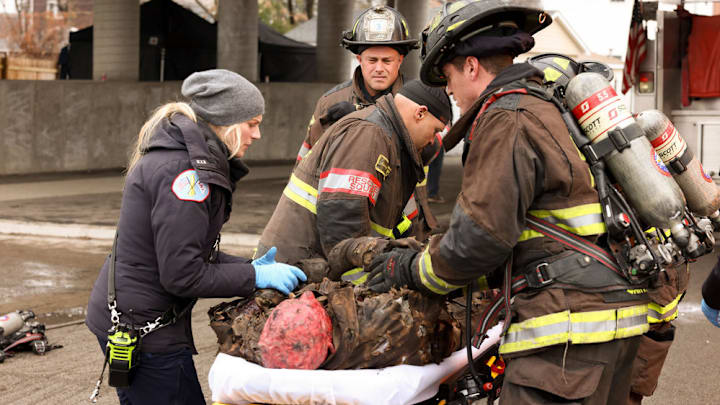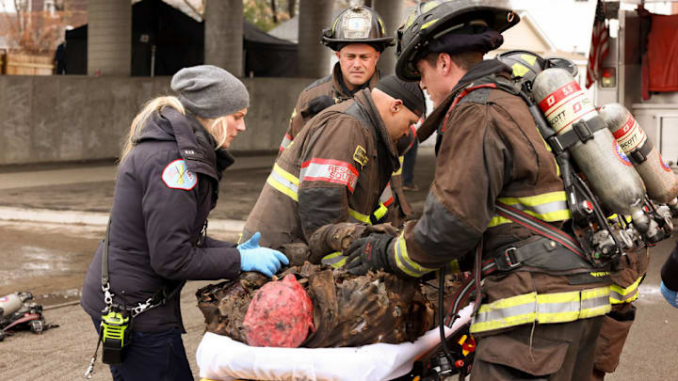
The production of the long-running NBC hit Chicago Fire has always been synonymous with high-octane realism, utilizing actual fire, heavy machinery, and complex stunt choreography to bring the perilous life of first responders to the screen. However, the thin line between cinematic spectacle and real-world danger was tragically crossed recently when a shocking accident occurred on the set, leaving the cast and crew in a state of profound distress and disbelief. For a show that has spent over a decade depicting the bravery of Firehouse 51, the sudden transition from scripted emergency to an actual medical crisis has shaken the “One Chicago” family to its core, reminding everyone involved that despite the most rigorous safety protocols, the nature of their work remains inherently volatile.
The incident reportedly took place during the filming of a high-stakes rescue sequence involving a multi-vehicle pileup and a simulated structural collapse. In a series known for its commitment to practical effects, the set was a maze of twisted metal and controlled pyrotechnics. According to eyewitness accounts from the production site, a mechanical failure occurred during a crane-assisted stunt, leading to an unexpected equipment collapse that injured several crew members and sent a wave of panic through the location. The irony was not lost on those present; while the actors were dressed in their iconic turnout gear, ready to “save” lives for the camera, they suddenly found themselves witnessing a genuine catastrophe where their training as performers was useless against the harsh reality of the accident.
The immediate aftermath of the event was described by sources on set as one of eerie silence followed by frantic activity. The production’s on-site medical team, which usually stands by as a precaution, was thrust into a high-pressure situation, providing emergency care until Chicago’s actual paramedics arrived. The cast, many of whom have portrayed firefighters for over ten years and have developed a deep respect for the profession, were visibly distraught. Stars like Taylor Kinney and Miranda Rae Mayo were seen huddled together as the set was evacuated and cordoned off as a crime scene. The emotional blow to the crew—the “unsung heroes” who build the fires and rig the explosions—is immeasurable, as many have worked together since the pilot episode in 2012.
In the wake of the tragedy, NBC and Wolf Entertainment issued a joint statement expressing their deepest sympathies to the injured parties and their families. Production was immediately halted indefinitely to allow for a full investigation by OSHA and local authorities. This “shocking accident” has reignited a fierce debate within the industry regarding the safety of practical stunts in an era where digital effects (CGI) have become increasingly sophisticated. While Chicago Fire fans have long praised the show for its “real feel,” the cost of that authenticity is now being scrutinized. Showrunners are facing difficult questions about whether the pursuit of realism has reached a point of diminishing returns, where the physical risk to the human beings behind the scenes outweighs the artistic value of the shot.
The psychological impact on the cast and crew cannot be overstated. Chicago Fire is unique in that it films on location in the city of Chicago, often in the freezing cold or under intense physical strain. This environment has fostered a legendary sense of camaraderie, often referred to as the “51 Spirit.” To have that spirit shattered by a preventable mechanical failure has left many questioning when, or if, they feel comfortable returning to the set. Industry veterans note that an accident of this magnitude often leads to a “post-traumatic” atmosphere that can linger for years, changing the way directors approach action sequences and how actors perceive their own safety.
As the investigation continues, the “One Chicago” community has rallied around the victims. Support from the sister shows, Chicago Med and Chicago P.D., has been overwhelming, with cast members from across the franchise offering tributes and financial support for the medical expenses of the injured crew. This tragedy serves as a somber reminder that the heroism we celebrate every Wednesday night on television is built upon the hard, dangerous work of hundreds of individuals who stay behind the lens. The fire trucks of 51 may be parked for now, but the hope is that this “shocking accident” will lead to a new standard of safety that ensures no one else has to face a real-life tragedy in the name of entertainment.
The road to recovery for the Chicago Fire family will be long and paved with difficult conversations. As the show eventually prepares to resume filming, the atmosphere will undoubtedly be different. The roar of the flames will carry a new weight, and the sound of a siren will serve as a permanent echo of the day the line between fiction and reality disappeared. For now, the focus remains on the healing of those injured and the collective mourning of a crew that has always prided itself on being a family that looks out for one another, both on and off the screen.