🏠 When Haunted Houses Feel Like Home: The Magic of Woodstone
Let’s be honest for a second. The holidays are… complicated. While every commercial on TV tries to sell us on the idea of a perfect, rosy-cheeked nuclear family sitting around a turkey, the reality for a lot of us is a bit more chaotic. Sometimes, the people we share DNA with aren’t the ones who truly get us. That is why the concept of “found family” has become such a powerful, resonant theme in modern storytelling. And nowhere is that theme more beautifully, hilariously, and touchingly explored than in the Ghosts holiday special, “It’s a Wonderful Christmas Carol.”
I’ve watched a lot of holiday television, from the saccharine sweet to the cynical and dark. But Ghosts managed to hit a sweet spot I didn’t even know was possible. They took the two most overused holiday tropes in existence—Dickens’ A Christmas Carol and Frank Capra’s It’s a Wonderful Life—and mashed them together into something that felt entirely fresh. How? By centering the story on the weird, dysfunctional, and deeply loving bond between a living couple and their house full of dead people.
🎭 A Double Homage: Subverting the Classics
The writers of Ghosts (the US version, for clarity) are masters of the “meta” joke. They know we know these stories. By titling the episode “It’s a Wonderful Christmas Carol,” they basically issued a challenge to themselves: can we pay tribute to the classics without being cheesy?
The “Scrooge” of Woodstone: Sam’s Perfectionism
In this iteration, the “Scrooge” figure isn’t a wealthy miser, but our beloved Sam. Driven by her desire to create a “perfect” Christmas for her visiting sister-in-law, Sam becomes a bit of a holiday tyrant. She’s obsessed with the aesthetic, the traditions, and the performance of Christmas. It’s a relatable struggle, isn’t it? We all want the Instagram-worthy holiday, often at the expense of actually enjoying the people right in front of us.
The Ghostly Intervention: More Than Just Chains and Rattling
Instead of three terrifying spirits, we get our resident ghosts. They decide to “Christmas Carol” Sam’s sister-in-law, Bela, to get her to fall for a friend. But in true Ghosts fashion, the plan goes sideways. The brilliance here is that the ghosts aren’t teaching a moral lesson to a stranger; they are trying (and failing) to interfere in the lives of the people they consider their own. Their meddling is their love language.
💞 The Heart of the Matter: Defining “Found Family”
What makes this episode a “perfect love letter” to found families? It’s the realization that the Woodstone ghosts aren’t just roommates stuck together by geography and death. They are a family by choice—and by mutual endurance.
The Ghosts: A Mosaic of Eras and Errors
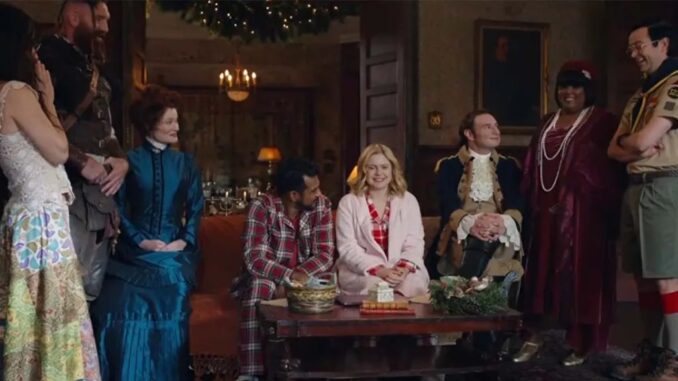
Think about the lineup. You’ve got a Viking, a Native American, a Prohibition-era lounge singer, a 1980s scout leader, a 90s finance bro, a hippie, a Revolutionary War captain, and a Gilded Age socialite. In any other world, these people would have nothing in common. But in death, they’ve seen each other’s worst moments for decades—or centuries.
They know each other’s repetitive stories, their deepest regrets, and their annoying habits. Yet, when the chips are down, they protect one another. When Sam is stressed, they care. When Jay feels left out (since he still can’t see them), they try to include him in their own ghostly way. This episode highlights that a family isn’t about shared blood; it’s about who shows up (or, in this case, stays put) when things get messy.
🎬 The “Wonderful Life” Twist: Sam’s Moment of Clarity
The episode’s second half leans into the It’s a Wonderful Life side of the coin. After Sam’s plans crumble and she feels like she’s ruined the holiday, we get that classic moment of reflection.
H3: Seeing the Mansion Through a Different Lens
Sam realizes that the “perfect” Christmas isn’t about the decorations or the dinner. It’s about the fact that she and Jay have built a life in a house full of friends who literally cannot leave them. There’s a profound security in that. While her living relatives might come and go, the ghosts are a constant. They are the audience to her life, and she is the bridge to theirs.
H3: The Jay Factor: Love Without Sight
We have to give a shout-out to Jay. His role in the found family is perhaps the most touching. He participates in the traditions, cooks the meals, and talks to the empty air because he loves Sam and trusts her. He has accepted eight dead people as his surrogate siblings without ever having seen their faces. If that isn’t the definition of a “found family” commitment, I don’t know what is.
🤣 Comedy as a Bridge to Connection
You can’t talk about Ghosts without talking about the laughs. The episode uses humor to prevent the sentimentality from becoming too heavy.
-
Isaac’s Obsession with Hamilton: Watching a Revolutionary War ghost deal with modern interpretations of his era is a gift that keeps on giving.
-
Trevor’s “No Pants” Holiday Spirit: Trevor somehow manages to be both the most annoying and the most oddly supportive member of the group.
-
Hetty’s Hardened Heart Melting: Seeing the stoic Hetty gradually succumb to the holiday spirit (and her surprising fondness for Thor) is a masterclass in character growth through comedy.
The humor serves as the “burstiness” in the narrative. We get these high-intensity comedic beats that break up the emotional “perplexity” of the deeper themes. It makes the heart-tugging moments feel earned rather than forced.
✨ Why the “Found Family” Trope Hits Different in December
For many people, the holidays are a reminder of what they don’t have. Maybe they are estranged from their parents, or they’ve lost loved ones.
H4: Validating Non-Traditional Bonds
By showcasing a family made up of a Viking and a 90s stockbroker, Ghosts validates every non-traditional bond out there. It says: “Hey, your chosen people are real. Your friends who know your coffee order and your childhood trauma are your family.” This episode is a warm hug to anyone who finds their holiday joy in “unconventional” places.
🏛️ The Woodstone Mansion as a Character
The house itself acts as the womb for this found family. It’s the physical space that forces them together, but their shared experiences are what turn it into a home. The holiday decorations draped over the ancient architecture symbolize the blending of the old and the new, the dead and the living.
📈 The Evolution of Sam and the Ghosts
In the beginning of the series, Sam saw the ghosts as a burden—a haunting to be managed. By “It’s a Wonderful Christmas Carol,” that dynamic has completely shifted. She isn’t just their “seer”; she’s their sister/mother/friend. She cares about their happiness as much as her own. This evolution is the backbone of the episode’s emotional weight.
🎁 The Gift of Being Seen (and Unseen)
The episode ends with a sense of peace. No, the Christmas wasn’t “perfect” by the standards of a glossy magazine. But it was perfect for them.
The Final Scene: A Table for Many
The final image of everyone gathered—living and dead—is a powerful visual metaphor for the found family. It’s crowded, it’s noisy, and it’s full of people from different centuries who probably shouldn’t get along. But they do. And in that moment, the haunting isn’t a curse; it’s the greatest gift Sam and Jay ever received.
Final Conclusion
Ghosts managed to do something truly special with “It’s a Wonderful Christmas Carol.” By deftly weaving together classic holiday tropes with its unique brand of supernatural comedy, the show created a moving tribute to the power of choice. It reminds us that family isn’t just something you’re born into; it’s something you build through patience, shared history, and a whole lot of forgiveness. Whether you’re a Viking, a socialite, or just a living person trying to get through the holidays, the message is clear: as long as you have your “people” (even the invisible ones), you’re exactly where you need to be. It is, indeed, a wonderful life at Woodstone Mansion.
❓ 5 Unique FAQs After The Conclusion
Q1: Which classic holiday stories does the episode parody?
A1: The episode title and plot are a dual homage to Charles Dickens’ A Christmas Carol and the film It’s a Wonderful Life. It blends the “intervention by ghosts” from the former with the “realizing your life’s value” theme from the latter.
Q2: Does Jay ever get to see the ghosts in the Christmas special?
A2: No. Consistent with the show’s rules, Jay still cannot see or hear the ghosts. However, the episode emphasizes how much he has integrated them into his life anyway, showing his deep love for Sam and his acceptance of their “found family.”
Q3: What is the main conflict Sam faces in the episode?
A3: Sam becomes obsessed with hosting a “perfect” traditional Christmas for her sister-in-law, Bela. Her perfectionism leads to stress and conflict, eventually forcing her to realize that the true spirit of the holiday lies in the messy reality of her unconventional family.
Q4: Is there a specific character arc that stands out in this special?
A4: Many fans pointed to the relationship between Thor and Hetty (and their evolving bond) as well as Isaac’s ongoing journey of self-acceptance. However, Sam’s growth from a stressed-out host to a grateful “found family” member is the central arc.
Q5: Is this episode considered part of the show’s canon for future seasons?
A5: Absolutely. Like most Ghosts episodes, the events of the Christmas special have lasting impacts on character relationships and the overall history of the Woodstone Mansion inhabitants.