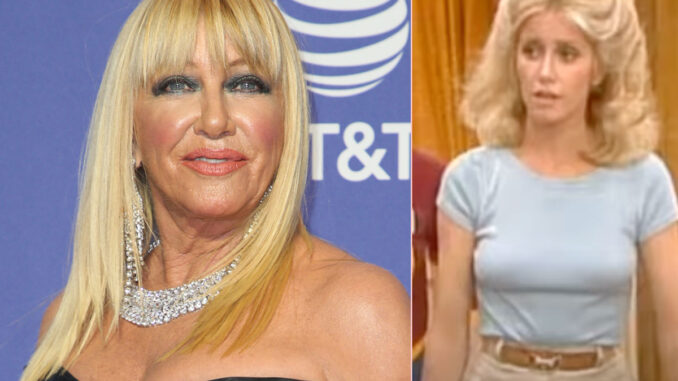
At the height of Three’s Company, Suzanne Somers was everywhere.
Her face was on magazine covers. Her voice echoed in living rooms across America. Chrissy Snow wasn’t just a character—she was a pop-culture phenomenon. For many viewers, Three’s Company felt incomplete without her.
And then, suddenly, she was gone.
No dramatic farewell episode. No proper goodbye. Just a quiet disappearance that left audiences confused—and rumors swirling for decades.
So what really happened?
From Breakout Star to Problem Name
By the early 1980s, Three’s Company was one of ABC’s biggest hits, and Suzanne Somers knew her value. While John Ritter was earning top billing and top pay, Somers believed her contribution to the show’s success deserved equal recognition.
She asked for a significant salary increase.
From a business perspective, the request wasn’t shocking. From the network’s perspective, it was unacceptable.
ABC executives viewed her demand as a challenge to the established hierarchy of television at the time—especially for a female sitcom star. Negotiations quickly turned tense. What should have been a contract discussion became a power struggle.
The Slow Erasure
Instead of firing Somers outright, the network made a calculated move.
Her screen time was dramatically reduced.
Chrissy Snow, once the heart of the show’s misunderstandings, began appearing only in brief scenes—often calling in from off-screen, or showing up at the very end of episodes. The absence was impossible to ignore.
To viewers, it felt strange. To Somers, it felt deliberate.
She later described the experience as being quietly pushed out rather than openly confronted. The message was clear: fall in line, or fade away.
The Final Break
Eventually, Suzanne Somers was released from the show entirely.
Officially, it was framed as a contract dispute. Unofficially, it became a warning story in Hollywood—about what happened when an actor, especially a woman, demanded more than the system was ready to give.
Chrissy Snow was written out. New characters were brought in. The show continued.
But something had changed.
The Cost of Speaking Up
For years after leaving Three’s Company, Somers struggled to find steady television work. Hollywood can forgive many things, but challenging network authority has never been one of them.
Yet time reframed the story.
Somers reinvented herself—becoming an author, entrepreneur, and wellness figure. She built a second career entirely outside traditional television, proving that disappearance from one show didn’t mean disappearance from relevance.
A Legacy Reconsidered
Today, Suzanne Somers’ departure is often viewed differently.
What once looked like greed now looks like early resistance. What was framed as “difficult behavior” now reads as a woman recognizing her worth in an industry unwilling to acknowledge it.
Her disappearance from Three’s Company wasn’t just about money.
It was about control, power, and a system that wasn’t ready for actresses who knew their value.
And in hindsight, the most surprising part isn’t that Suzanne Somers left—
It’s how long it took for the industry to admit she may have been right.