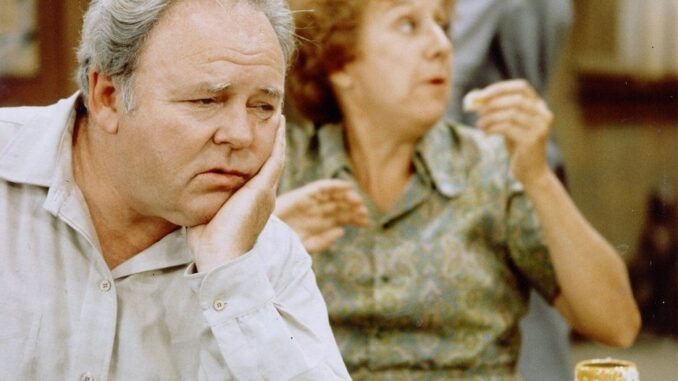
Few classic television shows inspire as much admiration—and anxiety—as All in the Family. Every few years, the question resurfaces: could this landmark sitcom be remade for modern audiences? The honest answer is uncomfortable but clear. All in the Family could exist today only in name. The show itself—the tone, the risk, the unapologetic discomfort—would be almost impossible to recreate.
Comedy That Refused to Play It Safe
All in the Family was never designed to reassure its audience. It thrived on confrontation. Episodes unfolded through arguments that were loud, unresolved, and morally messy. The humor did not soften the conflict—it sharpened it.
Modern television, even when tackling social issues, tends to cushion its blows. Jokes are framed carefully. Messages are clarified. Offense is anticipated and neutralized. All in the Family did none of that. It trusted viewers to sit with discomfort, to feel unsure, and to argue back at the screen. That level of risk is rare in today’s tightly managed media environment.
Archie Bunker Would Be Too Dangerous Now
Archie Bunker is the single greatest obstacle to a faithful remake. His language, attitudes, and worldview were intentionally abrasive. The show’s brilliance lay in refusing to fully condemn or redeem him. Archie was wrong—often painfully so—but he was also emotionally sincere and culturally real.
In today’s television landscape, such ambiguity would be nearly impossible to sustain. A modern Archie would either be softened into satire or reshaped into a clear villain. The original show’s refusal to offer moral clarity would likely be seen as irresponsibility rather than realism.
Satire Without a Disclaimer
One of All in the Family’s most radical choices was its lack of explanation. The show did not pause to clarify its intent. It did not reassure viewers that prejudice was being criticized rather than endorsed. It assumed media literacy—and accepted the risk of being misunderstood.
Today, satire often arrives with context, framing, and explicit signals of “correct” interpretation. Without those guardrails, creators risk backlash, boycotts, and misrepresentation. All in the Family operated without a safety net, and that freedom was essential to its power.
A Culture Less Willing to Argue With Itself
The show emerged at a time when public disagreement was unavoidable. Political and social divisions were loud, visible, and unresolved. All in the Family did not try to heal those divisions—it exposed them.
Ironically, despite today’s polarized climate, mainstream television is less willing to host genuine ideological conflict. Discussions are often filtered through irony, distance, or consensus-driven storytelling. All in the Family forced opposing beliefs into the same room and refused to let them coexist peacefully.
Why a Modern Remake Would Miss the Point
Any attempt to remake All in the Family today would almost certainly improve representation, update language, and clarify moral positioning. In doing so, it would lose the very thing that made the original revolutionary: its refusal to be comfortable.
The show was not designed to be liked. It was designed to be argued with. A remake that avoids offense would not be All in the Family—it would be an echo, stripped of danger.
The Show That Worked Because It Could Fail
All in the Family existed in a moment when television was willing to risk failure, outrage, and misunderstanding. That environment no longer exists in the same way. And perhaps that is why the show still feels so sharp.
It cannot be remade not because society has progressed—but because television has grown more cautious. All in the Family was brave enough to trust its audience with unresolved truth. That trust may be its most unrepeatable quality.
And that is precisely why it still matters.