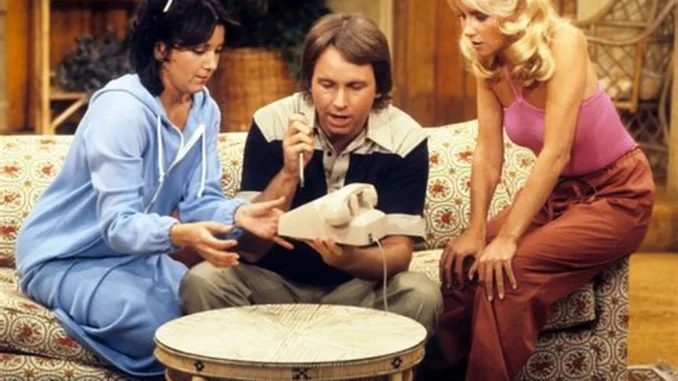
For millions of viewers, Three’s Company was pure, effortless comedy. Doors slammed, misunderstandings escalated, and laughter arrived right on cue. But behind the bright lights and perfectly timed jokes, the reality of making one of television’s most beloved sitcoms was far more complicated—and far more human—than audiences ever imagined.
What happened behind the scenes was a mix of discipline, creative tension, quiet power struggles, and performances shaped by pressure as much as talent.
A Comedy Built on Precision, Not Chaos
On screen, Three’s Company looked loose and spontaneous. In reality, it was one of the most tightly controlled productions on television. Scripts were rehearsed extensively, blocking was choreographed down to inches, and timing was treated as sacred.
John Ritter, in particular, approached the show with near-theatrical seriousness. His physical comedy—falls, freezes, frantic movements—was rarely improvised. Cast and crew later recalled that Ritter would rehearse the same sequence repeatedly, adjusting pauses by fractions of a second. The goal was not exaggeration, but inevitability: comedy that felt accidental while being meticulously planned.
John Ritter: The Anchor Everyone Relied On
Behind the scenes, Ritter was widely seen as the stabilizing force on set. As the show’s popularity exploded, pressure mounted on everyone involved. Ritter responded not with ego, but preparation. He learned everyone’s rhythms, adjusted his performance to support his co-stars, and often absorbed the comedic weight of scenes to keep the ensemble balanced.
Producers knew that if Ritter’s timing held, the episode would work. If it didn’t, nothing else mattered.
Suzanne Somers and the Shift No One Expected
One of the most significant behind-the-scenes developments in Three’s Company history involved Suzanne Somers. As Chrissy Snow became a breakout fan favorite, contract negotiations began to strain relationships. While much of this tension unfolded after the show’s peak years, its early signs were already present.
Behind the laughter, producers quietly adjusted scripts, redistributed screen time, and worked to preserve the show’s rhythm. Viewers noticed changes in character focus long before they understood the reasons why. What appeared to be creative evolution was often logistical necessity.
Joyce DeWitt: The Quiet Professional
While others became headlines, Joyce DeWitt remained known on set for her consistency and discipline. Crew members often described her as the emotional anchor—someone who stayed focused regardless of outside noise.
Her grounded performance was not accidental. DeWitt deliberately played against the chaos, giving scenes a sense of reality that made the absurdity land harder. Behind the scenes, that restraint was respected and relied upon, even if it rarely drew public attention.
Norman Fell and the Power of Saying Less
Norman Fell’s Mr. Roper became iconic for his suspicious looks and perfectly timed pauses. What viewers didn’t know was that many of those moments were the result of deliberate behind-the-scenes choices.
Fell often advocated for fewer lines, believing silence could be funnier than dialogue. Producers allowed reaction shots to linger, trusting Fell’s instincts. Those quiet beats became some of the show’s biggest laughs—proof that restraint, not volume, often carried the joke.
Tension That Never Reached the Camera
As Three’s Company grew into a ratings powerhouse, the atmosphere on set inevitably changed. Fame brought scrutiny. Success brought leverage. Creative decisions were no longer just artistic—they were strategic.
Yet what remains remarkable is how little of this tension leaked onto the screen. Episodes continued to feel cohesive, energetic, and emotionally clear. That illusion was maintained through professionalism, editing precision, and an unspoken agreement: whatever happened off camera stayed there.
The Illusion That Made It Work
Editors played a crucial role in shaping what audiences saw. Scenes were trimmed aggressively. Reaction shots were shortened or extended by frames. The pacing was engineered to create constant momentum, masking any fractures beneath the surface.
The result was a show that felt effortless, even when it wasn’t.
The Real Story Behind the Laughter
What really happened behind the scenes of Three’s Company was not scandal-driven chaos, but something more interesting: a group of people navigating fame, pressure, and creative ambition while trying to make something consistently funny.
That tension—controlled, managed, and rarely acknowledged—may be exactly why the show still holds up today.
The laughter was real.
The work behind it was harder than anyone ever saw.