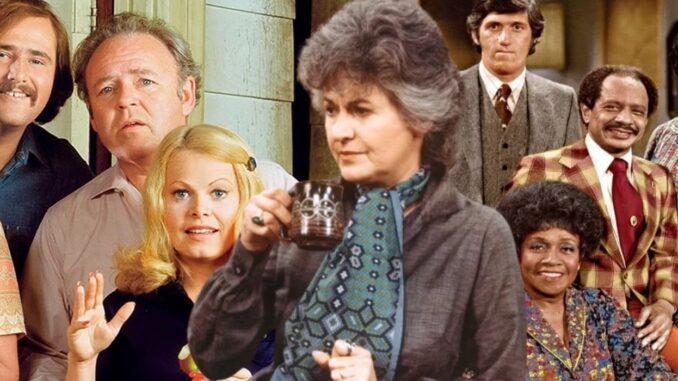
When All in the Family premiered on American television in 1971, audiences quickly realized they were watching something completely different from the polished, safe sitcoms that had dominated the airwaves for years. Instead of idealized families living in spotless suburban homes, the show introduced viewers to the loud, opinionated, and deeply flawed Bunker family of Queens, New York.
The arguments were sharp. The language was bold. And the topics—racism, politics, gender roles, and generational conflict—felt almost uncomfortably real.
That realism has led fans to ask the same question for decades: Was the world of All in the Family actually based on real life?
The answer, surprisingly, is both yes and no.
The Show That Changed Television
Created by legendary television producer Norman Lear, All in the Family was unlike anything American audiences had seen before. At the center of the show was Archie Bunker, played by Carroll O’Connor, a working-class dock foreman who lived with his patient wife Edith and frequently clashed with his liberal son-in-law Mike.
Archie was blunt, stubborn, and often politically incorrect. But he was also recognizable to millions of viewers who saw echoes of their own relatives, neighbors, or coworkers in his character.
This authenticity made many people believe the show must have been pulled directly from a real family’s story.
In reality, the truth behind the show’s origins is even more fascinating.
Inspired by a British Sitcom
Before it became an American television phenomenon, All in the Family actually began overseas.
The show was loosely adapted from the British sitcom Till Death Us Do Part, which aired in the United Kingdom during the 1960s. That series featured a similarly outspoken father figure who constantly argued with his more progressive son-in-law.
When Norman Lear first encountered the British show, he immediately recognized its potential for American audiences. But simply copying it would not work. The cultural tensions of Britain were different from those in the United States.
So Lear reshaped the concept entirely.
He transplanted the story to working-class Queens, New York, and rebuilt the characters around the political and social conflicts dominating America in the late 1960s and early 1970s.
In other words, while the structure came from Britain, the soul of the show came from American life itself.
Archie Bunker Wasn’t One Person
Another reason the show feels so authentic is the character of Archie Bunker himself.
Many viewers have long wondered whether Archie was based on a specific real individual. According to Norman Lear, however, Archie was not modeled after one person, but rather a combination of many.
Lear famously admitted that parts of Archie were inspired by people he had known growing up, including his own father. But the character was also shaped by countless conversations, political debates, and cultural tensions taking place across America at the time.
Archie represented a type of person rather than a specific person: a working-class man struggling to understand a rapidly changing world.
This blend of real-life influences made the character feel authentic—even when audiences disagreed with him.
Real Issues, Real Conversations
What truly grounded All in the Family in reality was its willingness to address topics that other sitcoms avoided.
Episodes tackled issues such as:
- racism and prejudice
- the Vietnam War
- women’s rights
- religion
- generational political divides
These were not abstract debates. They were the same conversations happening in American living rooms during the early 1970s.
By bringing those discussions into the Bunker household, the show created a mirror for the country itself.
Viewers sometimes laughed at Archie’s ignorance. Other times they sympathized with him. But either way, they recognized the arguments on screen because they had heard similar ones in their own families.
A Working-Class Family That Felt Real
Another key to the show’s realism was its setting.
Unlike the glamorous homes often shown in television comedies, the Bunkers lived in a modest house in Queens. The furniture was dated, the living room was cramped, and the family often worried about money.
That detail may seem small today, but at the time it was revolutionary.
American sitcoms had rarely portrayed working-class families with such honesty. Instead of pretending life was perfect, All in the Family showed the everyday frustrations, misunderstandings, and small victories that defined ordinary households.
For many viewers, this made the show feel less like fiction and more like a documentary of real life.
The Legacy of Realism
Whether or not the Bunker family was directly based on a true story, the show’s influence is undeniable.
All in the Family became one of the most important sitcoms in television history. Its success opened the door for future series willing to tackle serious social topics through humor.
More importantly, it proved that audiences were ready for television characters who felt real—flawed, complicated, and sometimes difficult.
That authenticity is why the show continues to resonate decades after its debut.
So Was It Based on Real Life?
In the strictest sense, All in the Family was not based on a single true story or a specific real family.
But its characters, arguments, and struggles were drawn from the real experiences and cultural conflicts shaping America at the time.
And that may be why the show still feels so powerful today.
Because while the Bunker family may have been fictional, the world they lived in was unmistakably real.