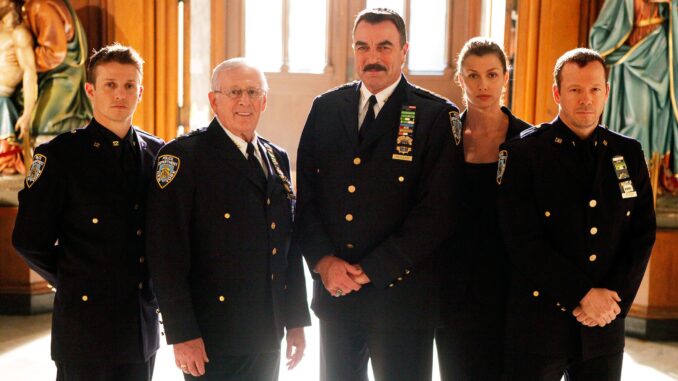
For more than a decade, Blue Bloods wasn’t just another CBS procedural — it was a television institution. At the center of it all stood Tom Selleck’s Frank Reagan, a steady, principled presence who became synonymous with Friday night television. So when the long-running drama finally came to an end, it wasn’t just fans who felt the loss. According to Selleck himself, the emotional impact hasn’t faded — especially as the franchise appears poised to live on without him.
In recent comments that have resonated deeply with longtime viewers, Selleck admitted that watching a Blue Bloods spinoff find momentum has been, in his words, “not a great feeling.” While he stopped short of bitterness, the sentiment was unmistakable: saying goodbye to a show that defined the latter half of his career has been far more complicated than simply turning the page.
A Farewell That Still Hurts
When Blue Bloods wrapped its run, many fans felt the ending came too soon. The series remained one of CBS’s most consistent performers, maintaining strong ratings and a fiercely loyal audience even as network television struggled to retain viewers. For Selleck, that context makes the goodbye especially difficult.
After spending years portraying Frank Reagan — a character rooted in duty, family, and moral clarity — Selleck didn’t just lose a job. He lost a routine, a creative home, and a cast and crew that had become extended family. In interviews, he has spoken openly about how rare it is for an actor to remain with one show for so long, calling Blue Bloods “a gift” in an industry defined by uncertainty.
That’s why the idea of the universe continuing without him stings. While spinoffs are often framed as celebrations of a franchise’s success, for those left behind they can feel like a reminder of what’s been lost.
Watching the Spinoff Move Forward
The rumored Blue Bloods spinoff — often referred to by fans as Boston Blue — has sparked intense debate online. Some viewers are eager to explore a new chapter within the same world, while others feel the Reagan family and New York setting were the heart of the series and can’t be replicated.
Selleck’s reaction seems to echo that emotional divide. He hasn’t criticized the spinoff outright, nor has he suggested it shouldn’t exist. Instead, his comments reflect something quieter and more human: the discomfort of seeing a legacy continue while your own chapter has closed.
“It’s not about resentment,” one industry observer noted. “It’s about identity. When you’ve been the face of something for 14 years, watching it evolve without you is bound to be complicated.”
Frank Reagan’s Shadow Looms Large
One of the biggest questions surrounding any Blue Bloods continuation is whether it can truly escape Frank Reagan’s shadow. Selleck’s portrayal anchored the show’s moral compass, particularly during its iconic family dinner scenes, which became a defining ritual for the series.
Even fans who are curious about the spinoff often admit the same thing: it won’t feel like Blue Bloods without Frank at the head of the table.
That reality likely makes the transition harder for Selleck as well. His performance wasn’t just central — it was foundational. And while television history is full of successful spinoffs, it’s also littered with examples that struggled to justify their existence once the original heart was removed.
A Career Built on Longevity
To understand why this moment carries such weight, it helps to look at Selleck’s career as a whole. From Magnum, P.I. to Blue Bloods, he’s built a reputation not on chasing trends, but on stability, integrity, and audience trust. Few actors of his generation can claim two defining television roles, let alone ones that span decades.
That longevity has made Selleck something of a symbol of old-school television values — the kind where characters grow slowly, stories breathe, and viewers feel like part of a long conversation rather than a short binge.
So when Blue Bloods ended, it wasn’t just the conclusion of a series. It felt like the end of an era — both for network TV and for Selleck himself.
Fans Feel the Same Conflict
Unsurprisingly, fans have mirrored Selleck’s mixed emotions. Online discussions are filled with comments like, “I’ll try the spinoff, but it won’t be the same,” and “They should’ve fought harder to keep Blue Bloods going.”
Many viewers believe CBS underestimated how much Frank Reagan — and Selleck — mattered to the show’s identity. Others argue that expanding the franchise is a natural move in a competitive TV landscape desperate for recognizable brands.
What’s clear is that the audience remains emotionally invested, and Selleck’s honesty has only deepened that connection. By admitting that watching the spinoff succeed isn’t easy, he’s validated the complicated feelings many fans share.
Looking Ahead, Not Back
Despite the lingering disappointment, Selleck hasn’t closed the door on the future. He’s expressed gratitude for the opportunity Blue Bloods gave him and pride in the work the cast accomplished together. He’s also emphasized that his comments come from a place of love, not bitterness.
Whether or not he returns to television in another major role remains to be seen. At this stage in his career, Selleck has earned the right to be selective — or to step away entirely if he chooses.
Still, one thing is certain: no spinoff, however successful, can erase the impact of what came before.
A Legacy That Can’t Be Replaced
As the Blue Bloods universe moves forward, Tom Selleck’s Frank Reagan remains its emotional cornerstone. The spinoff may thrive, critics may debate its merits, and CBS may celebrate a familiar brand reborn — but for millions of viewers, Blue Bloods will always begin and end with the man who wore the commissioner’s badge.
And perhaps that’s why Selleck’s words hit so hard. They remind us that behind every franchise decision are real people — artists who invest years of their lives into stories that matter.
For Tom Selleck, Blue Bloods wasn’t just a show. It was a chapter he wasn’t ready to close. And watching the next one begin without him? As he put it himself — it’s simply “not a great feeling.”