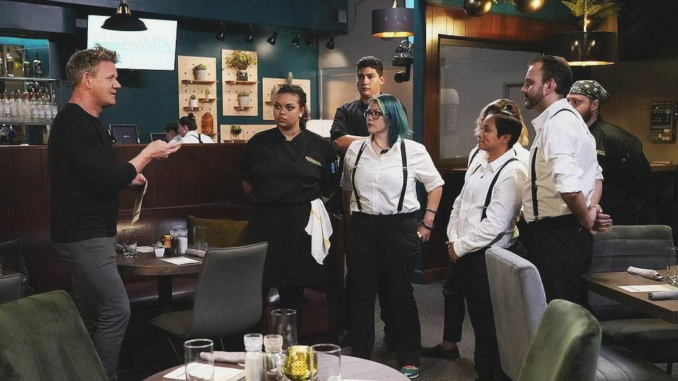
There was a time when a Gordon Ramsay show felt genuinely risky. Not just for contestants—but for Ramsay himself. One wrong dish could trigger an explosion. One weak leader could be dismantled in front of millions. Viewers tuned in because anything could happen, and often did.
Now, fans say that edge is gone.
Across forums, comment sections, and reaction videos, a phrase keeps surfacing: the soft era. Not said with affection—but with disappointment. The claim isn’t that Ramsay has lost his skill or authority. It’s that his shows no longer feel truly dangerous.
And for many viewers, that changes everything.
The first thing fans point to is consequence. In older seasons, a single mistake could end a run. A burnt protein. A broken service. A moment of hesitation. Today, similar errors often result in warnings, second chances, or vague critiques that lead nowhere.
It’s not mercy that bothers fans—it’s inconsistency.
Viewers notice when standards appear flexible, when accountability feels negotiable, and when Ramsay’s legendary intolerance for mediocrity seems selectively applied. The kitchen still looks intense, but the fallout doesn’t land the same way.
That’s where the sense of danger disappears.
Another major shift fans highlight is emotional safety. Contestants recover quickly. Eliminations are cleaner. Breakdown moments feel contained, almost curated. Ramsay still raises his voice, but the fury feels measured—controlled rather than explosive.
To some, this is growth. To others, it feels like restraint imposed from outside.
Longtime viewers argue that Ramsay’s shows once thrived because they didn’t protect anyone—not contestants, not egos, not even Ramsay’s own image. The kitchen was unforgiving, and that brutality made success feel earned.
Now, success feels smoother. And smoothness, fans say, kills tension.
The editing has also come under scrutiny. Episodes move faster, with less time spent dissecting failure. Technical explanations are shortened or cut entirely. The focus shifts to reactions, pacing, and cliffhangers rather than process.
When viewers stop learning, they stop fearing mistakes.
Social media reactions reveal a generational split. Newer fans embrace the change, calling the shows more watchable and less exhausting. Veteran viewers feel alienated, insisting that exhaustion was the point.
A Gordon Ramsay kitchen wasn’t supposed to be comfortable.
Ramsay himself complicates the debate. He appears calmer, more composed, and undeniably in control. Some fans admire this evolution, interpreting it as confidence earned through decades of dominance. Others see it as disengagement—less teacher, more figurehead.
The shouting is still there. But the passion feels filtered.
Insiders suggest legal, cultural, and branding pressures have reshaped what can be shown on television. Mental health awareness. Workplace standards. Network caution. All valid. All necessary.
But fans argue that something vital was lost in the translation.
The danger wasn’t abuse—it was accountability. It was knowing that excellence was the only shield. When that clarity fades, the kitchen becomes just another set.
And that’s the fear.
Viewers aren’t worried Ramsay’s empire will collapse. They’re worried it will settle. Become safe. Predictable. Comfortable. The very things his brand once rejected.
Ironically, ratings haven’t suffered. Engagement remains high. But the tone of engagement has changed. Less awe. More analysis. Less fear. More forecasting.
Fans don’t watch to be shocked anymore—they watch to confirm expectations.
That’s a dangerous shift for any competition.
Because Gordon Ramsay wasn’t built on comfort. He was built on pressure so intense it revealed who people really were. When the pressure feels simulated, the revelations stop feeling real.
The “soft era” label may be unfair. It may ignore progress. It may underestimate Ramsay’s ability to recalibrate.
But it exists for a reason.
It reflects a growing belief that something fundamental has changed—not loudly, not catastrophically, but undeniably.
And until fans feel that danger again—the sense that anything can happen, and no one is protected—the question will linger over every new episode:
Is this still a Gordon Ramsay kitchen?
Or just the memory of one, carefully managed for television?