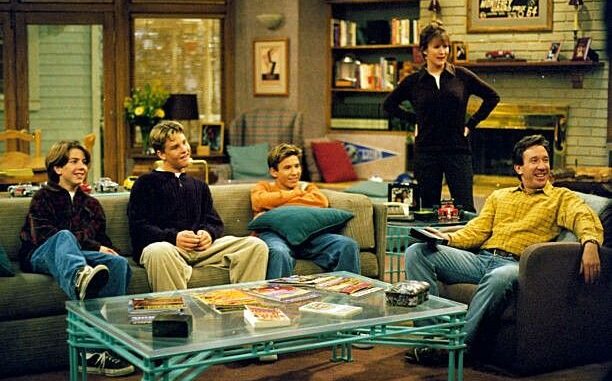
If you grew up in the 90s, the sound of three rhythmic grunts probably triggers an immediate Pavlovian response. You can almost see the flannel shirts and smell the sawdust. Tim “The Tool Man” Taylor was the king of the suburban jungle, a man whose solution to every life problem was “More Power!” Fast forward to the mid-2020s, and that same actor, Tim Allen, gave us Mike Baxter—a man trading the hot rod for a marketing vlog and the garage for an outdoor sporting goods empire.
As we sit here in 2026, looking back at these two cultural pillars, it’s fascinating to see how the “American Dad” has shifted. Are we looking at two sides of the same coin, or has the very definition of fatherhood undergone a total renovation? Let’s grab a cold one and look under the hood of these two iconic sitcoms to see how they portray the men who lead the household.
🛠️ The 90s Blueprint: Tim Taylor and the Cult of “More Power”
In the 1990s, Home Improvement wasn’t just a show; it was a weekly ritual. Tim Taylor represented a specific kind of post-Cold War masculinity. He was a guy who worked with his hands (often poorly), loved his family (often awkwardly), and lived in a state of constant competition with his neighbor’s yard.
The Bumbling but Well-Intentioned Father
Tim was often the “lovable loser” when it came to domesticity. He’d blow up a dishwasher or accidentally glue himself to a roof, and while the audience laughed, there was a clear message: Dads are great at fixing things, but they are a bit lost when it comes to feelings. He needed Jill to translate the “emotional language” for him. Does that trope still hold water today? Or does it feel like a relic of a bygone era?
🏹 The 2010s Pivot: Mike Baxter and the “Outdoor Man” Philosophy
When Last Man Standing hit the airwaves, the world had changed. The internet was a thing, politics were louder, and the “Modern Dad” felt like he was under siege. Mike Baxter wasn’t a bumbling amateur; he was a highly competent executive.
Competence Over Chaos
Unlike Tim Taylor, Mike Baxter rarely broke things. He was the smartest guy in the room, or at least he thought he was. He traded the “Oops, I broke it” slapstick for a sharp-tongued, conservative-leaning commentary on how the world was “going soft.” In Last Man Standing, the American Dad shifted from a guy trying to figure out his tools to a guy trying to figure out a world that no longer spoke his language.
🏠 The Battle of the Household Dynamics
The way these dads interacted with their families tells us a lot about the decade they lived in.
Raising Three Boys vs. Raising Three Girls
Tim Taylor’s house was a testosterone-fueled chaos zone. His struggle was teaching his sons how to be “men” while he was still figuring it out himself. Mike Baxter, however, was a man’s man surrounded by women. This forced a different kind of evolution. He couldn’t just grunt his way through a conversation with Mandy or Kristin; he had to engage, even if he did so with a smirk and a sarcastic remark.
H3: The Role of the Wife: Jill Taylor vs. Vanessa Baxter
You can’t talk about the dads without the moms. Jill Taylor was the “sensible one,” the psychological anchor who often had to parent Tim alongside the kids. Vanessa Baxter was Mike’s equal—a scientist with her own career and her own bottle of wine. This shift reflects the 2026 reality where the “traditional” stay-at-home dynamic has evolved into a true partnership of two professionals.
📺 Technology: From the Workbench to the Webcast
How a dad interacts with technology says a lot about his era.
The Analog Era of Tool Time
Tim Taylor lived for the tangible. He wanted a bigger engine, a faster mower, and a louder drill. His “Tool Time” show-within-a-show was about hardware. It was analog, greasy, and loud. It represented a world where “doing” meant getting your hands dirty.
H3: The Digital Soapbox of the Outdoor Man Vlog
Mike Baxter used technology as a weapon of influence. His “vlogs” were the centerpiece of the show’s messaging. In 2026, we see this as the precursor to the modern influencer dad. He didn’t just want to build a cabinet; he wanted to tell the world why the cabinet mattered. It shows a shift from physical labor to intellectual and cultural influence.
💪 Redefining Masculinity: Is the Grunt Still Relevant?
In 2026, the concept of “masculinity” is a hot-button issue.
Tim Taylor’s “Manly” Insecurity
Tim was constantly worried about looking “unmanly.” Whether he was losing a race to Bob Vila or failing to catch a fish, his ego was tied to his performance. He was a caricature of the 1950s ideal struggling to fit into the sensitive 1990s.
H3: Mike Baxter’s Unapologetic Traditionalism
Mike Baxter didn’t have that insecurity. He was comfortable in his skin. He didn’t care if people thought his views were outdated; he wore them like a badge of honor. He represented the “Dad as a Protector” of traditional values in an increasingly progressive world.
🎓 The Neighbor Factor: Wilson vs. Chuck Larabee
The “wise mentor” changed drastically between the two shows.
The Mystery of Wilson’s Wisdom
Wilson was a philosopher. He stayed behind the fence, quoting poetry and offering cryptic advice that Tim would inevitably misunderstand. He represented the idea that “Dad” doesn’t have all the answers and needs to look toward history and art for guidance.
H3: The Rivalry with Chuck Larabee
In Last Man Standing, Mike’s “Wilson” was Chuck Larabee—a retired Marine and a Black man with whom Mike shared a constant, friendly-fire rivalry. Their relationship was built on mutual respect and “roasting” each other. It was a more grounded, realistic portrayal of male friendship in a diverse America.
📉 The “Dad” Evolution: Who Wins in 2026?
If we look at the data of 2026, which portrayal resonates more?
The Nostalgia of the Bumbling Dad
There’s a reason Home Improvement is still a massive hit on streaming. We miss the simplicity of a dad who just wanted a bigger lawnmower. It’s nostalgic and safe.
H3: The Reality of the Competent Dad
However, Mike Baxter feels more like the dads we see in our neighborhoods today. We are multitasking, career-driven, and highly opinionated. We aren’t blowing up the kitchen as much as we are arguing about politics at the dinner table.
🤔 Lessons Learned from the Taylor and Baxter Households
What can we take away from these two icons?
-
Vulnerability is Key: Both Tim and Mike were at their best when they dropped the act and showed they cared.
-
Laughter is the Glue: Whether it’s a grunt or a sarcastic quip, humor is how the American Dad survives.
-
Adaptation: A dad who doesn’t change with the times—whether it’s learning about “the Google” or understanding his daughter’s career—gets left behind.
Conclusion
Comparing Home Improvement to Last Man Standing is like looking at a “Before and After” photo of the American psyche. Tim Taylor was the dad of our childhoods—clumsy, loud, and full of heart. Mike Baxter is the dad of our adulthood—competent, stubborn, and fiercely protective of his way of life. In 2026, we realize we need a bit of both. We need the humility to laugh at our mistakes like Tim, but the strength to stand our ground like Mike. As the landscape of fatherhood continues to shift, these two characters remain the gold standard for how to be a “man of the house” in a world that’s constantly changing its mind about what that means.
❓ 5 Unique FAQs After The Conclusion
Q1: Which show had better ratings during its original run?
A1: Home Improvement was a juggernaut, often sitting in the Top 10 of all television shows during the 90s. While Last Man Standing had a incredibly loyal fan base and survived a network cancellation, it never quite reached the cultural saturation of Tim Taylor’s peak.
Q2: Did Tim Allen prefer playing Tim Taylor or Mike Baxter?
A2: Allen has often said that Tim Taylor was closer to his stand-up persona at the time, but Mike Baxter allowed him to express his personal political and social views more clearly. He treats both characters like family.
Q3: Are there any “Easter Eggs” connecting the two shows?
A3: Absolutely! Several Home Improvement stars guest-starred on Last Man Standing, including Richard Karn (Al Borland) and Patricia Richardson (Jill Taylor). In one famous episode, Tim Taylor even “meets” Mike Baxter in a meta-crossover!
Q4: How does 2026 society view Tim Taylor’s “accidents”?
A4: Today, some see Tim’s lack of safety as a bit stressful to watch, but most viewers appreciate the slapstick as a metaphor for the universal struggle of trying to be “handy” when you’re just not.
Q5: Is there a reboot planned for either show in 2026?
A5: While there are constant rumors about a Home Improvement revival (possibly titled The Tool Box), nothing has been officially greenlit yet. Fans remain hopeful for a “where are they now” look at the Taylor boys.