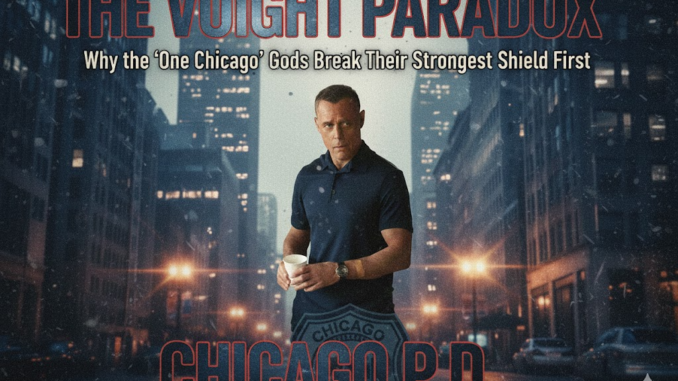
In the gritty, rain-slicked streets of the 21st District, there is an unwritten law of narrative physics: the more weight a character can carry, the more the writers will pile on until the bones snap. At the center of this structural cruelty stands Jason Beghe’s Hank Voight, the grizzled, gravel-voiced patriarch of Chicago P.D. who serves as the ultimate litmus test for this theory. We often ask why the “One Chicago” universe seems to reserve its most jagged tragedies for its most resilient figures, but the answer lies in the brutal mechanics of high-stakes drama. The “strong” character—the one who survives the unthinkable, the one who anchors the team, the one who moves the bodies to protect the “family”—is not rewarded for their strength; they are punished by it. In the eyes of the showrunners, a strong character like Voight is a bottomless well of dramatic potential, a vessel that can be emptied and refilled with trauma indefinitely because they possess the internal architecture to remain standing when others would have been written out of the script.
The primary reason Jason Beghe’s character is subjected to a relentless gauntlet of loss—from the death of his son Justin to the agonizing departure of his surrogate daughter Erin Lindsay and the execution of his best friend Alvin Olinsky—is the “Load-Bearing Wall” theory of television writing. For a procedural to maintain its tension over hundreds of episodes, it requires a central pillar that can absorb the shock of constant upheaval. Voight is that pillar. Because Beghe portrays him with such a terrifying, stoic gravitas, the writers know they can strip away everything he loves without breaking the show’s reality. If a “weaker” or more emotionally fragile character suffered half of Voight’s losses, the narrative would have to shift into a story of total collapse or psychiatric recovery. But because Voight is built as the “Strong Man,” his suffering is used as a tool to harden the plot, turning his personal grief into the fuel that drives his morally gray crusades for justice.

Furthermore, the targeting of strong characters is a calculated move to raise the stakes for the entire ensemble. When the “invincible” leader is wounded, the ripples of fear are felt more acutely by the audience and the supporting cast. By breaking Voight—or forcing him into impossible ethical corners—the showrunners create a “trickle-down trauma” effect. We saw this with the death of Anna Avalos; it wasn’t just another informant dying, it was the systematic dismantling of Voight’s attempt to be “better,” a direct hit to his soul that forced every member of the Intelligence Unit to recalibrate their own moral compass. The writers aren’t being cruel for the sake of cruelty; they are using Beghe’s immense acting range to explore the “sunk cost fallacy” of being a hero in a broken city. They understand that the audience finds more resonance in the cracks of a granite statue than in the shattering of a glass one.
This phenomenon is also deeply tied to the “Tragic Hero” archetype that Jason Beghe has perfected over a decade. In the tradition of classic literature, the strongest figures are often plagued by a hamartia—a fatal flaw—which in Voight’s case is his obsessive loyalty to his “family” and his city. The “One Chicago” puppet masters exploit this flaw by targeting exactly what the character values most. By hurting Voight’s inner circle, they force him to react with the “dirty deeds” that define the show’s DNA. If Voight were allowed a stable, happy life, the very conflict that makes Chicago P.D. the dark, brooding sibling of the franchise would evaporate. His strength is essentially a prison; the more he proves he can handle the darkness, the more darkness the writers are compelled to send his way to keep the character evolving.
Ultimately, the reason it hurts to watch is exactly why the show succeeds. Jason Beghe brings a visceral, haunted quality to Voight that makes every loss feel like a physical blow to the viewer. The showrunners recognize that his strength is the show’s greatest asset and its most convenient target. They break the strongest characters first because those characters are the only ones capable of surviving the “One Chicago” meat grinder while keeping us coming back for more. In the Windy City, the reward for being the toughest man in the room isn’t a badge of honor—it’s a bullseye on your back, painted there by the very writers who need your strength to keep their world from falling apart.