🌊 The Unsinkable Reputation of James Cameron’s Giant
Let’s be real for a second. Mention Titanic in a room full of “serious” cinephiles, and you’re likely to get a few eye-rolls. For decades, it’s been fashionable to dismiss James Cameron’s 1997 epic as a sugary, over-the-top melodrama. We’ve spent nearly thirty years arguing about whether Jack could fit on that door, mocking Celine Dion’s heart-stopping high notes, and rolling our eyes at the “I’m the king of the world!” exuberance.
But here’s the cold, hard truth: Titanic is a genuinely great movie. In fact, it might be one of the last truly “perfect” Hollywood blockbusters. The problem isn’t the film itself; it’s the sheer, staggering weight of its success. It became so big, so omnipresent, and so culturally dominant that we eventually turned on it. It’s the “U2 effect”—once something is everywhere, we start to wish it was nowhere. But if you strip away the 11 Oscars, the billions in box office, and the endless radio play, you’re left with a feat of filmmaking that modern cinema struggles to replicate.
📽️ The Art of the Historical Epic: Why It Works
When we talk about Titanic, we have to talk about scale. James Cameron didn’t just build a set; he basically rebuilt the ship. This wasn’t the era of lazy green screens and “we’ll fix it in post” CGI. This was the era of practical effects meeting burgeoning digital technology in a way that felt grounded.
Building a Legend from Scratch
James Cameron’s obsession with the Titanic is legendary. He didn’t just want to tell a love story; he wanted to document a tragedy with surgical precision. He made more dives to the actual wreck than the original passengers spent on the ship itself! This level of commitment translates to the screen. Every rivet, every piece of fine china, and every carpet pattern was meticulously researched.
The Structural Brilliance of the Narrative
Have you ever noticed how the movie is perfectly bisected? The first half is a lush, vibrant period romance. The second half is a terrifying, claustrophobic survival horror. Cameron uses the first 90 minutes to make you fall in love with the ship’s beauty and the characters’ hope, so that when the steel starts snapping, the loss feels personal. It’s like a slow-motion car crash where you’ve spent the first hour getting to know the driver.
🎭 Jack and Rose: More Than Just a “Chick Flick”
One of the loudest criticisms of the film is that the romance is “corny.” Well, sure, it’s a melodrama! But calling Titanic corny is like calling water wet. It’s supposed to be!
The Chemistry of DiCaprio and Winslet
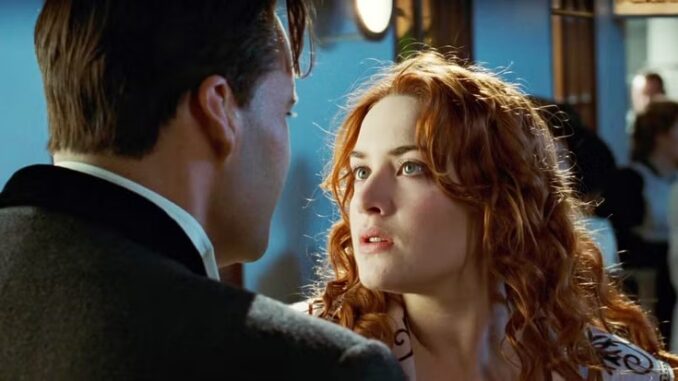
Before they were “Leonardo DiCaprio: Oscar Winner” and “Kate Winslet: Living Legend,” they were two young actors with an undeniable, electric connection. Their chemistry is the engine of the film. Without it, the sinking of the ship is just a technical exercise. They represent the clash of the old world’s rigid class structures and the new world’s yearning for freedom.
Rose DeWitt Bukater as a Modern Protagonist
If you watch the movie again today, Rose is actually a surprisingly progressive character for 1997. She’s a woman being sold into a gilded cage, contemplating suicide because she sees the “narrow gap” of her future closing in. Her survival isn’t just about the water; it’s about her reclaiming her name and her life. When she steps off the Carpathia and calls herself “Rose Dawson,” it’s one of the most satisfying character arcs in blockbuster history.
🚢 A Victim of Overexposure: The Backlash Explained
So, if it’s so good, why do so many people claim to hate it? It’s simple: the movie was victims of its own “King of the World” status.
The “My Heart Will Go On” Fatigue
You couldn’t go to a grocery store, a wedding, or a funeral in 1998 without hearing Celine Dion’s flute intro. The song became a caricature of the movie’s emotion. Because the music was so sentimental, people started projecting that sentimentality onto the entire three-hour film, ignoring the gritty, terrifying realism of the actual sinking sequence.
The Dominance of the 1998 Oscars
Winning 11 Academy Awards is a double-edged sword. It puts a target on your back. When Titanic tied Ben-Hur’s record, critics started looking for reasons to tear it down. Suddenly, it wasn’t a great movie; it was an “overrated” monster that “stole” awards from smaller, more “deserving” films.
⚙️ Technical Mastery: The Last Great Practical Spectacle
If you watch the sinking sequence today, it still looks better than 90% of the Marvel movies released in the last five years. Why? Because the physics are real.
The Weight of Water
Cameron used a massive tank and a nearly full-scale model of the ship. When the water rushes into the Grand Staircase, that’s real water destroying a real set. The actors are actually cold; the fear is often tangible. This “burstiness” of action—the sudden, violent shift from luxury to chaos—is executed with a level of clarity that modern “shaky-cam” directors can’t touch.
H4: Sound Design and Pacing
Listen to the movie. The groaning of the steel, the snapping of the cables, the haunting silence of the after-math. The pacing is a masterclass in tension. Cameron gives you moments of quiet dread, followed by bursts of adrenaline. It’s a rhythmic experience that keeps a 195-minute movie from ever feeling its length.
⚖️ The Tragedy of Success: Why Blockbusters Stopped Trying
In a weird way, Titanic’s success killed the very genre it perfected. Hollywood saw the box office numbers and decided that “big” meant “better,” but they forgot the “heart” part.
The Loss of the “Mid-Budget” Soul in Big Budgets
Titanic was a massive risk. At the time, it was the most expensive movie ever made. Everyone thought it would be a disaster—the Waterworld of its day. Because it succeeded so wildly, studios started chasing that high, but they stopped investing in the character-driven writing that made Titanic work. They kept the scale but lost the soul.
The CGI Takeover
The success of the digital elements in Titanic (like the digital passengers) paved the way for the total CGI takeover. Ironically, the movie that used digital tools to enhance reality eventually led to an industry that uses digital tools to replace it. We’ve lost that tactile, “you are there” feeling that Titanic captured so perfectly.
🤔 Is the “Door Debate” Really a Flaw?
We have to address it. The door. Could Jack have fit? James Cameron actually did a scientific study recently to prove that maybe he could have, but it wouldn’t have stayed buoyant enough for both to survive the freezing temperatures.
Missing the Forest for the Trees
Arguing about the door is a fun meme, but it’s a pedantic way to view art. Jack’s death is narratively necessary. It’s a tragedy! The whole point is that life is unfair and the “unsinkable” sinks. If Jack survives, the movie loses its emotional punch. His sacrifice is the final piece of Rose’s liberation. He saved her “in every way that a person can be saved.”
🌊 Cultural Impact: The Movie That Defined a Generation
Whether we like it or not, Titanic is part of our collective DNA. It’s one of the few movies that everyone’s grandmother and everyone’s teenage cousin have both seen.
The Return of the Epic
In recent years, we’ve seen a slight return to this kind of filmmaking—Oppenheimer or Dune—where directors are once again trusted with massive budgets to tell serious, historical, or complex stories. These movies owe a debt to Titanic. They prove that the audience is hungry for more than just superheroes; we want grand, sweeping stories that make us feel the scale of human existence.
Conclusion
At the end of the day, Titanic is a victim of its own greatness. It was so successful that it became “uncool” to like it. But if you take a step back and watch it with fresh eyes, you’ll see a movie that is impeccably directed, beautifully acted, and technically unsurpassed. It’s a film that balances the micro (a drawing, a necklace, a kiss) with the macro (the industrial revolution, class warfare, and the hubris of man). It’s time we stop apologizing for liking Titanic and start acknowledging it for what it truly is: a masterpiece that Hollywood might never be able to build again.
❓ 5 Unique FAQs After The Conclusion
Q1: Was the Titanic set actually built to scale?
A1: Almost! James Cameron built a 90% scale model of the ship in a massive 17-million-gallon tank at Fox Baja Studios in Mexico. The starboard side of the ship was fully completed, which meant the crew had to flip the film in post-production for scenes that required the port side!
Q2: Why did James Cameron focus so much on the love story instead of the history?
A2: Cameron argued that the best way to make the audience feel the tragedy of the 1,500 people who died was to make them care deeply about two specific people. The romance acts as a “Trojan Horse” to get viewers emotionally invested in the historical event.
Q3: How much of the film’s sinking sequence is historically accurate?
A3: Surprisingly, a lot of it. The ship breaking in half was a relatively new theory at the time (confirmed by the 1985 discovery of the wreck), and Cameron depicted it more accurately than any previous film. Many of the supporting characters, like the unsinkable Molly Brown and Captain Smith, are based on real people and documented accounts.
Q4: Did Leonardo DiCaprio and Kate Winslet really get along on set?
A4: They became best friends! The shoot was notoriously grueling—lasting over 160 days and involving cold water and long hours. Their close bond was one of the few things that kept the production from falling apart, and they remain close friends to this day.
Q5: Is Titanic still the highest-grossing movie of all time?
A5: Not anymore. It held the record for 12 years until it was surpassed by another James Cameron film, Avatar, in 2009. Currently, it sits in the top 4, often swapping places with Avatar: The Way of Water and Avengers: Endgame depending on re-releases.