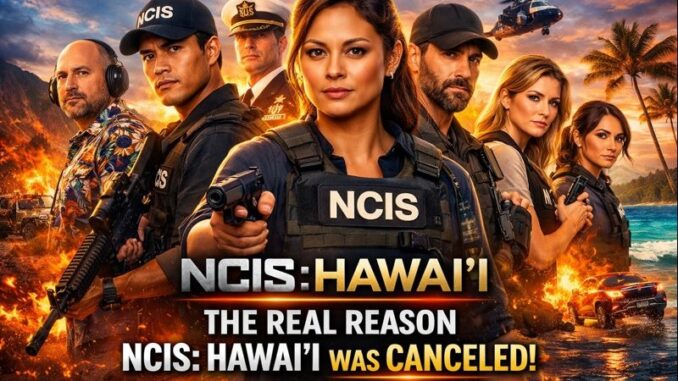
When NCIS: Hawai’i premiered, it felt like a fresh breeze blowing through the long-running NCIS universe. A stunning island backdrop, the franchise’s first female-led series, and a loyal fanbase ready to tune in every week—on paper, it looked like a guaranteed hit.
So why did CBS pull the plug?
If you think the answer is “low ratings,” think again. The real reason NCIS: Hawai’i was canceled is far more complicated—and honestly, a little surprising.
Let’s peel back the curtain and talk about what really happened.
NCIS: Hawai’i Was Not a Ratings Disaster
Here’s the first myth we need to bust.
The Show Still Pulled Solid Viewership
Contrary to popular belief, NCIS: Hawai’i wasn’t failing in the ratings. It consistently performed better than many other broadcast dramas and held its own on Monday nights—a competitive time slot.
In fact, compared to several shows that survived longer, NCIS: Hawai’i often ranked higher in total viewers.
So if people were watching, why cancel it?
That’s where things get interesting.
The Hidden Cost of Paradise
Hawai’i may look like paradise on screen, but behind the scenes? It’s expensive. Very expensive.
Filming in Hawai’i Comes With a Heavy Price Tag
Producing a network drama in Hawai’i isn’t like filming on a soundstage in Los Angeles.
We’re talking about:
-
Transporting cast and crew
-
Housing and per diem costs
-
Shipping equipment across the Pacific
-
Limited local production infrastructure
All of that adds up fast.
High Costs + Flat Growth = Trouble
Even with decent ratings, the production costs were significantly higher than other NCIS shows. And in today’s TV economy, networks aren’t just asking, “Is it popular?” They’re asking, “Is it growing?”
And that’s where NCIS: Hawai’i struggled.
The Streaming Era Changed the Rules
This might be the most overlooked factor of all.
Linear Ratings Aren’t Enough Anymore
Back in the day, live TV ratings were king. Now? Not so much.
CBS, like every other network, is laser-focused on streaming performance, particularly on Paramount+.
NCIS: Hawai’i Didn’t Move the Streaming Needle
While the show had a loyal audience, it didn’t drive significant new subscriptions or major streaming buzz. Compare that to shows that trend weekly or spark viral moments—and the difference becomes clear.
In short, NCIS: Hawai’i was stable, not explosive.
And in today’s industry, stable isn’t always enough.
Franchise Fatigue Is Real
Let’s be honest—the NCIS brand has been around for a long time.
Too Much of a Good Thing?
Between:
-
NCIS
-
NCIS: Los Angeles
-
NCIS: New Orleans
-
NCIS: Sydney
Audiences are spoiled for choice. But that abundance comes with a downside.
Viewers Are Fragmented
Instead of one massive hit, the audience is split across multiple versions of the same formula. That makes it harder for any single spin-off to stand out.
NCIS: Hawai’i didn’t fail—it blended in.
Scheduling and Network Strategy Played a Big Role
Sometimes, cancellations have less to do with performance and more to do with timing.
CBS Needed Room for New Content
Networks constantly reshuffle their schedules to make space for:
-
New dramas
-
Cheaper unscripted shows
-
Co-productions with better profit margins
One Show Had to Go
When budgets tighten, even solid performers become vulnerable. NCIS: Hawai’i was a casualty of strategic trimming, not a creative failure.
Contract Renewals and Rising Salaries
Here’s a behind-the-scenes truth fans rarely hear about.
Cast Contracts Get Expensive Over Time
As a show enters later seasons:
-
Actor salaries increase
-
Contract renegotiations become tougher
-
Production insurance costs rise
Success Can Be Costly
Ironically, the more successful a show becomes, the more expensive it is to keep alive. NCIS: Hawai’i reached a financial tipping point where renewal simply didn’t make economic sense.
The Industry Is Cutting Costs Everywhere
This cancellation didn’t happen in a vacuum.
Broadcast TV Is in Survival Mode
Across the industry, we’re seeing:
-
Shorter seasons
-
Fewer scripted dramas
-
More emphasis on profitability over passion
NCIS: Hawai’i Became a Business Decision
It wasn’t about quality. It wasn’t about fans. It was about spreadsheets, margins, and long-term strategy.
Cold? Yes. Surprising? Absolutely.
Fan Backlash Proved the Show Still Had Life
If CBS doubted the passion behind NCIS: Hawai’i, the reaction proved otherwise.
Fans Were Loud—and Loyal
Social media exploded with:
-
Hashtags demanding renewal
-
Petitions with tens of thousands of signatures
-
Emotional tributes to the cast and characters
Cancellation Doesn’t Equal Lack of Love
If anything, the backlash confirmed one thing: NCIS: Hawai’i still mattered.
Could NCIS: Hawai’i Be Saved Elsewhere?
Never say never in Hollywood.
Streaming Platforms Love Built-In Audiences
A show with:
-
A known franchise
-
A dedicated fanbase
-
International appeal
…is exactly the kind of property streamers look for.
The Door Isn’t Fully Closed
While nothing is confirmed, revivals and continuations happen all the time. Just ask fans of once-canceled shows that later found new life.
The Real Reason NCIS: Hawai’i Was Canceled—Summed Up
So what’s the truth?
It Wasn’t One Thing
The cancellation came down to a perfect storm:
-
High production costs
-
Moderate (not explosive) growth
-
Streaming priorities
-
Franchise saturation
-
Network budget strategy
A Victim of the Modern TV Economy
NCIS: Hawai’i didn’t fail its audience. The system failed the show.
Conclusion: A Cancellation That Still Feels Personal
NCIS: Hawai’i wasn’t just another procedural—it was representation, evolution, and comfort TV rolled into one. Its cancellation feels less like an ending and more like an unfinished sentence.
The real reason NCIS: Hawai’i was canceled might surprise you, but one thing is clear: the show deserved better than a quiet goodbye.
And who knows? In today’s TV landscape, goodbye doesn’t always mean forever.