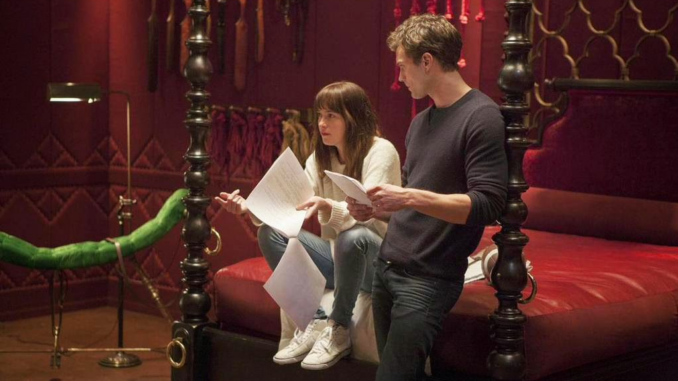
In the high-gloss world of Hollywood press junkets, Jamie Dornan is widely considered a professional’s professional. He is charming, self-deprecating, and possesses that rare Irish wit that can disarm even the most cynical journalist. Whether he is discussing the harrowing depths of a serial killer in The Fall or the tender, nostalgic streets of Belfast, Dornan usually navigates interviews with the grace of a seasoned veteran. However, there is a glitch in the matrix—a recurring moment of tension that occurs whenever a specific question about Fifty Shades of Grey is leveled at him.
Lately, that tension has reached a breaking point. As rumors of a potential reunion continue to swirl, Dornan’s strategic silence on one particular topic isn’t just a standard PR pivot anymore; it’s starting to feel deeply, intensely personal.
The Pattern of Deflection
For nearly a decade, Dornan has faced an onslaught of questions about his time as Christian Grey. He has answered the “how did you film the Red Room scenes?” questions a thousand times. He has laughed off the “do you own a grey tie?” jokes. But there is one inquiry that makes the light leave his eyes: “Does the legacy of Christian Grey still haunt your personal life?”
Observers have noted a distinct pattern. Whenever an interviewer touches on the psychological or domestic impact the franchise had on his real-world existence, Dornan’s demeanor shifts. He doesn’t just answer and move on; he shuts down. He employs a “polite wall”—a series of short, clipped answers or a quick redirection to his current projects. While his co-star Dakota Johnson has become increasingly comfortable dissecting the “psychotic” nature of the production, Dornan seems to be actively trying to bury the emotional remains of the experience.
The Shadow of the “No-Watch” Rule
To understand why this question feels so personal, one has to look at the unique domestic situation Dornan has maintained since 2015. It is a well-documented fact that his wife, the talented composer Amelia Warner, has reportedly never watched the Fifty Shades films. While Dornan has joked about this in the past, saying he doesn’t want to “pay for a ticket to see his wife uncomfortable,” the humor has recently been replaced by a stern protectiveness.
By avoiding questions about the “personal toll,” Dornan is likely protecting the sanctity of his marriage. The franchise didn’t just bring him fame; it brought a level of objectification that few male actors have ever endured. For a man who identifies primarily as a father and a husband, being the global face of BDSM fantasy created a friction that he clearly isn’t interested in revisiting. When journalists ask if he’s “moved on,” they are asking about his career. But when he hears it, he seems to be hearing a question about whether his family has finally recovered from the chaos.
The Contrast: Dakota’s Truth vs. Jamie’s Silence
The intrigue surrounding Dornan’s silence is amplified by Dakota Johnson’s recent transparency. Johnson has been an open book, discussing the creative “battles” and the “mayhem” of the set. Her honesty has provided a sense of closure for many fans. Dornan, however, has taken the opposite route. He has opted for a scorched-earth policy of silence regarding the internal dynamics of the franchise.
This discrepancy has led to intense speculation. Is Dornan’s silence a sign of a deeper resentment? Or is it a calculated move to ensure he is never again defined by a single role? Industry insiders suggest that Dornan views Fifty Shades as a “necessary detour” that allowed him the financial freedom to pursue the indie projects he loves, but the emotional cost was far higher than he ever anticipated. Every time he is asked to look back, he isn’t just looking at a movie—he’s looking at a version of himself that he no longer recognizes and perhaps no longer likes.
The Weight of the Objectified Male

There is also the matter of the “Male Gaze” in reverse. Dornan spent years being analyzed, dissected, and lusted after as a physical specimen rather than an actor. For someone who has since earned critical acclaim for his nuance and range, the constant tethering back to Christian Grey’s torso is a source of visible frustration.
When a question leans toward the “personal,” it often touches on how he felt being a “sex symbol” at the expense of his artistic integrity. His refusal to engage with this isn’t just about modesty; it’s about a man who has worked incredibly hard to be taken seriously. To answer the question is to acknowledge that the shadow of Christian Grey still lingers, and for Dornan, acknowledgment feels like a defeat. He wants the work to speak for itself, but the world keeps asking about the suit.
Is the Silence a Final “No” to the Reunion?
This brings us to the million-dollar question: If Dornan finds the subject this personal and painful, what does it mean for the rumored reunion script? If he can barely stand to answer a question about the franchise in a five-minute interview, how could he possibly spend months back on set inhabiting that character again?
His avoidance is being interpreted by many as a silent “veto.” While the studio may have a script and Dakota may have her conditions, Dornan’s body language suggests he is a man who has closed a chapter and double-locked the door. His “no comment” is becoming the most powerful “no” in Hollywood. He isn’t just avoiding a question; he’s avoiding a regression.
A Legacy in the Balance
Ultimately, Jamie Dornan’s silence is a testament to the complicated relationship between an actor and a role that changes their life. Fifty Shades made him a household name, but it also placed him in a gilded cage of public expectation. By refusing to let the conversation become personal, he is reclaiming his identity.
Fans may be frustrated by his deflection, but there is something undeniably respectable about his stance. He is drawing a line in the sand, separating the “Christian Grey” that belongs to the public from the “Jamie Dornan” that belongs to his family and his future. Whether he ever answers the question or not, the message is clear: the Red Room is a place he has left behind, and he has no intention of looking back to see who is still standing in the doorway.