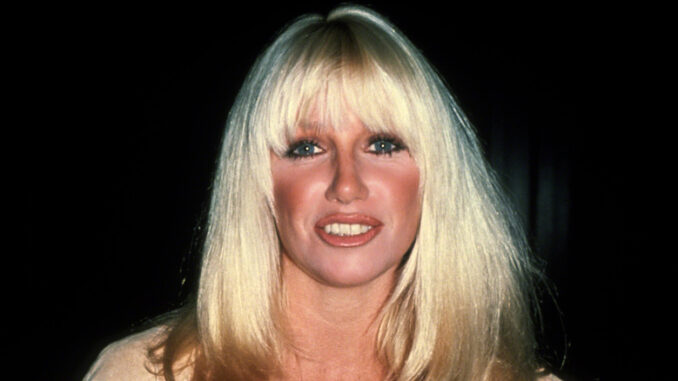
For a sitcom built on misunderstandings and laughter, Three’s Company produced an unusually serious question behind the scenes: who caused the most controversy?
The answer, even decades later, is unmistakable.
It was Suzanne Somers.
Beloved by audiences, scrutinized by executives, and endlessly debated by fans, Somers became the most scandal-linked figure in the show’s history—not because of bad behavior, but because she challenged the system that controlled television at the time.
America’s Sweetheart—Until She Asked for More
At the height of Three’s Company’s success, Suzanne Somers was everywhere. Chrissy Snow was the show’s most recognizable character, and Somers herself was becoming a marketing phenomenon.
That visibility came with confidence—and a request.
Somers asked for a salary increase that matched her popularity. What followed was not a negotiation, but a power struggle that quickly turned public. In an era when television contracts were rigid and stars were expected to comply quietly, her demand was seen as defiance.
Almost overnight, the narrative shifted. She was no longer just a sitcom star. She was “difficult.”
The Scandal That Changed the Show’s Tone
Rather than firing Somers outright, producers reduced her role. She appeared less frequently. Her scenes were filmed separately. Her character was slowly written out of the show’s emotional center.
Viewers noticed.
What made the situation scandalous wasn’t just the punishment—it was how visible it became. A hit sitcom was openly reshaping itself around an internal conflict, and the audience was watching it happen in real time.
When Somers finally left, it wasn’t just an exit. It was a rupture.
Blamed, Isolated, and Publicly Framed
In the media narrative of the time, Somers was often positioned as the problem. Reports focused on ego, greed, and ingratitude. Rarely discussed was the imbalance of power between networks and performers—especially women.
Years later, perspectives shifted. What once looked like scandal began to look like resistance. Somers wasn’t just negotiating pay; she was testing how much agency a sitcom star could have.
The backlash revealed more about the industry than about her.
A Reputation That Followed Her for Years
Unlike many TV controversies, this one didn’t fade quickly. Somers’ departure became shorthand for “career risk.” For years, it overshadowed her work, even as she continued to find success elsewhere.
That lingering reputation is what cements her as Three’s Company’s most scandal-associated figure. Not because she broke rules—but because she exposed them.
Why Suzanne Somers Still Divides Fans Today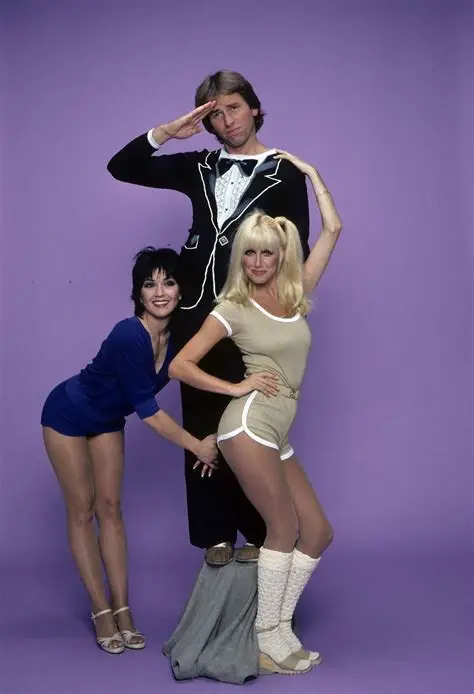
Some fans still believe her actions damaged the show. Others argue the show damaged itself by refusing to adapt. That divide is precisely why her story remains compelling.
She wasn’t a villain. She wasn’t a victim. She was a catalyst.
And catalysts are always controversial.
The Scandal That Became the Show’s Defining Moment
Three’s Company survived Suzanne Somers’ exit—but it was never quite the same. The warmth shifted. The balance changed. And the behind-the-scenes drama became inseparable from the show’s legacy.
That is why, when people talk about scandal and Three’s Company, they are really talking about one name.
Suzanne Somers.
Not just the star who left—but the star who dared to push back, and changed sitcom history in the process.