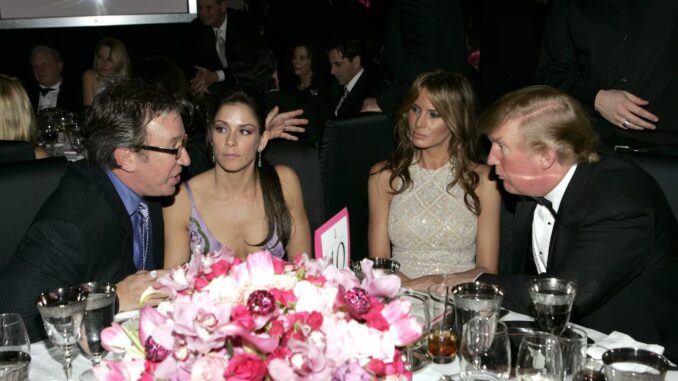
🤩 The Dinner Party That Altered the Timeline
Imagine you’re sitting at a fancy dinner table. To your left is a world-renowned comedian, and across from you is a real estate mogul who is currently the biggest reality TV star on the planet. This isn’t the setup for a joke; it was the reality for Tim Allen and Donald Trump during the final years of The Apprentice. We often think of history as a series of grand, inevitable events, but sometimes it hangs on a single conversation over steak and wine.
In a recent bombshell revelation on Bill Maher’s Club Random podcast, Tim Allen shared a story that sounds like a deleted scene from a political thriller. According to the Home Improvement star, Donald Trump was once seriously eyeing a move to Los Angeles to become a big-time movie producer. Can you picture it? “A Trump Production” flashing across the silver screen instead of the presidential seal. But he didn’t do it. Why? Because Tim Allen gave him a reality check so brutal it made the “Art of the Deal” author walk away from the table.
🏙️ Trump’s Tinseltown Dreams: More Than Just a Cameo?
Before he was “The 45th,” Trump was a fixture in New York and a frequent guest in Hollywood. He had the fame, the money, and—according to Allen—a genuine addiction to comedy and storytelling.
The Producer Itch
At this fateful dinner, Trump wasn’t talking about trade deals or border security. He was talking about studios. He wanted to know how the machine worked. He was fascinated by the idea of building a film empire. Allen recalls Trump asking specific questions about the costs of production. “If we got a studio together… let’s say a movie costs a million six or a million twenty,” Trump posited. He was looking at movies like he looked at real estate: as assets to be acquired and developed.
The Comedy Connection
It might surprise some, but Allen noted that Trump was “addicted to comedy.” During the dinner, Allen was cracking jokes, and Trump was genuinely impressed by the “gift” of being able to make people laugh. This wasn’t a man looking for a podium; it was a man looking for an audience. But as Allen quickly pointed out, the movie business is a lot less “solid” than a Manhattan skyscraper.
📉 The “Math of Misery”: Tim Allen’s Brutal Financial Warning
If you want to scare a billionaire, don’t talk about ghosts—talk about unrecoverable losses. That is exactly what Tim Allen did. He used his decades of industry experience to explain that Hollywood isn’t just about red carpets; it’s a financial meat grinder.
The Promotion Trap
When Trump suggested a budget, Allen hit him with the first “gotcha” of the night: Promotion. “You’ve got to double that at least for promotion,” Allen warned. Suddenly, a $100 million movie becomes a $200 million gamble. In the world of real estate, if you build a tower, you have a tower. In the world of movies, if you build a blockbuster and no one shows up, you have… nothing.
The “Sh—y” Movie Analogy
Allen’s most effective point was comparing a bad movie to a bad building. This is where the lightbulb really went on for Trump.
-
Real Estate: If you buy a bad building and it won’t sell, you still own the land and the structure. It has intrinsic value.
-
Hollywood: If you make a “sh—y” movie (Trump’s own words, according to Allen), you have nothing. You can’t live in it. You can’t rent it out. You just have a digital file that cost you $200 million.
🛑 The Moment the Hollywood Dream Died
According to Allen, the shift in Trump’s demeanor was instantaneous. The mogul realized that every movie is essentially a startup company with a 90% failure rate. For a man who prides himself on “winning,” the idea of “amortizing losses with losers over winners” sounded like a nightmare.
H3: A Fiscal Conservative’s Nightmare
Trump, ever the fiscal hawk in his own mind, couldn’t wrap his head around why anyone would stay in a business where you could do everything right and still lose it all because a teenager in Ohio didn’t like the trailer. Allen says Trump completely decided at that moment, “I’m not going to get in this business.”
H3: The Door to Politics Swings Open
If Hollywood was a “no-go,” where else could a man with that much ambition and need for an audience go? While Allen doesn’t explicitly say he “made” Trump run for president, the implication is clear: by closing the door on Hollywood, he left only one other arena large enough for Trump’s persona—the political stage.
🎭 Tim Allen: The “Anarchist” Conservative in a Liberal Town
Allen’s perspective on this isn’t just coming from a place of finance; it comes from his unique position as one of the few openly conservative voices in Hollywood. He’s often described the industry as a place where you have to “be careful.”
H4: The 1930s Germany Comparison
In the past, Allen famously (and controversially) compared being a conservative in Hollywood to living in 1930s Germany. While he later walked back the severity of the metaphor, the sentiment remains: Hollywood is a monoculture. Perhaps he was doing Trump a favor by keeping him out of a world that would have likely “bullied” him even more than the political establishment has.
H4: Fiscal Values Over Party Lines
Allen identifies as a “fiscal conservative” who hates taxes. This shared DNA with Trump is likely why they hit it off at that dinner. They speak the same language—the language of the “silent partner” (the government) taking a cut of your hard work. By explaining the tax “benefits” (or lack thereof) in film, Allen was speaking directly to Trump’s soul.
🎥 What Would a “Trump Studio” Have Looked Like?
It’s fun to play the “What If” game. If Allen hadn’t been there to rain on the parade, would we be watching Apprentice: The Movie today?
-
High Stakes Dramas: He likely would have gravitated toward stories of power, wealth, and “winning.”
-
Reality-Leaning Content: Given his success with Mark Burnett, he might have revolutionized the film industry with interactive, reality-style features.
-
The Branding: Every movie would have had “Gold Standard” production values, even if the scripts were, well, “sh—y.”
But as Allen pointed out, the uncertainty of the box office is the opposite of the “sure thing” Trump seeks in his ventures.
🤝 The Bill Maher Interaction: Common Ground in a Divided Time
It’s worth noting that Allen shared this story on Bill Maher’s podcast. Maher is no fan of Trump, yet he and Allen found common ground in discussing the insanity of the film business.
The Critique of Modern Hollywood
Both Allen and Maher expressed frustration with how the creative process has become hampered by bureaucracy and DEI practices. They argued that sitcoms and movies “just have to be funny.” This shared frustration suggests that if Trump had entered Hollywood, he might have ended up fighting the same “culture wars” he’s currently fighting in D.C.
🌟 The Ripple Effect of a Single Conversation
Think about the ripple effect. If Trump becomes a movie producer in 2012 or 2013:
-
Does he still run in 2016?
-
Does the political landscape of America look entirely different?
-
Does Tim Allen get a “Producer” credit on Trump’s first film?
It’s a fascinating look at how a simple explanation of ROI (Return on Investment) can change the course of a nation. Allen wasn’t trying to be a kingmaker; he was just being a “fiscal, conservative person with money” giving advice to another.
Conclusion
In the end, Tim Allen’s “Math of Misery” did more than just save Donald Trump from a potentially disastrous foray into film production; it arguably cleared the path for his political ascent. By highlighting the terrifying volatility of the movie business—where you can lose $200 million and have nothing but a “sh—y” product to show for it—Allen spoke to Trump’s deepest fears as a builder. Trump realized that in real estate, you keep the building; in politics, you keep the power; but in Hollywood, you’re only as good as your last weekend’s ticket sales. Whether you love him or hate him, we can all agree on one thing: the dinner where Tim Allen talked Trump out of Hollywood is one of the most consequential “what if” moments in modern history.
❓ 5 Unique FAQs After The Conclusion
Q1: Did Tim Allen actually tell Trump to run for President instead?
A1: No. According to Allen’s account on the Club Random podcast, he only focused on discouraging Trump from the movie business by explaining the financial risks. The decision to enter politics came later and was seemingly independent of this specific advice.
Q2: What was the specific movie budget they discussed?
A2: Trump suggested a hypothetical budget of around “a million six or a million twenty” (likely meaning $160M or $120M in today’s terms), but Allen corrected him, noting that once you factor in global promotion, the investment easily swells to over $200 million.
Q3: How does Tim Allen describe his own political stance?
A3: Allen describes himself as a “fiscal conservative and emotionally liberal.” He has often identified as a libertarian and emphasizes his dislike for taxes and government overreach rather than strict partisan loyalty.
Q4: Has Donald Trump ever confirmed this story?
A4: While Trump has frequently mentioned his love for the “showbiz” side of his career, he hasn’t publicly commented on this specific dinner conversation with Tim Allen. However, his decision to stick to real estate and media branding aligns perfectly with Allen’s “bad building” analogy.
Q5: Is Tim Allen still working with Disney despite his political views?
A5: Yes. Despite occasional backlash for his comments, Allen remains a major asset for Disney. He recently attended Disney Upfronts and is set to star in Toy Story 5 and his new sitcom Shifting Gears.