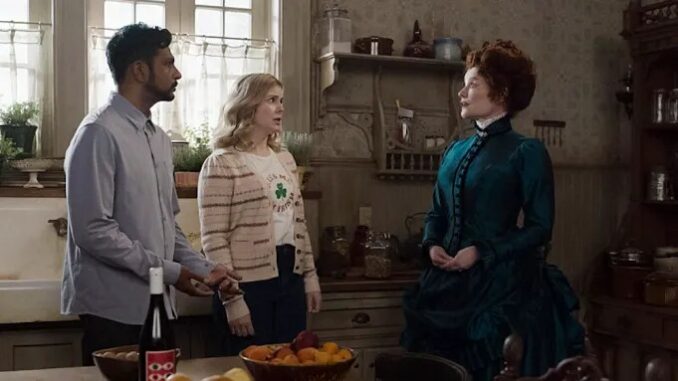
🎭 The Woman Behind the Corset: Rebecca Wisocky’s Deep Dive into Hetty
If you haven’t been watching CBS’s hit sitcom Ghosts, you’re missing out on one of the most brilliant ensemble comedies on television. But even among a cast of Vikings, hippies, and Boy Scout leaders, one character consistently steals the spotlight with a single arched eyebrow: Hetty Woodstone. Played with razor-sharp precision by the incredible Rebecca Wisocky, Hetty is the formidable matriarch of the Woodstone estate. She’s a relic of the Gilded Age, a woman defined by her status, her strict moral codes (mostly for others), and a certain… haughty disdain for anything “common.”
However, as the show progresses, we’re learning that there’s so much more to Hetty than just high-collars and a fear of “the help.” In recent interviews, Rebecca Wisocky has shed light on a fascinating psychological layer of her character. She argues that Hetty’s supernatural power—and her obsession with social power—is actually a desperate, buried need to finally feel understood. It turns out, being a powerful woman in the late 19th century wasn’t all tea parties and diamonds; it was a cage. And death hasn’t quite broken those bars.
👑 The Gilded Cage: Power as a Survival Mechanism
To understand Hetty’s power, we have to look at where she came from. The Gilded Age was a time of extreme wealth, but for women, that wealth often came with invisible handcuffs.
The Matriarch of Woodstone Mansion
Hetty wasn’t just a rich woman; she was the CEO of a household in a time when women couldn’t even vote. She managed servants, orchestrated social maneuvers, and maintained the “Woodstone” brand with an iron fist. But why? Wisocky suggests that this obsession with control was the only way Hetty could carve out a space for herself in a man’s world. If she wasn’t in power, she was invisible.
Power as Protection
Think of Hetty’s haughtiness as a suit of armor. In the 1800s, showing vulnerability was a death sentence for a woman of her standing. She had to be perfect. She had to be rigid. By wielding power over her household, she created a buffer against a world that didn’t actually value her thoughts or her soul—only her bloodline and her bank account.
🕯️ The Supernatural Connection: Hetty’s Ghostly Power
In the world of Ghosts, each spirit eventually discovers a “ghost power”—a supernatural ability that usually reflects something about their life or their death. For a long time, Hetty’s power was a mystery.
H3: The Power of Possession? No, It’s About Being Seen
While other ghosts can walk through walls or smell like fudge, Hetty’s connection to the physical world is different. When she finally discovers her ability to communicate or influence things, it’s rarely about destruction. It’s about impact. Wisocky points out that Hetty’s power manifests most strongly when she is trying to make a point or assert her relevance.
H3: The Frustration of Invisibility
Imagine spending eternity in a house you used to own, watching “living” people ignore your presence and trample on your traditions. For a woman like Hetty, this is the ultimate torture. Her power is a metaphysical “Look at me!” It’s a way to bridge the gap between her silent, spectral existence and her deep desire to influence the world she left behind.
💖 The Core Wound: The Need to Feel Understood
This is where Rebecca Wisocky’s insight gets really interesting. She explains that Hetty’s sharp tongue and demand for respect are masks for a profound sense of isolation.
The Loneliness of the “Proper” Woman
Hetty spent her entire life following rules that didn’t make her happy. She suppressed her desires, her intellect, and her emotions to fit the mold of a “lady.” Now, as a ghost, she’s surrounded by people (spirits) who are shamelessly themselves.
-
Isaac’s Flamboyance: She watches Isaac struggle with his identity, but at least he’s acknowledging it.
-
Flower’s Freedom: She’s baffled by Flower’s lack of boundaries, but secretly envious of her peace.
-
Sam’s Empathy: The fact that Samantha (Rose McIver) can actually hear and see her is the first time in over a century that Hetty has been truly “heard.”
H4: Why Being “Right” Isn’t Enough
Hetty often argues that she is right about social etiquette or class. But as Wisocky notes, Hetty doesn’t actually care about the rules anymore; she cares that someone acknowledges her perspective. When she scolds the other ghosts, she’s really saying, “My life and my sacrifices meant something. Please understand why I am the way I am.”
🤝 The Sam Factor: The Catalyst for Growth
The arrival of Samantha and Jay at the Woodstone estate changed everything for Hetty. For the first time, she has an audience that isn’t just other dead people who are tired of her stories.
A Modern Mirror
Samantha serves as a modern mirror for Hetty. Through Sam, Hetty sees what a woman can be when she isn’t restricted by a corset (both literal and metaphorical). Sam challenges Hetty’s prejudices, but more importantly, she listens to her. This interaction is the first time Hetty’s power—her voice—actually reaches someone who can change things.
H4: The Softening of the Matriarch
We’ve seen Hetty “soften” over the seasons. She’s experimented with modern concepts, bonded with unexpected allies (like the basement ghosts), and even started to question her own past. Wisocky plays these moments with a beautiful subtlety. Every time Hetty learns a new modern word or shows a flicker of empathy, it’s a step toward her feeling “understood” by the world she’s currently inhabiting.
📽️ Wisocky’s Performance: Finding Humor in the Hardness
Rebecca Wisocky is a master of physical comedy, using her posture and facial expressions to convey volumes. But it’s the moments of quiet reflection that really showcase her talent.
Using the Active Voice of Comedy
Wisocky doesn’t just play Hetty as a villain or a punchline. She makes Hetty an active participant in her own redemption. When Hetty delivers a biting insult, Wisocky ensures there’s a hint of “Is this still working?” in her eyes. She’s playing a woman who is performing a role, and as that performance breaks down, the character becomes infinitely more relatable.
The Analogy of the Antique Mirror
Think of Hetty as an antique mirror. She’s ornate, expensive, and a bit dusty. For years, she’s been reflecting a world that no longer exists. But as she interacts with the other ghosts and Sam, the dust is being wiped away. The mirror is starting to reflect the present, and in doing so, it’s finding a new kind of beauty. She’s not becoming a different mirror; she’s just finally being seen clearly.
🚀 Why Hetty’s Journey Resonates Today
You might think a Gilded Age ghost wouldn’t have much to say to a 21st-century audience, but Hetty’s struggle is universal.
The Struggle for Relevance
We all want to feel like we matter. We all want our experiences to be validated. Hetty’s ghost power is just a supernatural version of a social media post or a deep conversation with a friend. She’s fighting against the ultimate “un-follow”: death and irrelevance.
H4: Understanding the “Difficult” Woman
Wisocky’s portrayal forces us to look at “difficult” women through a different lens. Instead of dismissing Hetty as a snob, we start to ask, “What made her this way?” It’s a lesson in empathy. If we can understand a 19th-century ghost who hates the Irish and loves cocaine-infused tonics, maybe we can understand the people in our own lives who lead with their “armor” on.
Final Conclusion
Rebecca Wisocky’s portrayal of Hetty Woodstone in Ghosts is a masterclass in character development, proving that even the most rigid exterior can hide a deeply vulnerable heart. By linking Hetty’s supernatural and social power to her fundamental need to be understood, Wisocky has transformed a potential caricature into a living (well, semi-living) person with relatable fears and desires. Hetty isn’t just obsessed with power for power’s sake; she’s using it to scream into the void, hoping that someone will finally look back and say, “I see you, and I understand.” As the show continues, watching Hetty shed her Gilded Age defenses and find true connection is a journey that is as hilarious as it is deeply moving.
❓ 5 Unique FAQs After The Conclusion
Q1: What exactly is Hetty’s “Ghost Power” in the show?
A1: While many ghosts have obvious powers (like Isaac’s smell or Trevor’s touch), Hetty’s specific ability was revealed to be a “sending” power—specifically, she can send people “down” (to hell) if they deserve it, or even just influence the spiritual energy of the house when her emotions are high. However, her true “power” in the narrative is her indomitable will and social influence over the other ghosts.
Q2: How does Rebecca Wisocky’s real-life personality differ from Hetty’s?
A2: Wisocky is known to be incredibly warm, collaborative, and modern, which is a far cry from Hetty’s stiff and judgmental persona. She often speaks in interviews about the joy of playing someone so different from herself and the intense physical preparation (like the corset!) required to “become” Hetty.
Q3: Does Hetty ever actually find romance in the afterlife?
A3: Yes! In a surprising and hilarious twist, Hetty develops a complex “situationship” with Trevor, the 90s “finance bro” ghost who died without pants. Their relationship is a fascinating clash of eras and values, providing many of the show’s funniest and most unexpectedly tender moments.
Q4: Why is Hetty so obsessed with her husband Elias, even though he was terrible?
A4: Hetty’s obsession with Elias wasn’t necessarily born of love, but of status and propriety. In her time, a woman’s worth was tied to her husband. Even though Elias was a philanderer and a criminal, he was her husband and the father of her children. Her journey as a ghost involves unlearning the idea that his actions defined her value.
Q5: Will we ever see flashbacks to Hetty’s life before she died?
A5: The show frequently uses flashbacks to explore the “backstories” of the ghosts. We have seen several glimpses into Hetty’s life, including her marriage to Elias and her role as a mother. These scenes are crucial for providing context for her behavior and helping the audience (and the other characters) understand her better.