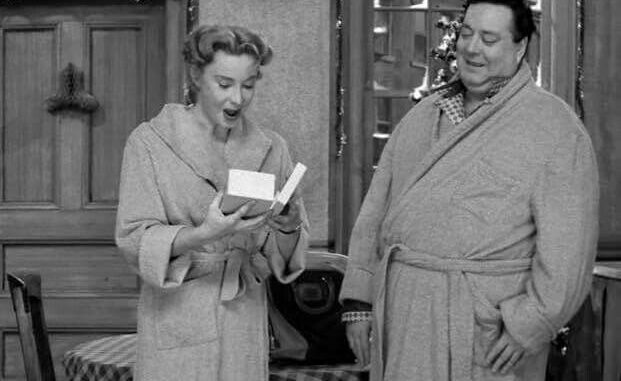
When audiences first tuned into The Honeymooners in 1955, they expected laughter. What they got—at least in the first episode—was something far more complicated.
Behind the punchlines and studio audience applause lies a surprisingly raw portrait of a marriage strained by ego, insecurity, and economic pressure. The debut episode doesn’t just introduce characters. It quietly sets the stage for one of television’s most uncomfortable yet fascinating depictions of domestic life.
A Marriage Built on Frustration
From the opening moments, we meet Jackie Gleason as Ralph Kramden—a loud, frustrated bus driver with big dreams and a fragile sense of pride. Opposite him is Audrey Meadows as Alice Kramden, sharp-witted, patient, but visibly worn down.
Ralph’s bluster isn’t just comedic exaggeration. It’s rooted in insecurity. He feels trapped by his job, embarrassed by his financial situation, and desperate to prove himself. That desperation often turns into verbal aggression—directed squarely at Alice.
And that’s where the laughter becomes uneasy.
Comedy That Walks a Dangerous Line
The show’s most famous catchphrase—Ralph’s exaggerated threats delivered in anger—was intended as slapstick hyperbole. In the cultural context of the 1950s, audiences interpreted it as over-the-top humor. But viewed today, it feels unsettling.
The first episode reveals a marriage fueled by:
-
Constant power struggles
-
Financial stress
-
Emotional manipulation
-
Cycles of apology and reconciliation
Ralph explodes. Alice fires back with biting sarcasm. The audience laughs. But if you strip away the laugh track, what remains is a relationship marked by imbalance and volatility.
Alice: The Quiet Strength
What keeps the episode from becoming unbearable is Alice.
She is not submissive. She does not crumble. Instead, she counters Ralph’s temper with intelligence and emotional control. In many ways, Alice represents early television’s first quietly feminist wife—long before that term was mainstream.
She sees through Ralph’s schemes. She calls out his immaturity. And crucially, she refuses to let his anger define her.
Without Alice’s resilience, The Honeymooners might have crossed from edgy comedy into outright tragedy.
The 1950s Reality Check
To understand the discomfort modern viewers feel, we have to consider post-war America. The 1950s emphasized:
-
Traditional gender roles
-
Male breadwinner pressure
-
Domestic containment
-
Suppressed emotional vulnerability
Ralph embodies the era’s wounded masculinity—ambitious but economically stuck. His anger isn’t random; it reflects a broader cultural anxiety.
The show didn’t invent toxic dynamics. It mirrored them.
Why the First Episode Still Matters
More than 70 years later, that first episode remains fascinating precisely because it is imperfect. It doesn’t present a fairy-tale marriage. It shows two flawed people navigating poverty, pride, and disappointment.
Yes, it’s funny.
But it’s also uncomfortable.
And maybe that discomfort is why The Honeymooners endures. It exposed something real: love doesn’t eliminate conflict. It complicates it.
Final Thought
Calling the first episode a “deeply disturbing drama” may sound dramatic—but beneath the laughter lies a sharp portrait of a toxic dynamic softened by humor and redemption.
The genius of The Honeymooners isn’t that it hides the darkness.
It’s that it lets us laugh at it—while quietly acknowledging it was always there.