For nearly five decades, Star Wars has been more than a film franchise. It has been mythology. A generational ritual. A cultural force that shaped how we understand heroes, villains, destiny, and hope.
But now, a question once unthinkable is being whispered louder across fandom forums and convention halls:
Is the Star Wars saga approaching its twilight?
With shifting film strategies, streaming turbulence, and passionate divisions within the fanbase, the galaxy far, far away appears to be standing at its most pivotal crossroads since the fall of the Empire.
Let’s examine what is really happening behind the hyperspace jump.
A Franchise at a Turning Point
When Lucasfilm was acquired by The Walt Disney Company in 2012, the promise was expansion. New trilogies. Anthology films. Streaming series. A cinematic universe designed to rival the dominance of the Marvel Cinematic Universe.
For a time, that promise seemed unstoppable.
The sequel trilogy—The Force Awakens, The Last Jedi, and The Rise of Skywalker—generated massive box office returns. Yet creatively, it fractured the fandom in ways the franchise had rarely experienced before.
Since 2019, no new Star Wars theatrical film has reached cinemas. Announced projects have been delayed, reshuffled, or quietly shelved. Directors have entered and exited development. Release calendars have shifted.
The momentum that once felt invincible now feels… cautious.
The Rey Question: A Risk or a Revival?
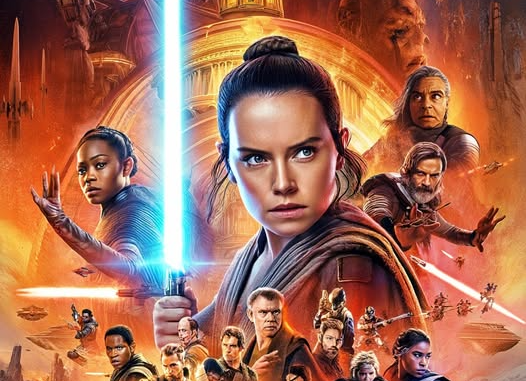
One of the most discussed developments centers on the return of Rey, portrayed by Daisy Ridley.
A new film set after The Rise of Skywalker promises to explore Rey rebuilding the Jedi Order. For some fans, this is a bold continuation of the Skywalker legacy. For others, it reopens unresolved debates surrounding the sequel trilogy’s creative direction.
Ridley’s return has reignited passionate discourse:
Is this a course correction?
A redemption arc for the sequels?
Or proof that the franchise cannot escape its most controversial era?
Few announcements in recent years have generated this level of scrutiny.
Streaming Success vs. Cinematic Uncertainty
While theatrical projects stall, streaming has become the franchise’s strongest engine.
The Mandalorian transformed the cultural conversation upon its debut. The introduction of Grogu became a global phenomenon, and Pedro Pascal emerged as one of the defining faces of modern Star Wars.
Then came Andor, praised for its mature storytelling and political nuance. Critics hailed it as some of the strongest writing the franchise has ever delivered.
Yet not every series received universal acclaim. The Book of Boba Fett and Obi-Wan Kenobi divided audiences, sparking conversations about overproduction and franchise fatigue.
The shift toward streaming has kept the galaxy alive—but has it diluted its mystique?
The Kathleen Kennedy Debate
At the center of much online discourse stands Kathleen Kennedy, president of Lucasfilm.
Supporters credit her with expanding representation, diversifying storytelling, and launching successful series. Critics argue that inconsistent long-term planning weakened the sequel trilogy’s cohesion.
Leadership transitions are frequently rumored. Each new film announcement is examined through the lens of creative stability.
In truth, few executives have overseen a franchise under such relentless scrutiny.
Fandom: United by Passion, Divided by Vision
Star Wars has always inspired debate. Even the prequel trilogy faced intense backlash before experiencing a generational renaissance.
Today’s discourse feels amplified by social media. Every casting decision trends. Every trailer is frame-by-frame analyzed. Every rumor becomes a headline.
Some long-time fans express exhaustion, claiming the saga has lost its mythic simplicity. Others argue that experimentation is necessary for survival.
Is this fragmentation a sign of decline—or simply the evolution of a living mythology?
The Box Office Shadow
Perhaps the most striking shift is the absence of theatrical presence.
After The Rise of Skywalker concluded the Skywalker saga in 2019, the cinematic silence has been conspicuous. Multiple announced films—from directors attached and later detached—have created an atmosphere of instability.
In blockbuster culture, visibility matters. Franchises thrive on spectacle. The longer Star Wars remains absent from theaters, the louder the speculation grows.
Has the franchise lost confidence in its big-screen dominance?
Or is it carefully rebuilding for a strategic return?
Legacy vs. Reinvention
Few franchises carry the cultural weight of Star Wars, created by George Lucas.
The original trilogy reshaped cinema. The prequels expanded its mythology. The sequels attempted generational transition.
Now the central question becomes philosophical:
Should Star Wars preserve nostalgia?
Or risk radical reinvention?
Recent projects like Andor suggest there is appetite for grounded, politically layered storytelling. Meanwhile, nostalgia-driven returns of legacy characters continue to draw massive engagement.
The franchise appears caught between honoring its past and escaping it.
Is This the End—or a Strategic Reset?
Declaring the “end” of Star Wars would be premature. The brand remains globally powerful. Merchandise sales endure. Conventions remain packed. Streaming viewership continues.
But the aura of inevitability—the sense that every new installment would dominate without question—has undeniably shifted.
What we may be witnessing is not a collapse, but recalibration.
A pause before the next era.
The Emotional Weight of an Era
For generations, Star Wars has symbolized hope, rebellion, family, and redemption.
If the franchise is indeed transforming, it carries enormous emotional stakes. Fans are not merely debating movies. They are defending memories.
The end of an era feels personal when that era helped define childhood.
So… Is the Galaxy Fading?
Here is the truth: Star Wars is not ending.
But it is evolving under pressure.
Between Rey’s controversial return, streaming experimentation, theatrical uncertainty, and ongoing leadership debates, the franchise stands at a defining inflection point.
Whether this moment becomes a renaissance or a retreat depends on creative clarity, narrative courage, and the willingness to listen without surrendering vision.
One thing remains certain:
The Force is still powerful.
The question is who will shape it next—and whether the galaxy is preparing for its final sunset or its boldest dawn yet.