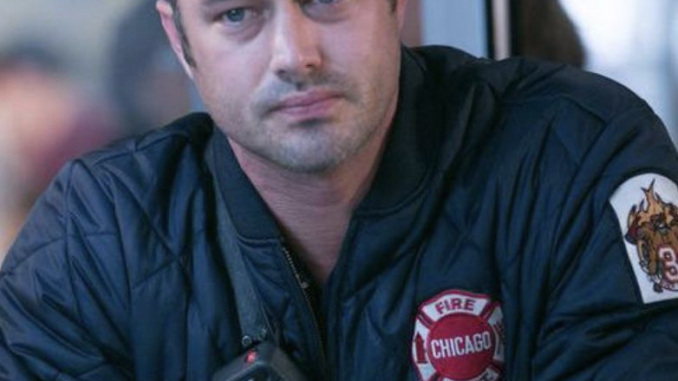
In the early, soot-stained days of Chicago Fire, Kelly Severide was more than just a lieutenant; he was a force of nature, a reckless, motorcycle-riding adrenaline junkie who treated the line between life and death like a suggestion rather than a boundary. He was the man who would dive into a literal inferno without a second thought, the playboy who broke hearts as easily as he broke down doors, and the rogue whose “edge” was the very fuel that kept Firehouse 51 burning bright. He was the dark, brooding contrast to Matthew Casey’s Boy Scout morality, a character defined by his scars—both the physical ones on his neck and the emotional ones in his soul. But as we navigate the latest seasons of the “One Chicago” saga, a quiet, unsettling question has begun to echo through the fandom: where did that Kelly Severide go? There is a growing, palpable fear among the “One Chicago” faithful that the “Puppet Masters” at Wolf Entertainment are systematically sanding down the sharp corners of their most iconic hero, trading his dangerous unpredictability for a domesticated stability that, while wholesome, feels increasingly like a slow-motion erasure of the man we first fell in love with. The “Edge” that once made every scene with Taylor Kinney feel like a ticking time bomb is being replaced by a polished, softened version of the character—a “Safe Severide” who seems more concerned with arson paperwork and domestic bliss than with the raw, chaotic heroism that defined the show’s golden era.
The primary culprit in this perceived “neutering” of Kelly Severide is the show’s transition into what fans call the “Stellaride Era,” where the character’s identity has become almost entirely subsumed by his relationship with Stella Kidd. While growth and maturity are theoretically positive for any long-running character, the “Puppet Masters” have chosen a path of domesticity that seems to have stripped Severide of his bite. We once saw a man who struggled with addiction, who defied authority with a sneer, and who lived for the high of the “Squad” life; now, we see a man who often plays the role of the supportive, quiet husband, nodding in the background while Stella takes center stage. This isn’t an indictment of the relationship itself, but rather an observation of how the writers have used it as a “pacifier” for Severide’s more volatile instincts. By giving him a “Happily Ever After,” the writers have inadvertently removed the conflict that made him compelling. A Severide who is settled is a Severide who is no longer dangerous, and in a show built on the foundation of high-stakes drama, a hero without danger is a hero in decline. The fans are noticing that the “edge” wasn’t just a personality trait; it was the narrative engine that drove his most memorable arcs, and without it, he risks becoming a legacy character—a statue of his former self that occasionally gives advice but rarely breaks the rules.

Furthermore, the pivot toward Severide as an “Arson Specialist” rather than a “Rescue Rogue” has fundamentally altered the character’s physical and emotional frequency. The “Puppet Masters” have increasingly moved him out of the firehouse and into the sterile, investigative world of OFI (Office of Fire Investigation), a move that feels like a strategic effort to keep Taylor Kinney’s character relevant without having to put him in the path of the “big” action. While his “savant-like” ability to read fire is a fascinating trait, it lacks the visceral, heart-pounding energy of the Squad 3 rescues that made the show’s first five seasons legendary. The fans know why this is happening—it’s easier to write a mystery procedural than a high-octane rescue mission—but the cost is the “edge” that defined the character. When Severide is hunched over a pile of charred debris theorizing about accelerants, he is a detective; when he was rappelling down the side of a skyscraper in a storm, he was a god. By shifting his focus from the “now” of the rescue to the “after” of the investigation, the writers have effectively put the character into a narrative retirement home, where the stakes are intellectual rather than existential. The “danger” is now a puzzle to be solved rather than a life to be saved, and for a character built on instinct and adrenaline, this feels like a betrayal of his core DNA.
Ultimately, the question of whether Chicago Fire is erasing Severide’s edge comes down to a fundamental clash between character longevity and creative risk. The “Puppet Masters” are playing it safe, protecting their most valuable asset by wrapping him in the cotton wool of domestic stability and professional specialization. They are terrified that if they let Severide be the “bad boy” again—if they let him fail, or be reckless, or push Stella away in a moment of self-destruction—the audience will turn on him. But they fail to realize that the audience’s devotion to Severide was born from his flaws, not his perfections. We loved him because he was a mess who managed to be a hero; we loved him because he was the one person in 51 who didn’t care about the consequences. By removing those consequences and smoothing out those flaws, the showrunners are creating a version of Kelly Severide that is easier to manage but much harder to be excited about. The fans aren’t asking for him to be a villain; they are asking for the return of the man who lived on the knife’s edge, the man who made the Windy City feel like it was actually on fire. If the “One Chicago” gods don’t find a way to bring back the bite, they might find that their strongest character has become a ghost, haunting a firehouse that no longer remembers how dangerous he used to be. The fire is still there, but the man who knew how to dance in it seems to have been replaced by someone who’s just trying not to get burned.