👻 Welcome to Woodstone: A Happy, Hilarious Prison
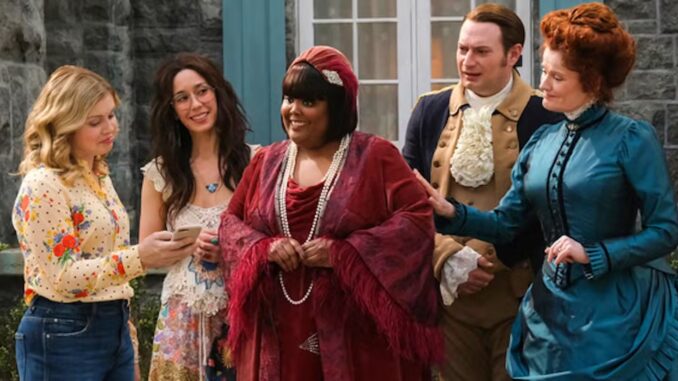
We adore Woodstone Mansion. It’s not just a beautiful, crumbling old estate; it’s the hilarious, charming, and eternally cozy setting for CBS’s hit comedy, Ghosts. We tune in every week to watch Sam (Rose McIver) and Jay (Utkarsh Ambudkar) navigate their chaotic life with a house full of spectral roommates—a diverse, quirky, and historically vibrant bunch, from the buttoned-up Isaac to the perpetually trousers-less Trevor. The show’s magic lies in its ability to blend absurdity with genuine, heartwarming camaraderie.
But let’s pull back the curtain on the laughter for a moment. Haven’t you ever noticed the subtle, creepy undertones? The way these ghosts, stuck together for centuries, treat each other and the living?
Season 5 of Ghosts, in particular, didn’t shy away from exposing the dark side of the Woodstone mansion dynamic. While the show maintains its signature light touch, the prolonged, inescapable closeness of the ghosts has led to some profoundly unhealthy, manipulative, and even psychologically unsettling behaviors. It makes you realize that Woodstone isn’t just a home; it’s a gilded, hilarious prison, and its inhabitants are suffering from a chronic case of eternal codependency. We are exploring the moments in the show’s progression that force us to look beyond the jokes and acknowledge the hidden toxicity that simmers beneath the surface.
💔 The Inescapable Prison: The Erosion of Personal Autonomy
The fundamental problem at Woodstone is permanence. These individuals cannot leave, cannot choose their neighbors, and cannot escape conflict. This eternal confinement has led to a profound erosion of personal autonomy.
The Tyranny of the Majority
Think about the simple act of choosing a television show, or even decorating. While the show frames these conflicts as lighthearted “roommate squabbles,” they actually reflect a much darker reality: the majority can always silence the minority.
-
No Privacy, No Retreat: Unlike the living, the ghosts have virtually no ability to retreat. They are always visible, always audible, and always available to each other. This total lack of privacy fosters resentment and over-familiarity.
-
The Eternal Vote: If the group decides against a single ghost, that decision is final, forever. Imagine Trevor being permanently barred from watching his favorite game or Thorfinn being constantly ignored. There is no appeal, no new environment to seek, and no new friends to turn to. They are stuck with their oppressors for eternity.
H3: The Weaponization of Knowledge
Because they have spent centuries together, the ghosts possess total knowledge of each other’s deepest insecurities, embarrassing stories, and worst fears. They often weaponize this knowledge in arguments. It’s funny when Trevor threatens to reveal something about Isaac, but it’s fundamentally toxic. This is not playful teasing; it’s the calculated deployment of secrets garnered over centuries of unwilling intimacy.
👑 The Caste System: Woodstone’s Undemocratic Hierarchy
Despite the show’s lighthearted presentation, Woodstone operates under a clear, undemocratic hierarchy—a spectral caste system that marginalizes the newer and less powerful ghosts.
The Power of Longevity vs. Newness
The ghosts who died first—like Sasappis, Thorfinn, and Pete—often assert a subtle, sometimes cruel, seniority over the newer arrivals like Trevor and Alberta.
-
Claiming Space: Older ghosts feel entitled to the best spots, the most attention from Sam, and the central role in storytelling, often dismissing the anxieties and preferences of the newer ghosts.
-
The Basement Ghosts: The clearest example of this hierarchy is the treatment of the Basement Ghosts. They are actively marginalized and physically excluded from the main action of the house. While the show presents this as an amusing quirk of the house’s geography, it’s actually a profound act of social and physical exclusion perpetrated by the main cast. They actively maintain a barrier against those they deem “less desirable.”
H4: Alberta and Isaac: The Historical Power Struggle
Even among the main group, the dynamics are fraught with historical power imbalances. The ongoing, unresolved tension between Alberta and Isaac regarding their respective deaths and historical legacies is a prime example. While we laugh at Isaac’s pomposity, his relentless, centuries-long need to dominate the narrative and diminish Alberta’s cultural impact is deeply selfish and rooted in toxic historical competition. The show uses this tension for humor, but it exposes the ghosts’ inability to resolve conflicts permanently.
Manipulative Attachment: The Sam and Jay Dynamic
The relationship between the ghosts and the living owners, Sam and Jay, is the show’s comedic core, but Season 5 began to show the darker implications of this attachment.
The Dependency Trap
The ghosts view Sam not as a friend, but as their sole lifeline to the living world and their only means of influence. This creates a deeply unhealthy codependency.
-
Emotional Blackmail: When Sam wants to spend time with Jay, or pursue her own career, the ghosts often resort to emotional blackmail or petty sabotage to regain her attention. They are terrified of losing their connection to her, and that fear manifests as control.
-
Jay’s Marginalization: The ghosts frequently and intentionally marginalize Jay because he can’t see them. While funny, this is a coordinated effort to undermine his position in his own home and assert their dominance over Sam’s attention. They treat Jay as an inconvenience, a barrier to their needs, rather than the co-owner of the property. This constant undermining is an emotionally manipulative form of power play.
H3: The Fear of Being Forgotten
The underlying motivation for the ghosts’ neediness is the fear of being forgotten. They are utterly dependent on Sam’s ability to see them to maintain their relevance in the world. This makes their manipulation of her not just mean, but an act of spectral self-preservation. It’s the psychological horror of knowing you are invisible without the consent of one person.
💀 The Psychological Toll of Eternal Stasis
Perhaps the most unsettling element exposed in Season 5 is the psychological toll that eternal, unchanging stasis takes on the human psyche.
Stunted Emotional Growth
These characters died at various stages of their emotional development—from a teenager in Sasappis to a 1920s jazz singer in Alberta. For centuries, their emotional evolution has been stunted.
-
Repetitive Trauma: They are forced to relive their traumas, mistakes, and final moments every day. Trevor’s eternal trousers-less shame or Pete’s never-ending arrow-in-the-neck joke stops being funny when you consider the mental anguish of that perpetual loop.
-
Inability to Evolve: Characters like Isaac and Trevor struggle immensely with social progress and changing moral codes, not because they are inherently bad, but because they are trapped in time. This inability to change creates friction with Sam and Jay, and it demonstrates the deep, psychological difficulty of being a historical artifact forced into a modern world.
The Analogy of the Family Attic
Think of the Woodstone dynamic as being permanently sealed in your family’s dusty, overcrowded attic with all your most annoying, dysfunctional relatives. You cannot leave, the temperature is always uncomfortable, and everyone keeps rehashing the same three arguments from 1985. The jokes in Ghosts are built on this inherent, subtle horror.
🤝 Conclusion: Loving the Dysfunction
Ghosts Season 5 didn’t intentionally turn Woodstone into a horror show, but by diving deeper into the characters’ complexities and histories, it exposed the profound dysfunction that underlies the comedy. The dynamic is a brilliant, unsettling reflection of extreme codependency, systemic hierarchy, and the psychological burden of immortality.
We still love the ghosts, but our affection is now tempered by the understanding that we are watching a group of deeply troubled, mutually dependent, and often manipulative individuals navigate a forever sentence. The show remains hilarious, but now, every time Trevor makes a passive-aggressive comment or Isaac demands attention, we know the darkness of their eternal, inescapable prison is showing.
❓ 5 Unique FAQs After The Conclusion
Q1: Which major Ghosts storyline most clearly exposed the ghosts’ manipulation of Sam in Season 5?
A1: Storylines where Sam began to prioritize her writing career or her time with Jay over the ghosts’ direct requests, leading the ghosts to feel neglected and subtly sabotage her efforts or cause dramatic chaos to regain her full attention, most clearly exposed their manipulation.
Q2: Does the show ever directly address the emotional cruelty of the “Basement Ghosts” dynamic?
A2: The show addresses the exclusion of the Basement Ghosts primarily for comedic effect, treating it as an amusing hierarchy. While individual ghosts occasionally feel brief guilt, the systemic exclusion remains intact, demonstrating the main group’s sustained lack of empathy for their “lesser” spectral peers.
Q3: Which ghost character is chronologically the oldest in the Woodstone Mansion?
A3: Thorfinn, the Viking, is the chronologically oldest ghost, having died around 1000 AD. His long tenure gives him an informal, seniority-based authority over the newer ghosts, reinforcing the hierarchy.
Q4: How does the US version of Ghosts handle the psychological trauma of the ghosts differently than the UK original?
A4: Both versions explore the trauma, but the US version generally uses the ghosts’ pasts for more direct, relational comedy and heartwarming moments, often finding redemption. The UK original tends to maintain a slightly more melancholic, absurdist tone, often lingering on the ghosts’ sheer, existential boredom and the inescapable weight of their failed lives.
Q5: Has Jay’s inability to see the ghosts created any explicit safety risks for him in recent seasons?
A5: Yes. Jay’s inability to see the ghosts is a frequent source of danger, leading to him tripping over them, mistakenly talking to himself in public, or having to blindly navigate a room where a ghost might be having a dramatic reaction. This constant, invisible danger reinforces his marginalization and vulnerability in his own home.