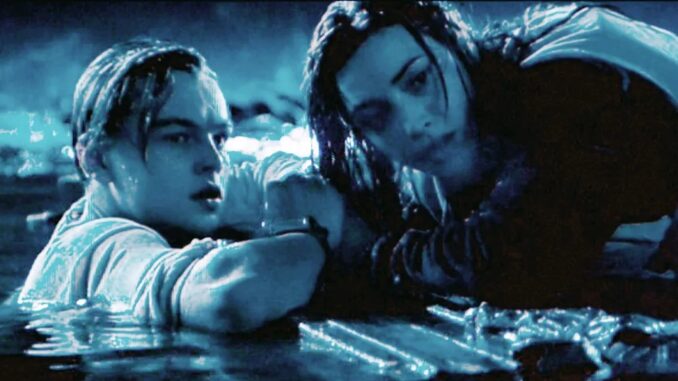
🚢 The Eternal Debate: Could Jack Have Fit?
If you grew up in the late 90s, you’ve probably spent a significant portion of your life yelling at a screen. We all know the scene: Rose is lying on a floating piece of debris (often called the “door”), and Jack is shivering in the North Atlantic until he eventually slips into the abyss. For nearly three decades, fans have accused Rose of being a “space hog” and Jack of being… well, a bit too polite.
But here’s the kicker: James Cameron, the man who lived and breathed the Titanic for years, didn’t just guess. He recently shared some intense, science-backed survival strategies that move past the “door” debate and into the realm of cold, hard physics. If you were on that ship in 1912, what would actually have kept you alive? Let’s dive into the icy waters of Cameron’s logic.
🧪 The “Forensic” Study: Why the Door Was a Death Trap
To put the rumors to rest, Cameron didn’t just look at movie stills. He commissioned a scientific study using stunt people with the same body mass as Leonardo DiCaprio and Kate Winslet. He even used internal thermometers to measure how quickly their organs would shut down.
The Buoyancy Nightmare
The first thing the study proved? It wasn’t about the size of the door; it was about the buoyancy.
-
Weight vs. Water: When both stunt people got on the door, it submerged. In 28-degree water, even being partially submerged is a death sentence.
-
The Mythbusters Trap: Sure, the Mythbusters suggested tying a life jacket to the bottom of the board. But as Cameron points out, try doing that while your motor skills are failing and you’re suffering from Stage 2 hypothermia. You’d drown trying to save yourself.
The “Plank” Strategy
Interestingly, the study did find one scenario where Jack could have survived on the wood. If he and Rose had both positioned their upper bodies (their vital organs) out of the water in a “plank” position, he might have lasted a few hours. But there’s a catch: they would have to be world-class athletes who weren’t already exhausted from running through a sinking ship for two hours!
🚤 The “Jump and Swim” Strategy: Cameron’s 2026 Survival Hack
In a surprising 2026 update, Cameron revealed what he thinks is the single most effective way to survive if you weren’t lucky enough to get a seat in a lifeboat. Forget the debris; it’s all about the timing of your jump.
H3: The Courage to Leap
Cameron explains that most people died because they stayed on the ship until the very end. The “death grip” on the railing felt safer than the water. But the secret to survival was actually jumping near a lifeboat as it cast off.
H4: The Social Pressure Factor
Why jump next to a boat? Because of human nature. If you’re floating in the dark a mile away, no one sees you. But if you jump in right next to a lifeboat as it hits the water, the people already inside—and the hundreds of people still watching from the ship’s rails—create a moral obligation.
-
Guilt-Tripping Your Way to Safety: “Are they going to let you drown when everyone is watching?” Cameron asks. “No, they’d pull you in.”
-
The “Boat Four” Trick: Cameron specifically mentions Boat Four as a prime target for this “bold move.”
❄️ Understanding the Cold: The Real Enemy
We often think of drowning as the main threat, but on the Titanic, the water was 28 degrees Fahrenheit (about -2 degrees Celsius). That’s below the freezing point of fresh water.
H3: Cold Shock vs. Hypothermia
Most people don’t realize that the cold kills you in two phases.
-
Cold Shock: The second you hit the water, you gasp. If your head is under, you inhale water and drown instantly.
-
Hypothermia: This takes 15 to 30 minutes. Your blood retreats from your limbs to protect your heart and brain, making your hands useless “claws.”
H4: Why Jack’s Hands Failed
This is why Jack couldn’t just “try again” to get on the door. By the time the ship was fully gone, his motor control was likely shot. He couldn’t grip the wood even if he wanted to.
🧠 The Psychological Barrier to Survival
Survival isn’t just about muscles; it’s about the brain. Cameron notes that “most people wouldn’t have had the courage to jump.” We tend to stay with the “big thing” (the ship) because it feels permanent, even when it’s clearly sinking.
🎨 Artistic Necessity vs. Physical Reality
At the end of the day, Cameron is a storyteller. He’s been very open about the fact that even if Jack could have survived, he had to die.
The Romeo and Juliet Parallel
“It’s a movie about love, sacrifice, and mortality,” Cameron explains. If Jack survives, the sacrifice is gone. The story loses its “novelistic” quality. Jack’s death serves as the ultimate proof of his love for Rose—it is the measurement of his devotion.
H3: Would Cameron Change the Ending?
When asked if he regrets the “door” prop being so large, he jokingly said he would have made it smaller if he knew he’d be answering questions about it for 30 years. But he stands by the physics: under those specific, chaotic conditions, Jack’s fate was sealed by the script and the sea.
🛠️ Tips for Surviving a Modern Maritime Disaster
While we aren’t likely to hit an iceberg on a luxury liner today, Cameron’s insights offer some timeless survival wisdom:
-
Don’t Wait for Permission: If the ship is going down, don’t wait for a formal invitation to a lifeboat.
-
Stay Dry as Long as Possible: Every second out of the water is a second added to your life.
-
Identify the “Helpers”: Jump near groups or boats where people are already looking.
Conclusion
James Cameron’s deep dive into Titanic survival shows us that while Jack Dawson’s death was a heartbreak for millions, it was also a calculated narrative and scientific choice. Whether it’s the lack of buoyancy in a piece of oak or the psychological hesitation to jump into freezing water, survival in the North Atlantic was a game of slim margins. The “door” might have looked big enough for two, but the cold and the laws of physics had other plans. In the end, Jack didn’t die because there wasn’t room; he died because the story—and the sea—demanded a sacrifice.
❓ 5 Unique FAQs After The Conclusion
Q1: Did James Cameron really use thermometers inside stunt people for the study?
A1: Yes! To get accurate data on core body temperature for the National Geographic special “Titanic: 25 Years Later,” stunt doubles had sensors placed internally to monitor exactly how fast hypothermia would set in.
Q2: Why didn’t Jack just take turns with Rose on the door?
A2: Cameron explains that by the time they reached the “taking turns” phase, they would have both been too exhausted. Swapping positions in 28-degree water requires immense energy and would have likely flipped the board, plunging both of them back into the deep.
Q3: Is the “door” in the movie a real piece of Titanic debris?
A3: The prop was based on a real piece of wreckage found after the sinking—a piece of a door frame from the first-class lounge. You can actually see the original wood at the Maritime Museum of the Atlantic in Halifax!
Q4: What is the “Boat Four” strategy Cameron mentioned?
A4: Boat Four was a lifeboat that remained near the ship’s side for a long time. Cameron suggests that jumping near such a boat while it was being lowered or just after it cast off would be the best chance for a “non-ticketed” passenger to be pulled aboard.
Q5: Has Leonardo DiCaprio ever commented on the door debate?
A5: Interestingly, Leo has famously maintained a “no comment” stance for decades. Whenever he’s asked, he usually just laughs and says he’ll leave it to the scientists and the director!