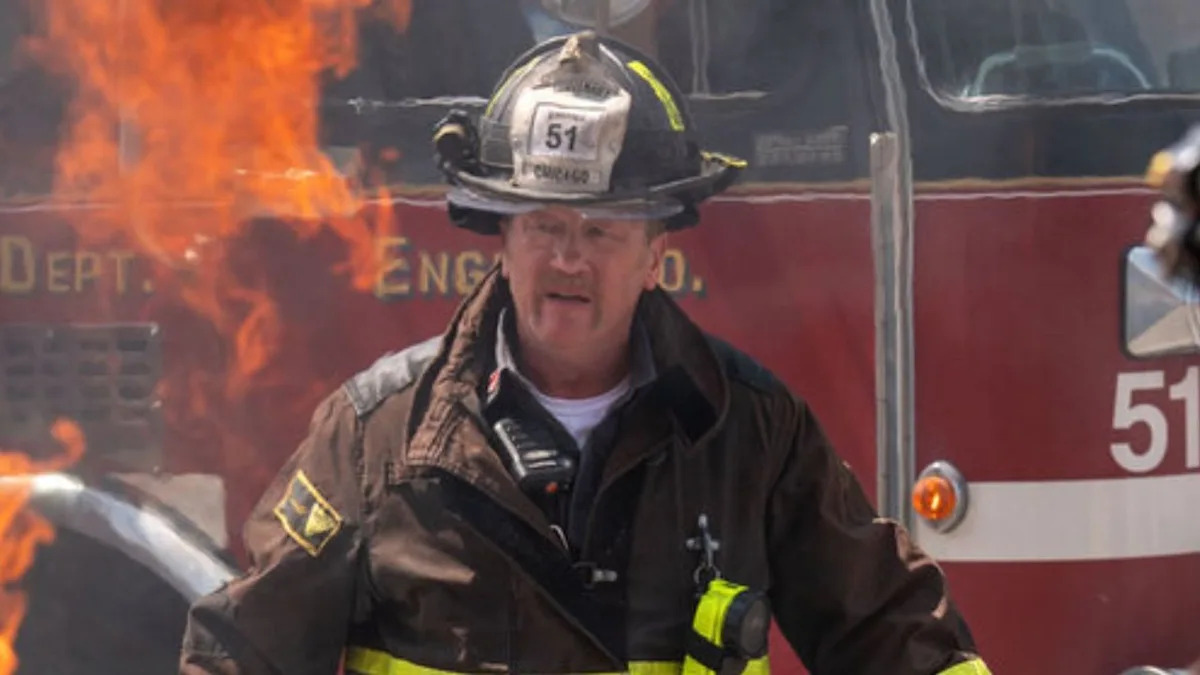
The firehouse at 51 has always been more than just a setting for heroic rescues and dramatic cliffhangers; it is a character in its own right, built on the shoulders of the men and women who wear the uniform. For over twelve seasons, one of the most immovable pillars of that foundation has been Randall “Mouch” McHolland, portrayed with soulful, deadpan brilliance by Christian Stolte. However, as the latest chapter of Chicago Fire unfolds, a heavy cloud of uncertainty has settled over the locker rooms and the common table. Rumors and narrative shifts have led fans to a sobering realization: Christian Stolte’s future on the show is in serious doubt, and for the first time in over a decade, Station 51 feels fundamentally different.
The anxiety surrounding Mouch’s tenure began as a slow burn but has recently ignited into a full-blown concern for the “One Chicago” faithful. Mouch has long represented the “old guard”—the seasoned, union-defending, couch-loving heart of Truck 81. He is the bridge to the department’s history, providing a sense of continuity that is increasingly rare in a television landscape defined by high cast turnover. When a veteran of his stature faces a storyline that hints at retirement, injury, or a career change, it isn’t just a plot point; it’s a seismic shift in the show’s DNA. Stolte has played Mouch not as a superhero, but as a deeply human man grappling with the physical and mental toll of a grueling profession, making the current uncertainty feel painfully realistic.
In recent episodes, the writing has leaned heavily into themes of legacy and the passage of time. We have seen Mouch mentor younger firefighters like Ritter with a renewed intensity, almost as if he is passing a torch that he knows he cannot hold forever. There is a specific kind of quietude in Stolte’s performance lately—a reflective quality that suggests a character looking toward the horizon rather than just the next alarm. This shift has not gone unnoticed by the audience. The camaraderie at Station 51, usually defined by boisterous humor and shared meals, now carries an underlying tone of melancholy. The seat at the head of the “Mouch couch” feels less permanent, and the silence between lines of dialogue seems to weigh heavier than in seasons past.
The doubt surrounding Stolte’s future also stems from the broader evolution of the NBC hit. Chicago Fire has entered a transitional phase where several original cast members have stepped away or seen their roles reduced. While the show has successfully introduced new blood, Mouch’s potential departure feels like the loss of the firehouse’s institutional memory. He is the person everyone turns to for advice on union bylaws, the intricacies of the department’s politics, or simply a dose of cynical yet comforting wisdom. Without him, the dynamic between the remaining veterans like Herrmann and Boden would lose its vital counterweight. The “old married couple” energy between Mouch and Herrmann, in particular, has been a source of emotional stability for viewers; losing that partnership would leave a void that no new recruit could ever truly fill.
Furthermore, Mouch’s personal life—specifically his marriage to Chicago P.D.’s Trudy Platt—has served as one of the most beloved cross-show anchors in the franchise. His departure wouldn’t just affect the firehouse; it would ripple through the entire “One Chicago” ecosystem. If Mouch were to leave the line of duty, the domestic scenes that humanize these high-intensity characters would lose one of their most grounded couples. Christian Stolte’s ability to balance Mouch’s grumpy exterior with a fierce, protective love for his friends and family has made him an irreplaceable asset. The fans’ reaction to the possibility of his exit is a testament to the quiet power of a character who didn’t always need the loudest lines to make the biggest impact.
As the production continues, the official word remains ambiguous, keeping the audience in a state of suspense that mirrors the life-and-death stakes of the show itself. Whether it is a creative choice to keep the narrative fresh or a personal decision by the actor to explore new chapters, the result is the same: a palpable sense of unease within the fandom. Station 51 is a place of brotherhood, but that brotherhood is currently facing its toughest test yet—the prospect of saying goodbye to one of its founding members.
The legacy of Randall McHolland is one of reliability and heart. If this is indeed the beginning of the end for Christian Stolte on Chicago Fire, he leaves behind a blueprint for how to play a supporting character with the depth and dignity of a lead. As we watch the bay doors open for the next call, the sight of Mouch climbing onto Truck 81 carries a new weight. Every siren feels a little louder, and every rescue feels a little more precious, because we are all beginning to realize that the seat might soon be empty. The firehouse will continue, but without Mouch, the fire will burn just a little bit differently.