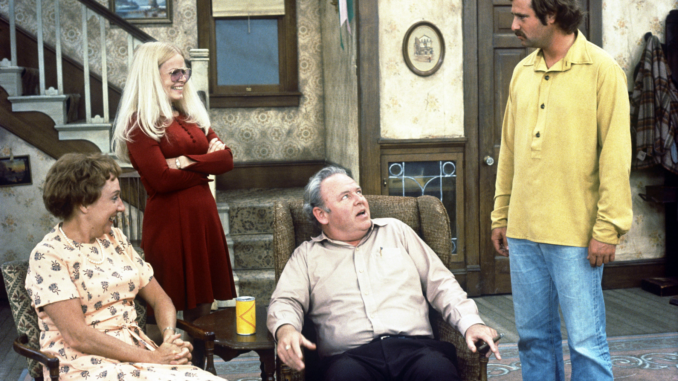
On Friday nights, the Bunkers and the Stivics were famous for their screaming matches over the dinner table. But for the actors—Carroll O’Connor, Jean Stapleton, Rob Reiner, and Sally Struthers—the drama didn’t always stop when the director shouted “Cut!”
While they were the most cohesive comedic team in America, the reality behind the scenes was a complex web of artistic ego, deep loyalty, and professional isolation.
1. Carroll O’Connor: The Perfectionist Who Intimidated Everyone
Carroll O’Connor was nothing like the uneducated Archie Bunker. He was a highly intellectual, classically trained actor—and he was a perfectionist nightmare.
-
The Tension: O’Connor would often stop rehearsals to rewrite entire scenes. He didn’t just play Archie; he controlled him. This frequently led to “cold wars” with creator Norman Lear.
-
The Bond: Despite his intensity, O’Connor looked at Rob Reiner (Mike) and Sally Struthers (Gloria) as his real-life protégés. He was fiercely protective of them, even if he made them nervous with his demands for excellence.
2. The “Meathead” vs. The “Bigot”: A Surprising Friendship
You would think the man playing Mike “Meathead” Stivic would clash with the man playing Archie, but the opposite was true.
-
The Dynamic: Rob Reiner and Carroll O’Connor shared a deep, mutual respect. In fact, Reiner often credited O’Connor for teaching him the “business” of Hollywood.
-
The Complication: The bond was so strong that it sometimes left the women—Jean and Sally—feeling like outsiders in a “boys’ club” of intellectual debate and political maneuvering.
3. Jean Stapleton’s “Quiet Isolation”
Jean Stapleton was the most beloved person on set, but she maintained a professional distance. Unlike her character Edith, who couldn’t keep a secret, Jean was incredibly private.
-
The Mask: While the others would argue or hang out, Jean would often retreat to her dressing room to shed the “Dingbat” persona.
-
The Struggle: She found it exhausting to stay in Edith’s high-pitched voice and frantic energy. Off-camera, she was a sophisticated, calm woman who sometimes struggled to connect with the chaotic energy of her younger co-stars.
4. Sally Struthers: The Daughter Seeking Approval
For Sally Struthers, the lines between fiction and reality blurred. Being the youngest, she often felt the weight of being “the kid” on set.
-
The Real Tears: During the show’s famous emotional scenes, the tears Sally shed were often real. The pressure of performing alongside a giant like O’Connor was immense.
-
The Breakout: Sally often felt trapped by the “Gloria” image, and while she loved her TV parents, she secretly fought a lonely battle to be seen as an independent artist, away from the shadow of Archie’s chair.
The Final Act: A Family Untethered
When the show ended, the “family” fractured in a way no one expected.
“We were a family for 200 episodes,” one crew member noted, “but once the set was struck, everyone ran in different directions to find their own identity.”
The bond was real, but it was forged in a pressure cooker. They loved each other, but they also needed to escape the characters that had defined—and sometimes confined—their lives for a decade.