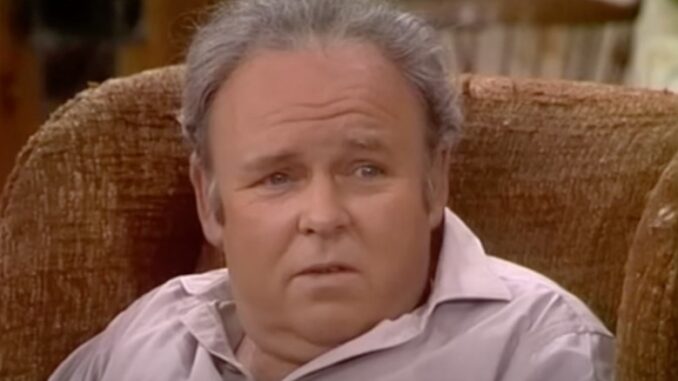
Television history is often shaped by moments viewers never see. Long before a show becomes iconic, creative battles unfold in writers’ rooms, rehearsal spaces, and network offices. Few examples capture this better than the controversy surrounding Archie Bunker’s very first line in All in the Family—a single sentence that immediately signaled the show was about to challenge American television like never before.
What audiences heard as sharp, unapologetic humor was, behind the scenes, the subject of intense debate.
A Risky Beginning
When All in the Family premiered in 1971, television comedy was still largely safe and predictable. Networks preferred broad humor over confrontation, and controversial topics were usually softened or avoided altogether.
Then Archie Bunker spoke.
His opening line didn’t ease viewers into the story—it confronted them. The remark reflected the character’s rigid worldview and hinted at the social tensions the series would explore. Some executives reportedly worried that starting the show so boldly might alienate audiences within minutes.
But creator Norman Lear understood something others didn’t yet see: if the show opened cautiously, it would betray its entire purpose.
The Creative Clash
Behind the cameras, opinions were divided. Network representatives feared backlash from advertisers and affiliates. Could a sitcom survive if it made viewers uncomfortable right from the start?
Writers and producers argued the opposite. Archie wasn’t meant to be universally liked—he was meant to be recognizable. His flaws were the point. By letting him speak exactly as written, the show forced audiences to confront attitudes that were often whispered in real life but rarely portrayed on television.
Carroll O’Connor, who brought Archie to life, also recognized the delicate balance required. The character had to feel authentic without becoming a caricature. Deliver the line too harshly, and Archie might seem irredeemable. Play it too lightly, and the show’s edge would disappear.
Finding that tone became a defining challenge.
Why That Line Mattered
Looking back, it’s clear the risk paid off. The opening immediately established that All in the Family wasn’t interested in background noise comedy—it demanded attention.
More importantly, the line created a contract with the audience: this show would not pretend society’s divisions didn’t exist.
It was a radical promise for its time.
Instead of offering escapism, the series invited conversation. Families didn’t just watch the show; they talked about it afterward—sometimes agreeing, sometimes arguing, but rarely staying indifferent.
Changing the Rules of Sitcom Storytelling
Today, it’s common for comedies to address serious themes, but in the early 1970s, that approach was groundbreaking. Archie’s first line helped redefine what a sitcom protagonist could be.
He wasn’t polished. He wasn’t always right. And he certainly wasn’t designed to avoid controversy.
That complexity influenced generations of television creators. Later character-driven comedies would embrace flawed leads, trusting audiences to handle nuance rather than simplicity.
All because one show refused to start quietly.
The Courage to Be Uncomfortable
Perhaps the greatest lesson from this behind-the-scenes battle is that meaningful storytelling often begins with creative courage. The team behind All in the Family understood that progress rarely comes from playing it safe.
By defending that opening moment, they preserved the show’s authenticity—and ultimately its legacy.
What once worried executives became one of television’s most important creative statements: sometimes the most powerful way to begin is not with comfort, but with honesty.
A First Line That Still Echoes
Decades later, All in the Family remains a landmark in television history, and that unforgettable first line still symbolizes the show’s fearless spirit.
It reminds us that groundbreaking art often starts with disagreement, persistence, and a willingness to challenge expectations.
After all, it wasn’t just a line.
It was a declaration that television comedy was ready to grow up.