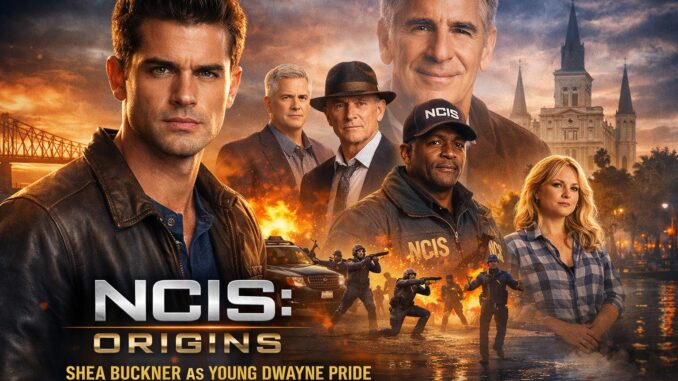
The NCIS universe just got bigger — and smarter. With NCIS: Origins officially casting Shea Buckner as a young Dwayne Pride, the franchise isn’t just revisiting its past. It’s strategically reshaping its future.
If you’ve followed the legacy of NCIS, you know that expansion is part of its DNA. From Washington to Los Angeles, from New Orleans to Hawai‘i, this procedural empire has built something few franchises ever achieve: emotional continuity across generations. And now, with NCIS: Origins, we’re heading back to where it all began. But what makes this move so powerful? Let’s break it down.
A Strategic Move That Strengthens the NCIS Legacy
The addition of young Dwayne Pride isn’t random. It’s calculated. It’s bold. And honestly? It’s brilliant.
For years, fans connected deeply with Pride on NCIS: New Orleans, where Scott Bakula turned the character into a moral anchor of the Gulf Coast.
Now, casting Shea Buckner as Pride’s younger self bridges emotional nostalgia with fresh storytelling. It’s the kind of layered world-building that keeps a long-running franchise alive.
Why Dwayne Pride Matters to the NCIS Universe
The Soul of New Orleans
Dwayne Pride wasn’t just another NCIS Special Agent in Charge. He was culture. He was rhythm. He was the heartbeat of New Orleans.
Unlike the sharp federal edge of Leroy Jethro Gibbs, Pride led with warmth. He balanced authority with empathy. He knew his city, and more importantly, his city knew him.
Bringing him into Origins reinforces the idea that NCIS isn’t just about cases. It’s about legacy.
Completing the “Fed Five”
The phrase “Fed Five” signals something bigger. It hints at the core federal figures who shaped the NCIS ecosystem across its major cities.
By incorporating a young Pride, Origins effectively rounds out that lineup — creating connective tissue between:
-
Washington D.C.
-
Los Angeles
-
New Orleans
-
Hawai‘i
-
And now, the early days of the agency itself
It’s world-building at its finest.
Who Is Shea Buckner — And Why This Casting Works
Let’s talk about the elephant in the room: casting a younger version of a beloved character is risky.
You can’t just find someone who looks the part. You need someone who carries the emotional blueprint.
Early reports suggest Shea Buckner brings grounded intensity — the kind that hints at Pride’s future calm authority. That’s not easy to replicate. Scott Bakula’s portrayal wasn’t flashy. It was measured. Quietly powerful.
So the real question is: Can Buckner capture that understated charisma?
If the franchise’s casting history is any indication, odds are high.
The Power of Prequels in the Procedural Genre
Why Prequels Work (When Done Right)
Prequels are tricky. Viewers already know where the story ends. So what’s the hook?
Simple: transformation.
We don’t watch prequels for outcomes. We watch them for evolution.
Origins isn’t about whether Pride becomes who we know. It’s about how he gets there.
Expanding the Emotional Backstory
What shaped Pride’s leadership style?
What early cases hardened his resolve?
What relationships defined his moral compass?
These questions give NCIS: Origins narrative fuel.
How NCIS Became a Television Powerhouse
You don’t last over two decades by accident.
Since its 2003 debut, NCIS has evolved into one of television’s most durable brands. It survived cast departures, shifting network strategies, and changing viewer habits.
Spin-offs like NCIS: Los Angeles proved the model could expand geographically while maintaining tonal consistency.
The franchise formula works because it blends:
-
Procedural reliability
-
Character-driven storytelling
-
Emotional continuity
And Origins leans heavily into that third pillar.
Nostalgia Meets Strategic Franchise Expansion
Let’s be honest. Nostalgia sells.
But nostalgia alone isn’t sustainable. What makes this move smart is that it doesn’t just rely on memory — it deepens mythology.
By introducing young Pride, the franchise is building backward to move forward. Think of it like planting roots to strengthen the branches.
What This Means for Longtime Fans
For fans of NCIS: New Orleans, this casting feels personal.
Pride wasn’t just a character. He represented resilience after Hurricane Katrina. He embodied community. He carried quiet gravitas.
Seeing his early days offers emotional payoff — like flipping through an old photo album and discovering stories you never heard before.
What This Means for New Viewers
Here’s the genius part: you don’t need to have watched New Orleans to enjoy Origins.
Prequels act as entry points.
New viewers get a clean slate. Longtime fans get deeper context. That’s how you widen a demographic without alienating the core audience.
The Creative Gamble — And Why It’s Worth It
Casting a younger version of an established character walks a tightrope.
Too similar? It feels like imitation.
Too different? It feels disconnected.
The sweet spot lies in essence.
If Buckner captures Pride’s moral gravity — not just his mannerisms — the gamble pays off.
The Future of the NCIS Franchise
A Blueprint for Longevity
Television franchises rarely sustain momentum beyond a decade.
NCIS is different because it adapts without abandoning identity.
By revisiting foundational characters, it reinforces brand cohesion across its multiple arms.
Could More Legacy Characters Follow?
If Pride’s younger story resonates, what stops the franchise from exploring:
-
A young Hetty
-
Early Gibbs field days
-
The formation of inter-agency alliances
Once you open the origin door, possibilities multiply.
Why Timing Is Everything
The television landscape is more fragmented than ever. Streaming dominates. Attention spans shrink.
In that environment, familiar intellectual property becomes gold.
Launching Origins now isn’t coincidence. It’s strategy.
It leverages decades of loyalty while inviting curiosity.
Emotional Continuity Is the Secret Weapon
What truly keeps fans returning isn’t explosions or plot twists. It’s emotional investment.
We don’t tune in for cases alone. We tune in for people.
Young Pride gives viewers the chance to witness growth — and growth builds attachment.
Final Thoughts — A Smart Expansion That Honors the Past
Casting Shea Buckner as young Dwayne Pride isn’t just another headline. It’s a carefully positioned chess move within a television empire.
By revisiting a beloved character through the lens of youth, NCIS: Origins strengthens narrative continuity, fuels nostalgia, and expands audience reach — all at once.
In a world where franchises often stretch too thin, this feels intentional.
And that’s the difference.
Conclusion
NCIS: Origins casting Shea Buckner as young Dwayne Pride signals more than just another addition to the ensemble. It represents a strategic expansion of the NCIS mythos — one that blends nostalgia with forward-thinking storytelling. By completing the symbolic “Fed Five,” the franchise reinforces its interconnected universe while opening fresh narrative doors. Whether you’re a longtime viewer or a newcomer, this prequel promises a deeper look into the foundations of a television powerhouse. And if history tells us anything, it’s that NCIS knows exactly how to play the long game.