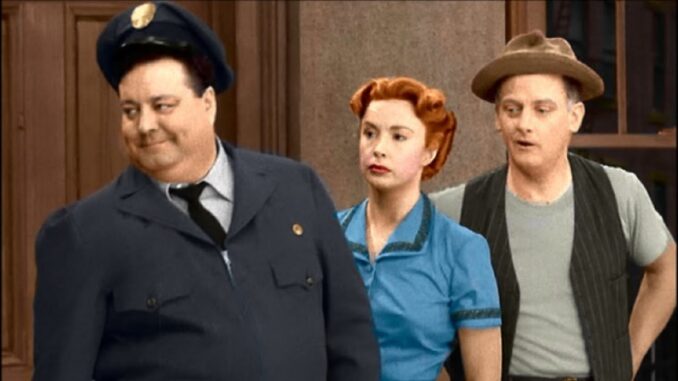
Few sitcoms have left a linguistic and emotional imprint as deep as The Honeymooners. While the series is often remembered for its famous catchphrases and explosive arguments, its true legacy lies in how dialogue was used not merely to provoke laughter, but to expose frustration, vulnerability, and quiet devotion. The words spoken by Ralph and Alice Kramden did more than entertain—they revealed a marriage, a social class, and an emotional reality rarely acknowledged so honestly on television.
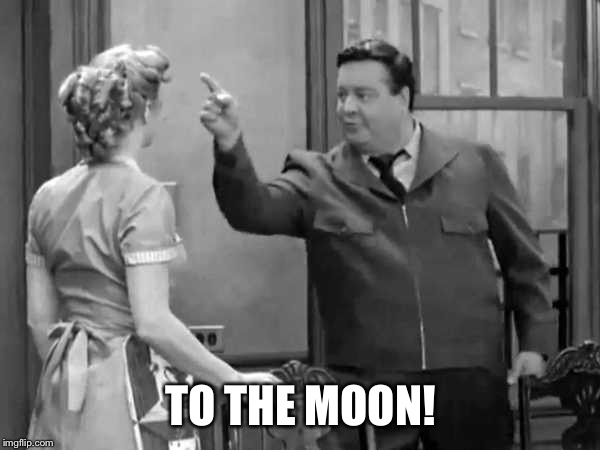
At a structural level, The Honeymooners understood that comedy could emerge from repetition rather than resolution. Ralph Kramden’s dialogue circles the same emotional territory episode after episode, and this circularity is deliberate. His most famous declaration, “To the moon, Alice!”, has often been misunderstood as a threat meant to shock. In truth, its exaggeration drains it of real menace. The line exposes Ralph’s lack of power rather than asserting dominance. It is the language of a man overwhelmed by circumstances, inflating his words because his life offers him so little control.
Similarly, Ralph’s recurring phrase “One of these days…” is never completed, and that omission is essential. The unfinished sentence captures the perpetual delay at the center of his character. It represents ambition without follow-through, hope without momentum. Ralph is always imagining a turning point, always postponing change to an undefined future. The audience laughs because the pattern is familiar—and because it is painfully human.
Alice Kramden’s dialogue operates in direct contrast. Where Ralph relies on volume and bravado, Alice speaks with restraint and precision. Her oft-repeated response, “I’ve heard that before,”, is not a punchline but a summary of lived experience. In just five words, she conveys memory, disappointment, and understanding. Alice does not mock Ralph’s dreams; she contextualizes them. Her language reflects emotional intelligence shaped by repetition and endurance.
This verbal tension creates the show’s distinctive rhythm. Ralph speaks to escape reality; Alice speaks to anchor it. Their exchanges are not built around jokes but around opposing worldviews. The comedy emerges organically from that friction. Importantly, The Honeymooners trusts silence as much as speech. Arguments often end not with clever resolutions, but with brief apologies, quiet acceptance, or simply the acknowledgment that life will go on unchanged.
Moments of tenderness are rare, and that rarity gives them weight. When Alice says “You know I’m proud of you, Ralph,” the line resonates precisely because it is understated. There is no sweeping emotional shift, no transformation arc. Instead, the line confirms what the show has always implied: that beneath the arguments lies loyalty. Love in The Honeymooners is not performative; it is persistent.
Even Ralph’s hopeful insistence that “This time it’s different” carries emotional truth. The audience knows it is not different, and Ralph likely knows it too. The humor comes from recognition, not surprise. The show understands that people repeat themselves not because they are foolish, but because they are stuck—economically, emotionally, socially. By allowing characters to recycle language, The Honeymooners captures the rhythm of real life more accurately than many polished modern sitcoms.
This approach to dialogue profoundly influenced later television comedies. Shows such as All in the Family, Seinfeld, and even The Simpsons inherited the idea that conversation itself—argument, interruption, misunderstanding—could be the engine of humor. Characters did not need to grow or improve; they needed to be consistent. Comedy could come from stasis rather than progress.
Ultimately, the enduring power of The Honeymooners lies in its emotional honesty. Its most famous lines survive not because they are clever quotations, but because they condense recognizable feelings into simple language. The show proved that dialogue could carry both humor and hurt—and that laughter does not require escape from reality. Sometimes, it comes from seeing reality named out loud.
In that sense, The Honeymooners was never just a sitcom about jokes or marriage. It was a study in how people speak when they are tired, hopeful, frustrated, and still committed to one another. Its words continue to echo because they sound like our own.