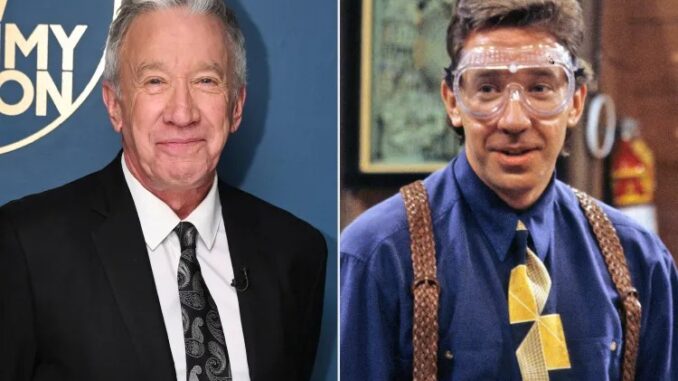
🎸 The Voice of a Generation: Cracking the Code of the Grunt
If you grew up in the 90s, you can hear it perfectly in your head right now. It’s that guttural, masculine “vibration” that signaled another successful DIY project (or a massive explosion) on Home Improvement. We’re talking about the Tim “The Tool Man” Taylor grunt. For eight seasons, this vocal tic became as synonymous with the show as flannel shirts and binford tools.
But have you ever stopped to wonder where that sound actually came from? It turns out it wasn’t just some random comedic improvisation on the set of a sitcom. Recently, while chatting on The Tonight Show Starring Jimmy Fallon, Tim Allen dropped a bombshell. He revealed that the inspiration for the most famous grunt in television history actually came from two unlikely sources: a rock-and-roll legend and a room full of hungry, steak-eating corporate executives.
👨🎤 The Bob Seger Connection: Searching for the “Hook”
It all started back in Detroit. Before Tim Allen was a household name, he was a stand-up comedian grinding out sets in clubs. It was during this period that he crossed paths with fellow Detroit native and rock icon Bob Seger.
The Advice That Changed Everything
Seger, a master of the rock “hook,” gave the young comedian a piece of advice that would echo through television history. According to Allen, Seger told him:
“You put butts in the seats, you own it, but you’ve gotta get a hook. Something that people remember.”
Think about it like a classic rock song. Without that catchy guitar riff or a memorable chorus, a song just fades into the background. Seger was telling Allen that a comedian needs a signature move—a “sonic brand” that sticks in the audience’s brain long after the show is over. Tim Allen took that to heart. He realized he needed something visceral, something that didn’t even require words to communicate his brand of “manly” humor.
The Musicality of the Grunt
Allen describes the grunt as his “new song.” He didn’t view it as just a noise; he saw it as a rhythmic punctuation mark. It was the “rhythm section” of his comedy act. Just as Seger used a saxophone or a gravelly vocal run to punctuate a verse, Allen would use the grunt to transition between jokes or emphasize a point about male behavior.
🥩 The Corporate Gig: Observations in the Wild
While Bob Seger provided the philosophy behind the hook, the sound itself came from observing men in their natural, “unfiltered” state. Specifically, Allen found his inspiration while performing at corporate gigs.
The Steakhouse Symphony
Picture this: a room full of “drunk guys eating steaks,” as Allen colorfully described it to Jimmy Fallon. These weren’t audiences focused on nuanced storytelling. These were men communicating in the most primitive way possible.
-
Non-Verbal Communication: Allen noticed that when men were deeply occupied—like eating a massive steak or staring at a new tire—they didn’t use sentences. They pointed and grunted.
-
The “Thanksgiving” Effect: He famously compared it to Thanksgiving at his own house. With seven brothers in the family, the dinner table wasn’t a place for sophisticated debate; it was a place of monosyllabic grunts and gestures.
H3: Translating “Manly” Mumbling into Comedy
Allen began mimicking these incoherent mumbles and gutteral noises on stage. He realized that by leaning into this “caveman” aesthetic, he was tapping into a universal experience. He wasn’t just making a sound; he was holding up a mirror to a specific type of American masculinity. It resonated because it was true.
📺 From the Stage to the Script: The Birth of Tim Taylor
When Home Improvement was developed in 1991, the grunt was already a staple of Allen’s stand-up routine (specifically his special Men Are Pigs). The writers didn’t just let him ad-lib it; they actually had to figure out how to put it on paper.
H3: How Do You Spell a Grunt?
The writers eventually settled on a very specific spelling in the scripts: “O-U-G-H.” * The Declarative Grunt: A simple “Ough!” for when Tim Taylor was happy or excited about a new Binford chainsaw.
-
The Interrogative Grunt: The famous “Ough?!”—which Allen describes as a “polite question”—used when Al Borland was explaining something technical that went right over Tim’s head.
📈 The “Burstiness” of the Grunt: Why It Went Viral (Before Viral Was a Thing)
What’s fascinating about the grunt is its burstiness. It wasn’t just used once an episode; it would erupt in flurries. There were episodes where Tim and his sons would engage in “grunt-offs,” creating a rhythmic, percussive layer to the scene.
The Statistics of Stardom
-
The Frequency: Over the course of 203 episodes, it’s estimated there were over 660 grunts. That averages out to more than three per episode!
-
Cultural Impact: Decades later, the sound is so iconic that it has become a staple of dating app voice prompts and social media impressions. As Allen noted on The Tonight Show, hearing people do the impression back-to-back is “horrible,” yet it proves the sound has outlived the show itself.
🚀 The Legacy of Tim “The Tool Man” Taylor
The grunt wasn’t just a gimmick; it was a character-building tool. It allowed Tim Taylor to express a wide range of emotions—confusion, arrogance, joy, and frustration—without ever having to admit to those feelings in words. It was the perfect mask for a character who struggled with emotional vulnerability but loved “More Power!”
Final Conclusion
Tim Allen’s signature Home Improvement grunt is a masterclass in branding. What began as a strategic “hook” suggested by rock legend Bob Seger was fleshed out through Allen’s sharp observations of men at steakhouse corporate gigs. By turning the primitive, non-verbal communications of everyday “manliness” into a rhythmic comedic device, Allen created a sound that defined an era of television. Whether it’s spelled “Ough” or “Ough?!”, the grunt remains a powerful reminder of why Home Improvement resonated with millions: it took the simplest, most human behaviors and turned them into legendary comedy.
❓ 5 Unique FAQs After The Conclusion
Q1: Did Bob Seger ever guest star on Home Improvement?
A1: While Bob Seger was a massive influence on Tim Allen and the show’s “Detroit-centric” identity, he never actually appeared on the show as a guest star. However, his music was a spiritual backdrop for the series.
Q2: How did the writers know when to insert a grunt into the script?
A2: Initially, Tim Allen would add them naturally, but as the show progressed, the writers began specifically scripting them (using “O-U-G-H”) to ensure they hit the right comedic beats, especially during “Tool Time” segments.
Q3: Does Tim Allen still do the grunt for fans today?
A3: He does! In interviews with Kelly Clarkson and Jimmy Fallon, Allen has mentioned that people on the street still ask him to do the trademark sound over 30 years after the show premiered.
Q4: Was the grunt used in Tim Allen’s other show, Last Man Standing?
A4: While Tim Allen’s character in Last Man Standing (Mike Baxter) was similar to Tim Taylor, the grunt was rarely used to avoid legal or branding conflicts. However, there was a famous “crossover” episode where Mike Baxter met Tim Taylor, and both characters grunted together.
Q5: Is there a “proper” way to perform the grunt?
A5: According to Tim Allen, it’s all in the throat and the inflection. The “Ough?!” with a rising pitch at the end is meant to be a question, while the deeper, flatter “Ough” is an exclamation of approval.