The Fire That Never Goes Out: Remembering Marina
If you’ve ever scrolled through Twitter on a Thursday night during the last seven years, you’ve likely seen the hashtag #Marina trending. It wasn’t just a ship name; it was a movement. When Station 19 first introduced the world to Maya Bishop and Carina DeLuca, I don’t think any of us—not even the writers—fully grasped the cultural tectonic shift about to happen. For years, lesbian and bisexual women have been relegated to the sidelines, given “sweeps week” kisses, or, most infamously, killed off for shock value. But then came Maya and Carina.
They didn’t just give us a romance; they gave us a blueprint for what a healthy, messy, complicated, and deeply enduring queer marriage looks like. As the sirens fade on Station 19, the legacy left behind by these two women feels like a warm embrace for a community that has spent too long in the cold. Why does this relationship still resonate so deeply? Is it the writing? The chemistry? Or is it the fact that for once, we got to see ourselves win? Let’s dive into the ashes and the glory of one of TV’s most beloved lesbian romances.
From a Severed Nose to a Lifetime of Love
Let’s take a trip down memory lane. Do you remember how they met? It wasn’t exactly a bouquet of roses. Maya delivered a severed nose in a Ziploc bag to Carina at Grey Sloan Memorial. Talk about a “meet-cute” that only Shondaland could pull off! But that weird, high-stakes introduction set the tone for everything that followed. It was visceral, it was urgent, and it was undeniably hot.
Maya Bishop: The Olympian Who Learned to Lose Control
Maya Bishop wasn’t an easy character to love at first. She was a former Olympian, a “gold medal or bust” kind of person who treated her life like a relentless sprint. She was rigid, she was competitive, and she was, frankly, terrified of intimacy. I mean, we’ve all been there, right? Building walls so high that nobody can see the cracks. Maya’s journey was about more than just becoming Captain; it was about learning that she didn’t have to win every moment to be worthy of love.
Carina DeLuca: More Than Just a Grey Sloan Transplant
Then you have Carina. Originally introduced on Grey’s Anatomy as Andrew DeLuca’s “fun” Italian sister, she found her true home on Station 19. She brought a level of emotional intelligence and passion that acted as a mirror for Maya. Carina wasn’t just the “wife” character; she was a brilliant surgeon with her own traumas and her own fierce desire for a family. Her presence softened Maya’s sharp edges while challenging her to be better.
Why Representation Matters: Breaking the Sapphic Glass Ceiling
Let’s be real for a second: representation isn’t just a buzzword. It’s a lifeline. When you grow up only seeing queer characters end up alone, dead, or miserable, you start to internalize that as your own future. Station 19 flipped the script. They showed Maya and Carina at the supermarket. They showed them arguing about IVF. They showed them simply being.
Bisexual Visibility in Primetime
One of the most radical things about “Marina” was that both women were explicitly, canonically bisexual. They didn’t shy away from their pasts with men, but they also didn’t let those pasts define their present. In a world that often tries to erase bisexual identity, seeing two proud bi women navigate a monogamous marriage was like finding water in a desert. It validated the experiences of millions who rarely see their specific reality reflected on screen.
The “Marina” Effect: How Fans Built a Digital Sanctuary
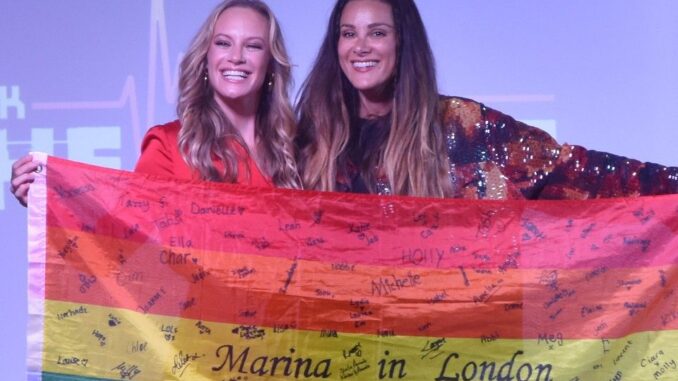
You can’t talk about the legacy of this couple without talking about the fans. The “Marina” fandom is a force of nature. They organized charities, bought billboards in Times Square, and created a digital sanctuary where queer women could discuss the show without fear of judgment. This wasn’t just a group of people liking a show; it was a community built on shared representation. When the show was cancelled, the outcry wasn’t just about losing a TV show; it was about losing a safe space.
Navigating the Hard Stuff: Mental Health and Marriage
Usually, TV shows stop once the couple gets married. They think the “happily ever after” is the end of the story. Station 19 knew better. They showed us that marriage is when the real work begins. The Season 6 arc where Maya suffered a mental health crisis was some of the most harrowing and honest television I’ve ever seen.
Healing the “Gold Medal” Trauma
Maya’s breakdown wasn’t just a plot device. It was a deep dive into the effects of an abusive, high-pressure upbringing. Watching her push Carina away—to the point of near-divorce—was painful because it felt real. We’ve all pushed away the person we love most when we’re at our lowest. The show didn’t sugarcoat it; it showed the ugly, snot-crying reality of trauma.
The Unwavering Support of a Partner
And Carina? She stood her ground. She didn’t just “fix” Maya; she set boundaries. She showed that loving someone doesn’t mean letting them destroy you. When Maya finally chose to get help, the reunion felt earned. It wasn’t a magical fix, but a deliberate choice to heal together. That’s a legacy of hope for anyone struggling with mental health in a relationship.
The IVF Journey: Real-World Struggles on Screen
Can we talk about how Station 19 handled the IVF storyline? It’s a journey that so many queer couples go through, yet it’s rarely depicted with this much detail. From picking a donor to the crushing disappointment of a negative test, the show took us through every needle and every heartbreak. It wasn’t just “medical drama”; it was a human story about the desire to bring a new life into the world with your person.
The Finale’s Promise: A Glimpse into a Bright Future
When the series finale finally aired, fans were on the edge of their seats. Would they get the “Happy Ending” we all craved, or would Shondaland break our hearts one last time? Thankfully, we got the win. The finale gave us the ultimate gift: security.
Flash-Forwards and Happy Endings
Seeing Maya and Carina survive the final fire was one thing, but those flash-forwards? Pure gold. We saw them with their children. We saw Maya back in her Captain’s uniform. We saw a life that continued long after the cameras stopped rolling. It was a rejection of the “tragic lesbian” trope. It told the audience: “Yes, you get to be happy. You get to have the kids, the career, and the love.”
The Impact on the Stars: Danielle Savre and Stefania Spampinato
You can’t have “Marina” without the lightning-in-a-bottle chemistry of Danielle Savre and Stefania Spampinato. These two didn’t just play the roles; they championed the characters. They spent their off-hours at conventions, engaged with fans on social media, and advocated for the authenticity of the relationship.
The Off-Screen Chemistry That Fueled the Fire
There’s a reason people thought they were together in real life (and some still do!). Their friendship and mutual respect translated into a comfort on screen that you just can’t fake. Whether it was the improvised Italian nicknames or the tender touches in the background of scenes, they put in the work to make Maya and Carina feel like a real couple with a shared history.
Why We’ll Never Forget Station 19’s Best Couple
As we look back, the legacy of Maya and Carina is one of resilience. They showed us that love is a fire that needs tending. They showed us that you can break cycles of abuse and build something beautiful from the wreckage. They made us feel seen in a world that often looks right through us.
Station 19 might be over, but the story of the firefighter and the surgeon will live on in every fan edit, every fanfiction, and every young queer woman who sees their relationship and realizes that she, too, is worthy of a great love.
Conclusion
The legacy of Maya Bishop and Carina DeLuca—the iconic “Marina”—is far more than just a successful TV romance; it is a landmark in LGBTQ+ representation. By portraying a marriage that survived trauma, mental health crises, and the complexities of starting a family, Station 19 gave the world a realistic yet hopeful depiction of sapphic love. The stars, Danielle Savre and Stefania Spampinato, brought an authenticity to these roles that sparked a global movement, proving that queer stories deserve to be told with depth, longevity, and ultimately, joy. Though the show has come to an end, the flame of Marina continues to burn in the hearts of millions, reminding us all that true love—messy, difficult, and beautiful—is a legacy worth fighting for.
FAQs
1. When did Maya and Carina first meet in Station 19? They first met in Season 3, Episode 5, titled “Into the Woods,” which aired on February 20, 2020. Their first interaction actually technically occurred on Grey’s Anatomy before continuing at Joe’s Bar.
2. Why is their ship name called “Marina”? The name is a portmanteau of Maya and Carina. It has become one of the most popular ship names in modern television history.
3. Did Maya and Carina have children by the end of the show? Yes! The series finale revealed through flash-forwards that they adopted Liam and later had two more children, fulfilling their long-standing dream of building a family together.
4. What was the significance of the “bisexual bob”? Fans jokingly (and lovingly) referred to Maya’s haircut in Season 3 as the “bisexual bob,” as it coincided with her leaning into her relationship with Carina and her queer identity.
5. How did the fans try to save Station 19 after its cancellation? Fans launched a massive campaign under the hashtag #SaveStation19, which included flying planes over studios, renting billboards, and organizing online protests to show the network how much the show—and specifically the Marina representation—meant to them.