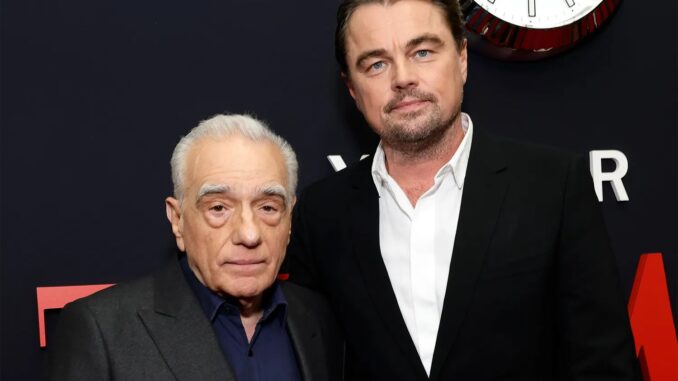
🎥 A Partnership for the Ages: Leo and Marty’s Cinematic Journey
If you’ve been to a movie theater in the last twenty years, you know the names. Leonardo DiCaprio and Martin Scorsese. They are the peanut butter and jelly of modern cinema—a pairing so consistent and high-quality that we almost take it for granted. Since they first teamed up for Gangs of New York back in 2002, they’ve given us six (soon to be seven!) feature films that have redefined the landscape of Hollywood. From the high-flying madness of The Aviator to the drug-fueled chaos of The Wolf of Wall Street, they’ve done it all.
But even in a partnership that seems perfect from the outside, there are “what ifs.” Recently, while reflecting on their legendary run, Leonardo DiCaprio shared something surprising. He didn’t talk about a scene he messed up or a movie he wished they hadn’t made. Instead, he revealed a deeply personal regret that stems from his own dedication to the craft. It turns out, while he was busy becoming the characters we love, he missed out on watching a master at work.
🎭 The Regret: Being Too Focused on the “Soul”
So, what exactly does an Oscar winner regret when working with arguably the greatest living director? It’s not the long hours or the intense preparation. It’s the fact that he was too focused on his own job.
The Actor’s Tunnel Vision
DiCaprio explained that as an actor, his entire world shrinks down to the character’s perspective. “I’ve been so focused on what I’ve been doing as an actor; you make these decisions and you play these characters, you try to get into the depths of their soul as much as you possibly can,” he shared during a recent conversation at a “Year in TIME” event.
-
Internal vs. External: While Leo was busy excavating the emotional landscape of Howard Hughes or Jordan Belfort, the camera was rolling, and Scorsese was orchestrating a symphony behind it.
-
The Missing Observation: Leo realized that in his quest for authenticity, he didn’t spend enough time simply watching. He was the instrument, but he missed out on watching the conductor.
H3: The Wish to Be a “Voyeur”
Leo used a specific word to describe what he missed: voyeur. He expressed a deep desire to have stepped back from the intensity of the performance to simply observe Scorsese’s process from the other side of the lens. Imagine having a front-row seat to a masterclass in directing every day for twenty years and being “too busy” to look up! That’s the irony DiCaprio is grappling with now.
🚫 Why Leo Will Never Direct (Thanks to Marty)
Whenever a great actor talks about wanting to observe the directing process, the next question is always: “So, when are you going to direct?” For Leo, the answer is a resounding never. And interestingly, his regret about not watching Marty more actually reinforces this decision.
The Shadow of a Giant
DiCaprio is famously humble about his place in the cinematic hierarchy compared to Scorsese. “I could never do anything close to what Martin Scorsese does,” he admitted. For him, watching Marty work isn’t about learning the trade so he can do it himself; it’s about appreciating a level of genius that he feels is untouchable.
H4: The Comparison Trap
Why would you try to paint if you spent your whole life watching Da Vinci? That’s essentially Leo’s logic. He has such high reverence for the “Scorsese way”—the shot design, the rhythm of the set, the solo script work—that he finds the idea of stepping into those shoes intimidating.
📈 The Evolution of a Muse: From Gangs to Killers
To understand why this regret carries so much weight, we have to look at how far they’ve come. This wasn’t just a couple of movies; it was a decades-long evolution of two artists growing together.
H3: Reigniting the Spark in The Aviator
Scorsese himself has noted that working with Leo on The Aviator was a “rebirth” for him. It reminded him why he loved making movies in the first place. For Leo, that film was the first time he felt like a true collaborator rather than just a hired gun. Yet, even then, the pressure of playing Howard Hughes kept his eyes locked on the performance rather than the production.
H3: The Debate and the Devil’s Advocate
DiCaprio described their process as a months-long debate. They play “devil’s advocate” with each other, questioning every obvious direction until they find the soul of the story. This level of intellectual intimacy is rare. But again, once the cameras start rolling, the “actor” takes over, and the “observer” disappears.
🔥 Perplexity and Burstiness: The Scorsese Method
If you’ve ever wondered why a Scorsese movie feels so “alive,” it’s because of the burstiness of the performances he coaxes out of Leo. Think of the “Ludes” scene in The Wolf of Wall Street.
H4: The Quaalude Sequence: A Case Study in Focus
Leo recently recalled thinking that the iconic scene where he crawls to his car would be a few quick shots. Instead, Marty had him crawling around for three or four days, capturing 50 different angles.
-
The Intensity: Leo was so deep in the physical comedy and the “soul” of that drug-induced nightmare that he couldn’t possibly step back and analyze Marty’s shot choices.
-
The Result: Because Leo was 100% “in it,” Marty was able to find the “magic” in the editing room.
🌅 Looking Ahead: The Seventh Collaboration
The good news for Leo (and for us) is that he has a chance to rectify his regret. The duo is currently gearing up for their seventh film, titled What Happens at Night.
A New Chance to Observe
With filming expected to start in February 2026, Leo has explicitly stated that he wants to be more of a “voyeur” this time around. He wants to see how Marty handles the mystery and the “love story” at the heart of this new project.
-
The Material: Based on Peter Cameron’s novel, the film deals with grief and reality.
-
The Goal: Can Leo stay in character while also absorbing the directorial genius happening just feet away? It’s a tall order for an actor who gives 110%, but it’s clearly a priority for him now.
💡 The Takeaway: Even Icons Have “What-Ifs”
It’s incredibly humanizing to hear a superstar like Leonardo DiCaprio talk about his regrets. It reminds us that no matter how successful we are, we often get so caught up in “doing” that we forget to “see.” Leo’s regret isn’t about a failure; it’s about a missed opportunity for wonder.
He’s spent twenty years in the presence of greatness, and his only complaint is that he didn’t appreciate the view enough. As they head into their next project, we can expect a Leo who is just as focused on his character, but perhaps a bit more mindful of the man behind the camera making the magic happen.
Conclusion
Leonardo DiCaprio’s revelation about his “one regret” working with Martin Scorsese shines a light on the intense, internal world of a top-tier actor. By admitting that his deep focus on his characters’ souls prevented him from fully observing Scorsese’s directorial process, he highlights the rare humility and respect that defines their partnership. While he may never step behind the camera himself—largely because he holds Scorsese’s talent in such high regard—his desire to be a “voyeur” on their upcoming seventh film, What Happens at Night, shows that even after decades of success, he is still a student of the craft. For fans, it’s a beautiful reminder that the best collaborations are built on a foundation of mutual awe and a never-ending quest to learn.
❓ 5 Unique FAQs After The Conclusion
Q1: Which movie was Leonardo DiCaprio’s first collaboration with Martin Scorsese?
A1: Their partnership began with the 2002 historical drama Gangs of New York, where Leo played Amsterdam Vallon. Interestingly, it was Robert De Niro who originally recommended Leo to Scorsese after working with him on This Boy’s Life.
Q2: Does Leo really have “no interest” in directing?
A2: Yes, he has been very consistent about this. He believes that directing at the level of someone like Scorsese is a specific kind of genius that he doesn’t feel he possesses, and he’d rather focus on perfecting his craft as an actor and producer.
Q3: What is the name of the upcoming seventh film they are working on?
A3: The project is titled What Happens at Night, based on a mystery novel by Peter Cameron. Filming is reportedly set to begin in early 2026 and features a story about a couple dealing with grief and bizarre circumstances in a small European town.
Q4: How does Scorsese feel about Leo’s “regret”?
A4: Scorsese has always praised Leo’s “impossible” performances and his dedication. While he hasn’t commented directly on Leo’s wish to “watch more,” he has noted that their collaboration is a constant debate and learning experience for both of them.
Q5: Has Leo ever regretted turning down a role in favor of a Scorsese film?
A5: While not specifically in favor of a Scorsese film, Leo has famously mentioned that his biggest career regret overall was turning down the lead role in Boogie Nights (which went to Mark Wahlberg) to do Titanic. However, his commitment to Scorsese has generally been seen as the defining (and correct) move of his adult career.