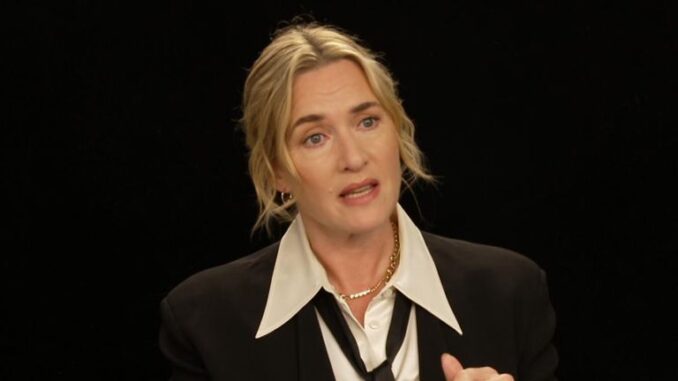
🎥 The Actor’s Ultimate Pivot: Why Kate Winslet Finally Stepped Behind the Lens
For over three decades, Kate Winslet has been our cinematic North Star. Whether she was clinging to a floating door in the North Atlantic or hunting down a killer in the gritty suburbs of Pennsylvania, her dedication to the craft of acting remained unshakeable. She is an actor’s actor—someone who dives so deep into a character that the lines between fiction and reality blur until they vanish. Throughout her illustrious career, people asked her the same question: “When are you going to direct?”
Her answer was always a polite, firm, and consistent “Never.” She loved the collaborative dance of acting; she loved being the clay, not the sculptor. But as they say in Hollywood, never say never. Recently, Winslet sent shockwaves through the industry by revealing that she has finally stepped into the director’s chair for a project so compelling, so personal, and so “extraordinary” that her decades-long vow of silence on directing simply crumbled.
What changed? Why now? It wasn’t just about finding a good script; it was about a story that demanded her specific vision. In her own words, she didn’t choose to direct—the project chose her. We’re going to peel back the layers of this decision, exploring the script that broke her “no,” the transition from muse to mastermind, and what this means for the future of one of cinema’s greatest icons.
🚫 The Long-Standing “No”: Why Winslet Resisted the Director’s Chair
To understand why this “yes” is so massive, we have to look at why she spent thirty years saying “no.” Winslet isn’t someone who lacks leadership or vision; she has been a producer on hit shows like Mare of Easttown and The Regime. So, what was the hold-up?
The Pure Joy of Performance
Winslet has always described acting as a visceral, almost spiritual experience. She loves the “internal” work—the psychology of a character, the physical transformation, and the emotional heavy lifting. Directing, by contrast, is an “external” job. It’s about logistics, budgets, lenses, and managing hundreds of people. For a long time, she felt that the administrative weight of directing would stifle the creative fire she feels as a performer.
Respect for the Craft
She has worked with the giants: James Cameron, Peter Jackson, Ang Lee, and Todd Haynes. Having watched these masters at work, Winslet harbored a deep, almost intimidating respect for the technical mastery required to direct. She didn’t want to be an actor who “dabbles” in directing just because they could; she wanted to wait until she felt she had something essential to say that could only be said from behind the camera.
📜 The Breaking Point: The “One” Project She Couldn’t Ignore
So, what was the magical catalyst? While the specific plot details are being guarded with typical Hollywood secrecy, Winslet has hinted that the project is a deeply intimate, female-centric narrative that deals with themes of hidden history and the resilience of the human spirit.
The Power of the Narrative Voice
Winslet realized that as a producer, she could shape the story, but as a director, she could protect its soul. The script she encountered was so delicate and required such a specific emotional shorthand that she felt a protective instinct over it. She realized that if she didn’t direct it, the subtle nuances she envisioned might get lost in translation. It wasn’t about ego; it was about stewardship.
H3: A Story of Hidden Figures
Rumors suggest the project may involve a historical biography or a narrative focusing on a woman whose contributions to art or science were overshadowed by her male contemporaries. This aligns perfectly with Winslet’s recent career trajectory, where she has focused on bringing “difficult” or “unseen” women to the forefront of our cultural consciousness.
🎭 From Muse to Mastermind: Managing the Transition
Moving from being the star of the show to the person calling “action” is a psychological mountain to climb. How did Winslet navigate the shift?
Leveraging Decades of Observation
While she hadn’t directed before, Winslet had been attending an “informal film school” for thirty years. Every day on a James Cameron set is a masterclass in technology and scale. Every day with a director like Todd Haynes is a masterclass in aesthetics and mood.
-
The Technical Edge: She knows how a set runs. She understands the rhythm of a shooting day.
-
The Emotional Intelligence: Most importantly, she knows how to talk to actors. Because she is one, she can provide the kind of shorthand and emotional safety that many technical-minded directors struggle with.
H3: The Producer-to-Director Pipeline
Her experience producing Mare of Easttown was the ultimate dress rehearsal. On that set, she was already heavily involved in casting, script revisions, and post-production. Directing was simply the final, logical step in taking full creative ownership of her work. She had already been doing 80% of the job; she just hadn’t taken the credit yet.
🛠️ The Directorial Style: What Can We Expect?
If we look at Winslet’s acting choices, we can make some educated guesses about her directorial style. It won’t be about flashy camera moves or “look at me” cinematography.
Prioritizing the Internal Landscape
Expect a film that is intimately scaled. Winslet is fascinated by the “unsaid”—the micro-expressions, the silences, and the subtle shifts in power between people in a room. Her direction will likely favor long takes and close-ups that allow the actors to truly inhabit the space.
H4: A Focus on Gritty Realism
Just as she demanded her “belly” and “aged skin” not be edited out of Mare of Easttown, her directorial eye will likely seek out unvarnished truth. She has no interest in Hollywood gloss. Her film will likely have a tactile, lived-in quality that values authenticity over perfection.
🌟 Breaking the Glass Ceiling: Female Directors in Hollywood
Winslet joining the ranks of directors isn’t just a personal win; it’s a win for the industry. While things are improving, female directors—especially those who are also established stars—bring a unique weight and “bankability” to female-led stories.
Empowering the Next Generation
By stepping behind the camera, Winslet sends a powerful message to younger actresses: you don’t have to wait for the phone to ring with the perfect role. You can create the world yourself. She is joining the likes of Greta Gerwig, Olivia Wilde, and Emerald Fennell in proving that a female perspective behind the camera is not a “niche” interest—it’s a box-office and critical powerhouse.
H4: The “Winslet Effect” on Casting
Actors want to work for other actors. When Kate Winslet calls and says, “I’m directing a film and I want you in it,” people don’t check their schedules—they just say “yes.” This gives her the power to assemble incredible ensembles that might otherwise be impossible to pull together.
🤔 The Fear of the “Big Chair”: Addressing the Critics
Every actor who directs faces a certain level of skepticism. Is it a vanity project? Can they handle the technical pressure? Winslet has addressed these fears with her trademark honesty.
“I was terrified. I thought, ‘What if I don’t know the answer when the DP asks me about a lens?’ But then I realized, the best directors don’t always have the answer—they have the vision, and they hire the best people to help them achieve it.”
This humility is her secret weapon. She isn’t walking onto the set pretending to be a technical genius; she’s walking on as a creative leader who knows how to collaborate.
🚀 The Future: Is This the Start of a New Career?
Now that the seal is broken, will Kate Winslet become a “director who sometimes acts,” or will this be a one-time affair?
-
The Artistic Expansion: Many actors who direct once, like Bradley Cooper or Regina King, find the experience so fulfilling that it becomes a permanent part of their artistic identity.
-
The Legacy Phase: Winslet is in the “legacy phase” of her career. She has nothing left to prove as an actor. Directing offers her a new mountain to climb, a new way to challenge herself, and a new way to contribute to the history of cinema.
Final Conclusion
Kate Winslet’s decision to finally direct is the culmination of a thirty-year evolution from a young, bright-eyed ingenue to a formidable titan of the industry. While she resisted the “big chair” for decades out of respect for the craft and a love for performance, she finally found a story whose soul was so precious she couldn’t trust it to anyone else. By merging her decades of high-level production experience with her unparalleled emotional intelligence as an actor, Winslet is poised to deliver a directorial debut that is as authentic, gritty, and deeply human as the performances that made her a legend. The world didn’t just gain a new director; it gained a guardian of storytelling who knows that the most powerful things in cinema happen in the quiet moments between the words.
❓ 5 Unique FAQs After The Conclusion
Q1: What is the name of the first film Kate Winslet is directing?
A1: While Kate Winslet has confirmed she has moved into directing, the official title and specific plot details of her directorial debut are currently being kept under wraps by the production team. It is expected to be a female-led, intimate drama.
Q2: Did Kate Winslet also act in the project she directed?
A2: Most reports suggest that Winslet focused primarily on her role behind the camera for this specific debut to ensure she could dedicate her full attention to the directorial process. However, she has not ruled out the possibility of acting in future projects she directs.
Q3: How did her experience producing Mare of Easttown help her as a director?
A3: Producing Mare of Easttown allowed Winslet to manage the entire lifecycle of a production, from casting and script development to daily on-set problem-solving and post-production. It gave her the confidence to handle the administrative and leadership demands of directing.
Q4: Has James Cameron given Kate Winslet any advice on directing?
A4: While she hasn’t shared specific advice from Cameron regarding this project, Winslet has often spoken about how observing James Cameron’s meticulousness and technical prowess on the Avatar and Titanic sets served as a massive, informal education in filmmaking.
Q5: Is Kate Winslet’s directorial debut a film or a limited series?
A5: The current project she has discussed is a feature film, though given her incredible success with limited series on HBO, fans are speculating that she may also direct for television in the near future.