🎥 The Actor Who Knows His Place in the Pantheon
Let’s be honest: in today’s Hollywood, it’s almost a rite of passage for an A-list actor to eventually pick up the megaphone. From Bradley Cooper to Angelina Jolie, the transition from the “talent” to the “auteur” is a well-trodden path. We expect our icons to want that ultimate creative control. So, when Leonardo DiCaprio, arguably the greatest actor of his generation, definitively says he will never direct, it stops us in our tracks.
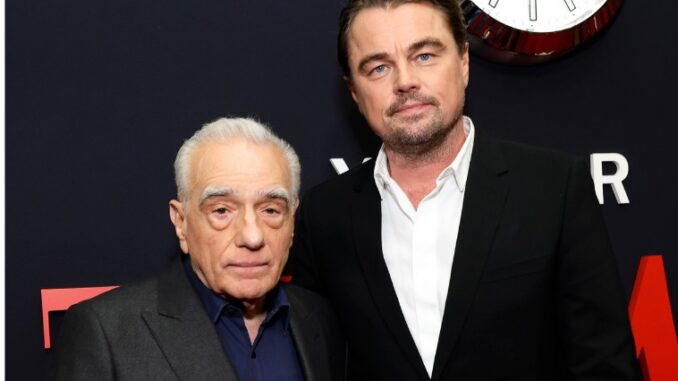
Why would a man who has spent three decades on the world’s most prestigious sets, working with the absolute masters of the craft, decide to stay firmly in front of the lens? The answer is as simple as it is humbling: Martin Scorsese. Leo isn’t just being modest; he’s acknowledging a level of genius that he believes is unattainable. He recently confessed that after watching Scorsese work up close for over twenty years, he realized he could “never do anything close” to what the master does.
This isn’t just about a lack of ambition. It’s a profound realization about the nature of storytelling. Leo is a student of cinema history, and he understands that directing isn’t just a job—it’s a spiritual and intellectual burden that some are simply born to carry. For DiCaprio, staying an actor is a way to remain a vessel for those masters, rather than trying to replicate a magic he views as supernatural.
🎨 The Scorsese Standard: A Masterclass in Every Frame
To understand Leo’s hesitation, you have to understand the Scorsese Standard. We’re talking about a man who doesn’t just “film a scene”; he orchestrates a symphony of light, sound, and psychological depth.
The Architecture of a Scorsese Set
Watching Marty work is like watching a grandmaster play chess against the concept of time itself. Every camera movement, every choice of lens, and every beat of the edit serves a singular, obsessive vision.
-
The Visual Language: Scorsese uses the camera as a character. Whether it’s the long, flowing steadicam shots in Goodfellas or the frantic, jagged energy of The Wolf of Wall Street, the camera speaks.
-
The Encyclopedic Knowledge: Leo often notes that Scorsese remembers every frame of every movie ever made. How do you compete with a walking, breathing library of world cinema?
The Intimidation Factor for an Actor-turned-Director
Imagine standing on a set for six months and seeing a man solve impossible narrative puzzles with a flick of his wrist. For DiCaprio, that experience wasn’t an invitation to try it himself; it was a warning. He recognizes that Scorsese possesses a primordial instinct for where the camera should live. To Leo, trying to mimic that would be like a gifted pianist trying to rewrite a Beethoven symphony. Why settle for a pale imitation when you can be the lead soloist for the composer himself?
🤝 A Partnership Forged in Creative Fire
DiCaprio and Scorsese have collaborated on six feature films (and counting), including Gangs of New York, The Aviator, The Departed, Shutter Island, The Wolf of Wall Street, and Killers of the Flower Moon. This isn’t just a professional relationship; it’s a creative marriage.
H3: The Muse and the Master Dynamic
In this partnership, Leo has become Scorsese’s primary muse, filling the void left by Robert De Niro.
-
The Evolution of Trust: Over twenty years, the trust between them has reached a point of telepathy. Scorsese pushes Leo to his darkest, most vulnerable places, and Leo delivers performances that redefine his career.
-
The Benefit of Specialization: Leo realizes that his greatest contribution to cinema is his ability to inhabit a soul. By focusing entirely on acting, he allows himself to be the clay that Scorsese molds. If he were directing, he’d be worried about the catering, the budget, and the lighting—distractions that would dilute the intensity of his performance.
H3: Seeing the “Strings” of the Puppet Master
Because Leo is so close to the process, he sees the “strings.” He sees the agonizing decisions Scorsese makes in the editing room. He sees the 4:00 AM phone calls about a single line of dialogue. While some actors see this and think “I want that power,” Leo sees it and thinks “That looks like a beautiful, exhausting nightmare I’m not equipped to lead.”
📽️ The Technical Burden: Why Leo Prefers the Mask
Directing is a technical marathon. It requires a brain that can handle 5,000 questions a day while keeping a three-hour narrative arc in mind.
The Complexity of Modern Filmmaking
DiCaprio has watched cinema transition from film to digital, seeing the technical overhead explode.
-
VFX and Scale: On projects like Inception or The Revenant, the technical logistics were mind-boggling. Leo witnessed directors like Christopher Nolan and Alejandro Iñárritu manage thousands of moving parts.
-
The Editing Room Purgatory: This is where Leo truly bows out. He knows that Scorsese spends months, sometimes years, in the edit. For an actor who loves the “moment” of performance, the idea of sitting in a dark room for a year obsessing over a three-second clip sounds like a special kind of hell.
H4: The “Second Banana” Philosophy Revisited
Remember Robert Duvall’s “second banana” comment? In a weird way, Leo applies this to directing. In his mind, in the world of directing, everyone is a “second banana” to the titans like Scorsese, Coppola, or Kubrick. If he can’t be at the very top of that specific mountain, he’d rather stay the king of the acting mountain.
🌟 The Ego Check: Avoiding the Vanity Project Trap
Hollywood is littered with the corpses of “vanity projects”—films directed by actors who thought they knew more than they did.
Maintaining the DiCaprio Brand
Leonardo DiCaprio is one of the few remaining “pure” movie stars. Every movie he makes is an event.
-
The Quality Control: By only working with top-tier directors (Tarantino, Inarritu, Spielberg, Scorsese), he ensures his brand remains synonymous with excellence.
-
Avoiding Mediocrity: If Leo directed a “just okay” movie, it would tarnish the mystique. By staying in his lane, he protects the legendary status he’s built. He’s smart enough to know that being a great actor doesn’t make you a great visual storyteller.
💡 What We Lose (And Gain) From Leo’s Refusal
Should we be sad that we’ll never see a “Film by Leonardo DiCaprio”?
H4: The Gain: More Iconic Performances
If Leo directed, he might make one movie every four years. By not directing, he can star in a movie every two years. We get more of his incredible range, more of his dedication to craft, and more collaborations with other greats.
The Loss: A Unique Perspective?
Perhaps we lose a unique, environmentalist, or socially conscious perspective that only he could bring behind the camera. However, Leo has found a way around this through producing. As a producer (Appian Way Productions), he can shepherd stories he cares about without having to deal with the minute-by-minute stress of being the director. He gets the creative input without the directorial “weight.”
🏆 The Legacy of the “Professional Actor”
In an age of multi-hyphenates, there is something incredibly refreshing about a man who says, “I am an actor, and that is enough.”
Leo’s refusal to direct is actually a love letter to cinema. It’s an admission that the craft of the director is sacred and distinct. By choosing to remain the student of masters like Martin Scorsese, Leo ensures that the art of acting remains elevated. He isn’t shrinking away from a challenge; he’s showing the ultimate respect to the men and women who sit in that lonely chair behind the monitor.
Final Conclusion
Leonardo DiCaprio’s definitive stance against directing is a rare moment of Hollywood humility, rooted in his deep-seated respect for the craft of Martin Scorsese. After decades of witnessing Scorsese’s near-supernatural ability to weave narrative, emotion, and technical precision, DiCaprio has concluded that he could never replicate that level of genius. By choosing to stay in front of the camera, Leo protects his brand of excellence and remains the ultimate muse for the industry’s greatest auteurs. His decision isn’t a lack of ambition, but a strategic commitment to the art of acting, ensuring that he remains a specialized master of his own craft rather than a “second banana” in the world of directing.
❓ 5 Unique FAQs After The Conclusion
Q1: Has Leonardo DiCaprio ever produced movies, even if he won’t direct them?
A1: Absolutely. Through his production company, Appian Way Productions, DiCaprio has produced dozens of films and documentaries, including The Wolf of Wall Street, The Revenant, and Orphan. Producing allows him to have significant creative and thematic input without the day-to-day technical burdens of directing.
Q2: Which directors besides Scorsese has DiCaprio praised as being “untouchable”?
A2: DiCaprio has frequently cited Christopher Nolan, Quentin Tarantino, and Alejandro G. Iñárritu as directors who possess a unique, uncompromising vision that he deeply admires. He often speaks about their ability to manage massive scales while maintaining an intimate focus on character.
Q3: Did DiCaprio ever take formal film school classes or training in directing?
A3: No formal film school, but he often describes his thirty years on professional film sets as the ultimate film school. He is known for spending time behind the monitor and in the editing room with Scorsese to understand the “why” behind every shot, even if he has no intention of doing it himself.
Q4: Is it common for A-list actors to refuse to direct throughout their entire careers?
A4: While many actors eventually try directing, several icons have famously stuck to acting or producing only. For example, Meryl Streep and Daniel Day-Lewis (now retired) focused almost exclusively on the craft of acting, much like DiCaprio, prioritizing the mastery of performance over directorial control.
Q5: Will DiCaprio and Scorsese work together again after Killers of the Flower Moon?
A5: Yes! The duo has several projects in development, most notably an adaptation of The Wager: A Tale of Shipwreck, Mutiny and Murder, another non-fiction survival story by David Grann. This continued partnership reinforces Leo’s commitment to being Scorsese’s primary creative collaborator for as long as possible.