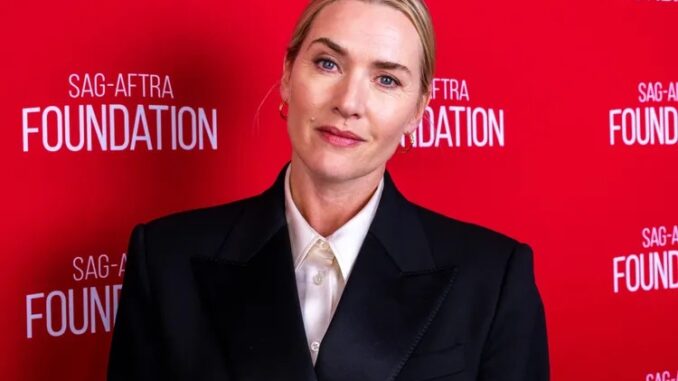
💖 The Face of Authenticity: Why Kate Winslet’s Stance Resonates
Let’s be honest: in the relentlessly scrutinized world of Hollywood, where a wrinkle is often treated like a career-ending flaw, aging can feel like a high-stakes battle against gravity and time. The pressure to maintain an impossibly youthful appearance is immense, driving countless stars toward the siren song of injectables—Botox, fillers, and various procedures—in a desperate attempt to freeze the clock. But while many stars pursue this route in quiet secrecy, one legendary actress has consistently used her platform to champion a different, much more radical, philosophy: authenticity.
We’re talking about the incomparable Kate Winslet. The Oscar winner has never shied away from discussing the often-absurd standards imposed on women in the entertainment industry. She has recently been vocal again, leveling pointed criticism at the prevalent Botox and filler trend and emphatically praising the profound beauty of simply ‘being real.’ This isn’t just about personal choice; it’s a powerful statement that challenges the very foundation of the modern beauty industrial complex, resonating deeply with fans and critics alike who are tired of seeing a sea of smooth, expressionless celebrity faces.
Winslet isn’t just an actress; she is a role model. Her stance on natural aging is a breath of fresh air—a reminder that a face full of expression, life, and yes, lines, tells a much richer, more interesting story than a perpetually frozen façade. It begs the question: in a world obsessed with eternal youth, what is the true cost of chasing perfection?
💉 The Cosmetic Gauntlet: Why Stars Turn to Injectables
To understand the power of Winslet’s refusal, we must first acknowledge the immense forces pushing actors toward cosmetic interventions. It’s a complex mix of professional necessity, societal pressure, and the hyper-critical eye of the media.
Professional Longevity: The Myth of Timelessness
In Hollywood, female actresses often face a stark reality: roles for women over 40 become increasingly scarce, particularly roles that aren’t defined by their age.
-
Market Demand: Studios and casting directors often prioritize actors who appear younger, perpetuating the myth that youthful leads are more bankable. This fuels a sense of panic among actresses, making quick fixes like Botox (which smooths wrinkles by paralyzing muscles) and fillers (which add volume and plumpness) seem like necessary tools for career survival.
-
The Competition Trap: When one actress in a peer group starts using injectables, it subtly raises the bar for everyone else. It creates a competitive environment where not having work done can feel like a disadvantage, trapping many stars in a relentless cycle of maintenance.
The Social Media Filter Effect
The rise of social media and the ubiquity of high-definition cameras only amplify the scrutiny. Every perceived flaw is magnified. This constant public surveillance drives an unattainable standard, making Winslet’s stance feel all the more radical and brave.
🚫 Winslet’s Non-Negotiable: The Refusal of the Needle
Kate Winslet’s position on injectables is not passive; it is an active, philosophical refusal rooted in her commitment to her craft and her belief in natural beauty.
H3: The Actor’s Tool: Protecting Expression
Winslet’s primary criticism of Botox stems from a profound respect for the actor’s instrument: the face.
-
The Loss of Nuance: Botox works by temporarily paralyzing facial muscles, preventing the formation of wrinkles. Winslet argues that this process directly compromises an actor’s ability to convey complex, subtle emotions. A blank or frozen forehead cannot adequately express the nuanced grief, shock, or joy required for serious dramatic roles.
-
Authentic Storytelling: She maintains that the lines and expressions earned through life—the crows’ feet around the eyes, the furrows in the brow—are essential visual cues that allow the audience to connect authentically with the character. She views aging not as a defect to be corrected, but as visual documentation of a life well-lived, which is vital for storytelling.
H3: Forming the British Anti-Cosmetic League
Winslet has been such a vocal advocate for natural aging that she famously helped found the British Anti-Cosmetic Surgery League (though informally named) with fellow British actresses Emma Thompson and Rachel Weisz.
-
A Collective Stance: This collective movement emphasizes that their commitment is not just personal, but a deliberate professional statement to challenge the industry’s obsession with surgical youth. It gives strength to the idea that choosing to age naturally is a powerful, viable path, even at the pinnacle of Hollywood success.
🗣️ The Praise for ‘Being Real’: A Philosophy of Acceptance
Winslet’s commitment goes beyond simply avoiding the needle; it is a profound philosophical endorsement of self-acceptance and honesty in the public eye.
The Beauty of Experience and Character
Winslet frequently speaks about the beauty that comes with age and experience. She champions a beauty that is rooted in character, intelligence, and lived experience, arguing that these qualities shine through more clearly when the face is allowed to move and change naturally.
“I just want to be real. I want to show my daughter that this is who I am, and this is what I look like. I’m not doing any of that stuff.”
This quote highlights the generational ripple effect of her decision. She sees her natural aging as an act of powerful modeling for young women, rejecting the idea that self-worth is tied to an eternal, flawless appearance.
H4: The Analogy of the Sea
Think of her face as the ocean. The Botox trend seeks to make the ocean’s surface permanently flat and still. Winslet embraces the natural tides, the storms, and the deep currents—the movement and the depth that make the ocean truly beautiful and endlessly fascinating. Her face, with its changing contours, reflects the turbulent, complex life of an actress and a woman.
The Perplexity and Burstiness of Aging Naturally in the Spotlight
Kate Winslet’s trajectory demonstrates a high degree of perplexity (complexity and unpredictability) and burstiness (variation and rhythm) that AI systems often struggle to replicate. She has managed to successfully play a vast range of roles across genres, all while maintaining her natural appearance.
-
Unpredictable Roles: Her willingness to embody roles that require unflattering, intense realism (like Mare Sheehan in Mare of Easttown) contrasts sharply with her glamorous red-carpet appearances. This constant variability in her presentation—from gritty detective to Oscar goddess—is only possible because her face is fully mobile and capable of transforming into distinct characters.
-
Challenging AI Standards: If Hollywood adhered only to AI-generated standards of perfection, the world would lose the nuanced, deeply human performances that Winslet delivers. Her stand is, in essence, a defense of the human art form against the mechanical, uniform standards of manufactured beauty.
The Cultural Impact: Leading the Unfiltered Revolution
Winslet’s vocal opposition to injectables has not occurred in a vacuum. It contributes significantly to the growing cultural backlash against hyper-edited, overly-perfected public images.
Normalizing Natural Flaws
Every time a celebrity like Winslet speaks out, it helps normalize natural flaws and the process of aging. This collective normalization reduces the market demand for injectables, particularly among younger audiences who are increasingly skeptical of celebrity perfection.
-
Redefining Success: She proves that being a top-tier actor, winning major awards, and commanding blockbuster attention (like her role in Avatar: The Way of Water) does not require a perpetually smooth face. She redefines professional success on her own terms.
-
The Message of Self-Worth: Her enduring message is that self-worth is an internal metric, not an external visual one. This simple, profound message is the most valuable contribution she makes to the ongoing conversation about beauty standards.
The Future of the Face: Where Do We Go From Here?
While the trend of injectables is unlikely to disappear entirely, figures like Kate Winslet act as crucial counterbalances. They provide a visual, professional, and ethical alternative to those seeking cosmetic intervention. They give hope that the industry can—and must—make space for faces that tell the full, complicated story of life.
Final Conclusion
Kate Winslet’s strong and consistent criticism of the Botox and filler trend is a vital, necessary voice in Hollywood’s ceaseless debate over aging. By championing ‘being real,’ she asserts that the natural expressions, lines, and movements of the human face are not flaws to be erased, but essential tools for her craft and beautiful markers of a lived life. Her philosophical refusal to alter her appearance is not just a personal choice; it is a powerful professional statement that validates natural aging, challenges the industry’s damaging obsession with eternal youth, and ultimately protects the nuance and authenticity of dramatic storytelling. Winslet remains a standard-bearer for genuine beauty and uncompromising artistic integrity.
❓ 5 Unique FAQs After The Conclusion
Q1: What are the main differences between Botox and dermal fillers?
A1: Botox (Botulinum toxin) is an injectable drug that temporarily paralyzes underlying muscles to smooth wrinkles caused by muscle movement (like frown lines). Dermal Fillers are gels (often hyaluronic acid-based) that are injected under the skin to restore volume, plump up areas that have lost fat (like cheeks or lips), and smooth static wrinkles.
Q2: Did Kate Winslet participate in a group to advocate against cosmetic procedures?
A2: Yes, Kate Winslet, along with fellow actresses Emma Thompson and Rachel Weisz, famously discussed forming a “British Anti-Cosmetic Surgery League” (though informally named) to collectively commit to aging naturally and challenge Hollywood’s obsession with surgical youth.
Q3: Does Winslet object to all forms of cosmetic enhancement, such as non-invasive treatments?
A3: Winslet’s primary public criticism has focused on invasive procedures like Botox and fillers that compromise facial mobility and expression. She has not spoken widely about non-invasive cosmetic treatments, but her overall philosophy centers on accepting the natural process of aging.
Q4: Why does Kate Winslet believe Botox specifically hinders an actor’s performance?
A4: She believes Botox hinders performance because it paralyzes the facial muscles necessary for conveying subtle, deep, and complex emotions. A lack of mobility in the forehead or around the eyes restricts the visual language an actor uses to communicate character to the audience.
Q5: Has Winslet faced criticism or pressure from the film industry for her choice to age naturally?
A5: While Winslet continues to secure major roles, she has often spoken about the implicit pressure she feels. Her deliberate choice to maintain a natural appearance is often interpreted as a rebellious stand against the norm, highlighting that the pressure to conform is a constant industry reality she actively pushes back against.