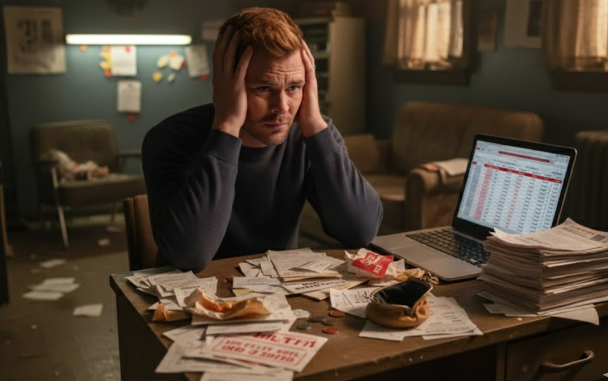
For years, Patrick Flueger was a familiar presence on network television — steady, reliable, and seemingly secure. As Adam Ruzek on Chicago P.D., he was part of a franchise that defined prime-time stability. Then, quietly, everything changed.
“I think people assume once you’ve been on a hit show, you’re set for life,” Flueger said recently. “That’s not how it works.”
In a rare and candid reflection, the actor opened up about the difficult period that followed his departure from the series, a chapter marked not by glamour, but by financial strain, uncertainty, and the humbling reality of starting over.
Life After the Badge Was Harder Than He Expected
When Flueger stepped away from Chicago P.D., there were no dramatic headlines or farewell tours. To the outside world, it looked like a natural transition — another actor moving on to the next opportunity.
Behind the scenes, however, the shift was jarring.
“The paycheck stops immediately,” he explained. “But life doesn’t.”
Without the structure of a long-running network contract, Flueger found himself confronting something many actors avoid talking about openly: how fragile financial stability in Hollywood really is.
“There were months where I was doing the math over and over,” he admitted. “Not because I was reckless — but because work is unpredictable.”
The Myth of ‘TV Money’
One of the biggest misconceptions Flueger wants to dispel is the idea that television actors are immune to financial pressure.
“Yes, you make good money when you’re working,” he said. “But when you’re not, the bills don’t scale down with your visibility.”
Between industry lulls, personal expenses, and obligations that don’t pause when a role ends, the gap between perception and reality can be brutal. Flueger described a period where every decision felt weighted, from turning down opportunities that didn’t align creatively to taking work simply to stay afloat.
“It messes with your pride,” he said. “You go from being part of something massive to wondering how long you can stretch what you have.”
Debt, Pressure, and the Quiet Panic
While Flueger stopped short of detailing specific figures, he acknowledged that financial obligations began to pile up, creating a pressure he hadn’t anticipated at this stage of his career.
“It wasn’t about luxury,” he said. “It was about responsibility.”
The stress, he noted, wasn’t just financial — it was psychological. The fear of slipping backward. The anxiety of not knowing when the next steady job would come.
“There’s a quiet panic that sets in,” he explained. “You don’t talk about it because everyone assumes you’re fine.”
Why He Stayed Silent for So Long
Flueger admits that ego played a role in his silence. So did fear.
“In this industry, admitting struggle feels like admitting weakness,” he said. “And weakness can cost you opportunities.”
Instead of speaking out, he internalized the pressure. He reassessed his spending. He re-evaluated his priorities. And slowly, he began to understand that the life he had been living needed adjustment — not justification.
Redefining Success Outside the Spotlight
What surprised Flueger most during this period wasn’t the struggle itself, but what it taught him.
“I had to separate who I am from the job,” he said. “From the paycheck. From the status.”
That recalibration didn’t happen overnight. It came through uncomfortable conversations, difficult choices, and moments where he questioned whether stepping away had been the right move.
“But I don’t regret it,” he said firmly. “I regret believing stability was permanent.”
A More Honest Hollywood Conversation
Flueger’s decision to speak now isn’t about sympathy. It’s about honesty — especially for younger actors who believe success is linear.
“This industry doesn’t warn you about the drop-off,” he said. “About how fast things can change.”
He hopes conversations like this can help normalize the reality that careers — even successful ones — have valleys as well as peaks.
“Struggle doesn’t mean failure,” he added. “It means you’re still in it.”
Where He Is Now
Today, Flueger describes himself as grounded and realistic. The financial pressure hasn’t magically disappeared, but it no longer defines him.
“I’m smarter now,” he said. “About money. About choices. About myself.”
He’s selective with projects, open to work that challenges him creatively, and unafraid of rebuilding at a slower pace.
“If starting over is what it takes to move forward honestly,” he said, “then that’s the price.”
The Truth Behind the Image
Patrick Flueger’s story cuts through a glossy illusion — that fame guarantees security, that success insulates against hardship. His reality tells a different story: one of resilience, recalibration, and survival without spectacle.
Leaving Chicago P.D. didn’t end his career. But it did strip away the safety net — revealing a version of Hollywood few like to admit exists.
And for Flueger, speaking that truth may be the most important role he’s played yet.