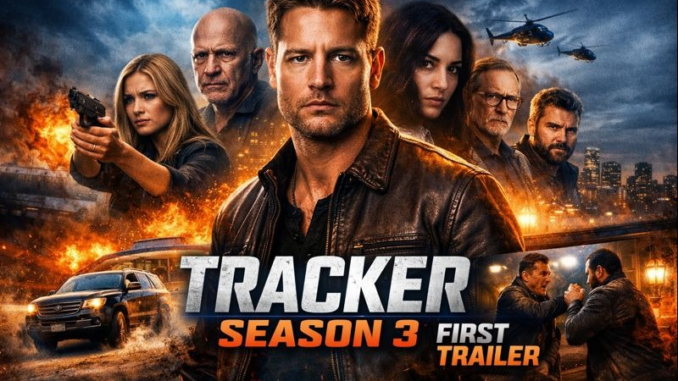
When Tracker premiered, it faced the monumental task of living up to the massive lead-in of the Super Bowl. Most “post-Bowl” shows see a 70% drop-off by episode three. Tracker did the opposite. It grew. By the middle of Season 2, it had officially dethroned NCIS as the #1 scripted drama on television—a feat many thought impossible in the era of TikTok and Netflix.
1. The “Competence Porn” Factor
At the heart of Tracker’s success is the “Appreciation of Pure Competence.” In a world of bumbling anti-heroes and confusing ensemble casts, Colter Shaw (Justin Hartley) is a breath of fresh air. He is calm, methodical, and preternaturally good at his job.
Viewers are drawn to Shaw’s “reporting style”—the way he breaks down percentages and tracking patterns with a matter-of-fact clarity. It’s a grounded mindset that treats high-stakes danger as a logical puzzle to be solved. This “competence porn” provides a deep sense of reassurance; there is something satisfying about watching a professional use logic and old-school survival skills to fix a broken situation.
2. The Justin Hartley “Gravity”
You cannot talk about the ratings without talking about Justin Hartley. Coming off the massive emotional success of This Is Us, Hartley brought a ready-made audience with him to CBS. However, he didn’t just play the same character. He transformed into a “walking jawline” of rugged self-reliance.
Hartley’s “swaggering appeal” (as critics call it) is balanced by a subtle, hangdog vulnerability. He manages to be an action hero who is also socially awkward and emotionally fractured. This combination makes him accessible to everyone—from the action-hungry demographic to those looking for a deep, character-driven soap opera.
3. The “Adventure Procedural” Revival
Tracker tapped into a nostalgia for shows like Burn Notice or The Fugitive. Each week offers a “neat, well-planned problem-solving story” with a clear goal and a satisfying resolution.
This episodic “Case-of-the-Week” format is highly “sticky” for broadcast TV. It allows new viewers to jump in at any time without feeling lost, while the overarching “Shaw Family Mystery” provides the “lore” that keeps the die-hard fans theorizing on Reddit. By the time Jensen Ackles showed up as Russell Shaw in Season 2, the “lore” had reached a fever pitch, resulting in episodes that pulled in nearly 12 million linear viewers alone.
4. The “Outdoorsy” Yellowstone Effect
The show’s visual identity is a major part of its “can’t-look-away” quality. Filmed primarily in the rugged forests and mountains of British Columbia (doubling for the US), Tracker offers a scenic, “big-sky” aesthetic that appeals to the same audience that made Yellowstone a hit. It’s “brewski beer me” television—big, bold, brassy, and unashamedly outdoorsy.
5. Ratings War 2026: The “High Potential” Rivalry
As of January 2026, the ratings battle has shifted into a new gear. While Tracker led 2024 and 2025, it is currently locked in a “virtual tie” with ABC’s High Potential.
Tracker: Dominates in Linear TV (11 million live viewers).
High Potential: Leads in Streaming (7.9 million viewers on platforms).
This rivalry has actually helped both shows. The “battle for the crown” has kept Tracker in the news cycle, fueling a 17% increase in Season 3 viewership compared to the Season 2 premiere.
Conclusion: Why We Can’t Look Away
Tracker is a “highly efficient entertainment machine.” It gives us a hero who doesn’t use gadgets, doesn’t need a massive team, and doesn’t panic. In an increasingly complex world, Colter Shaw represents the fantasy of the self-reliant individual who can fix anything for a price—and a reward.
As we look toward the March 1st return, the ratings suggest that the “Lone Wolf” isn’t just surviving; he’s leading the pack into a new era of legendary television.