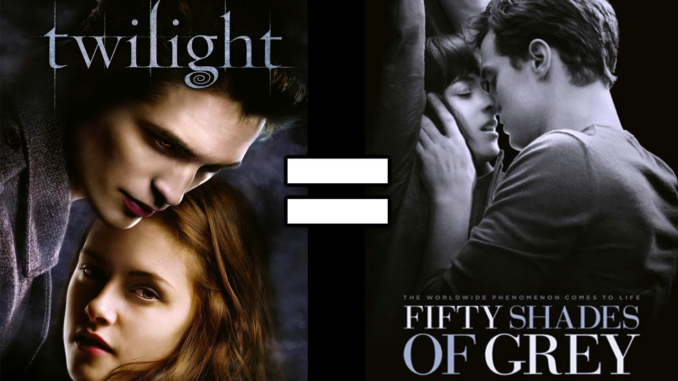
Hollywood has always had a complicated relationship with its past. It celebrates nostalgia, repackages it, monetizes it—and then pretends it never left. So when Twilight began quietly re-entering the cultural conversation, it wasn’t just a revival. It was a signal. And almost immediately, attention shifted to another franchise once considered finished, untouchable, and quietly shelved.
Fifty Shades.
For years, the industry treated Fifty Shades as a closed chapter. Financially successful, culturally explosive, but ultimately too divisive to revisit openly. Yet now, as Twilight finds renewed life through streaming buzz, social media rediscovery, and behind-the-scenes development talk, a question is becoming harder to avoid: is Hollywood preparing to reopen its most controversial modern franchise?
The comparison isn’t accidental. Both franchises defined an era. Both polarized critics while dominating pop culture. And both were written off as “products of their time” once the noise faded. But Hollywood doesn’t forget intellectual property that still generates attention—and Fifty Shades never truly disappeared.
What’s changed is context.
When Fifty Shades of Grey first arrived, the industry wasn’t equipped to handle the conversation it sparked. Discussions about power dynamics, consent, fantasy versus reality, and the responsibility of mainstream erotic storytelling were loud—but poorly managed. Studios leaned on box office numbers and avoided deeper engagement. It worked financially, but it left unresolved tension behind.
That tension is exactly what makes the franchise risky—and irresistible—today.
Hollywood in the mid-2020s is obsessed with reframing. Old stories are being re-examined, revised, and reintroduced under the promise of “new perspective.” Twilight benefited from this shift: once mocked, now reclaimed as a cultural artifact worth reassessing. Fifty Shades sits at the edge of the same opportunity, though with higher stakes.
The industry knows the name still carries weight. Every time the films resurface on streaming platforms, viewership spikes. Online discourse reignites. Younger audiences encounter the franchise without the original cultural baggage, asking different questions and reacting in new ways. For executives, that data matters more than public discomfort.
But reopening Fifty Shades isn’t as simple as greenlighting a sequel.
The franchise’s controversy is inseparable from its identity. Any return would require a recalibration—tonally, narratively, and ethically. This is where speculation intensifies. Insiders aren’t talking about a straightforward continuation. Instead, the ideas being floated feel cautious, strategic, and deliberately ambiguous.
A limited series rather than a film.
A reimagining rather than a sequel.
A perspective shift rather than a continuation of the original dynamic.
And notably, there’s been no rush to attach names publicly.
Jamie Dornan and Dakota Johnson have both distanced themselves from the franchise without disowning it. Neither has expressed eagerness to return—but neither has definitively closed the door. In Hollywood, that silence is meaningful. It allows studios to test the waters without commitment, and it keeps the possibility alive without provoking backlash.
The Twilight revival showed studios something crucial: controversy fades faster than recognition. What once felt embarrassing can be reframed as “era-defining.” What once drew criticism can be marketed as “complex.” And audiences, especially streaming audiences, are far more forgiving than traditional gatekeepers expect.
Still, Fifty Shades presents a unique challenge.
Unlike Twilight, its controversies weren’t just about quality or tone—they were about implications. Any attempt to revive the franchise would need to acknowledge that history rather than sidestep it. Ironically, that acknowledgment may be what makes a comeback viable now. The industry has learned how to speak in layered language, how to signal awareness without apology, how to sell evolution without rejection.
That doesn’t mean a revival is imminent. There are no official announcements, no confirmed scripts, no production timelines. But Hollywood rarely moves loudly at first. It tests reactions. It watches engagement. It waits for the right moment when nostalgia outweighs resistance.
And that moment may be approaching.
The return of Twilight didn’t just reopen a franchise—it reopened a strategy. It reminded studios that audiences are willing to revisit the past if the framing feels intentional. That reboots don’t have to erase criticism; they can absorb it. And that silence followed by careful re-entry is often more effective than bold declarations.
For Fifty Shades, the question isn’t whether it can return.
It’s whether Hollywood believes it can control the conversation this time.
Because reopening the franchise wouldn’t just revive a story—it would reopen a debate the industry once avoided. And if that happens, it will signal something bigger than nostalgia.
It will signal that Hollywood believes it’s finally ready to face the consequences of its own cultural phenomena—and sell them back to audiences, revised, reframed, and reborn.