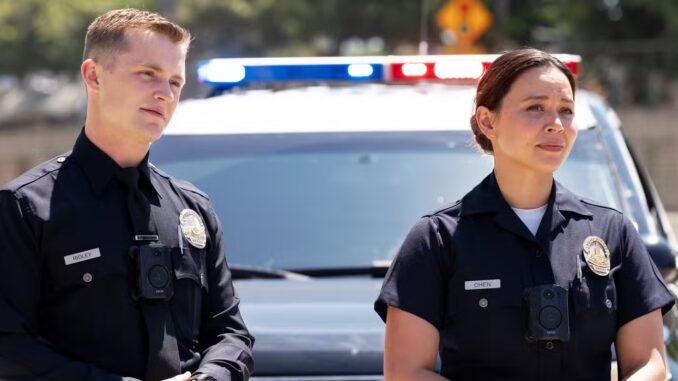
🚔 In Recent Years, The Rookie’s Shifted Toward Larger-Than-Life Emergencies
If you go back and watch the pilot of The Rookie, you’ll see something almost unrecognizable today. You’ll see John Nolan, a guy in his 40s with a dream and a very sensible tan, fumbling with his body cam and getting lectured about the proper way to conduct a traffic stop. It was grounded. It was gritty-ish. It was about the “small” stuff that makes the LAPD tick.
Fast forward to the last few seasons, and suddenly, our favorite patrol officers are dismantling international terrorist sleeper cells, engaging in high-stakes cyber warfare, and taking down massive criminal syndicates that would make the Avengers sweat. What happened? In recent years, The Rookie has undergone a massive DNA transplant. It shifted from a “rookie” procedural into a high-octane, larger-than-life emergency spectacle. But is this a bad thing, or is it exactly what the show needed to survive the streaming wars?
🚨 The “Grounding” Problem: Why procedurals eventually go big
Let’s be real for a second. There are only so many ways you can film a “standard” traffic stop before the audience starts checking their phones. In the beginning, the show relied on the novelty of Nolan being an “old guy” in a young man’s game. But once he passed his probation? Once he wasn’t a rookie anymore? The show faced a choice: end the story or expand the stakes.
Like a balloon being over-inflated, the show’s writers decided to push the boundaries of what a Mid-Wilshire patrol officer actually does. This is a common trope in Hollywood, often called “Power Creep.” If the hero stops a mugger in Season 1, he has to stop a bank heist in Season 2, and by Season 5, he’s basically stopping a nuclear launch.
💣 The “Super-Cop” Syndrome: Nolan’s journey to the center of the storm
John Nolan started as a guy who sold a construction company to follow a calling. Now, he’s the guy who seemingly every major criminal in the Western Hemisphere knows by name. Have you noticed how he’s always at the exact center of the world’s most improbable disasters?
It’s like Nolan has a magnet in his pocket that attracts “End of the World” scenarios. We’ve seen him face off against Russian spies and handle biological threats that could wipe out Los Angeles. Is it realistic? Not even slightly. A patrol officer wouldn’t be lead on these cases; the FBI or Homeland Security would kick them off the scene before they could say “show me your hands.” But is it entertaining? You bet your life it is.
🏢 From the Streets to the Soundstages: The shift in set pieces
In the early days, The Rookie spent a lot of time on the sidewalk. You felt the heat of the pavement. Now, the show leans heavily on “Event Television” set pieces. Think back to the episodes involving the massive, city-wide blackouts or the coordinated sniper attacks on the city’s infrastructure.
These aren’t just “crimes”; they are emergencies. The scale has shifted from the individual to the institutional. We aren’t worried about one person getting hurt; we’re worried about the city of Los Angeles falling into anarchy. This shift allows for more “burstiness” in the writing—intense action sequences followed by quick, emotional breathers.
🕵️♂️ The Rise of the Mastermind Villain
Another huge indicator of this shift is the villains. We’ve moved away from the “criminal of the week” and toward the “Big Bad.”
Elijah Stone: The criminal kingpin who wouldn’t die
Elijah Stone wasn’t just a drug dealer; he was a strategic mastermind who infiltrated the legal system, manipulated the police, and felt more like a Bond villain than a street thug. His arcs lasted seasons, turning the show into a serialized epic rather than a standalone procedural.
Monica Stevens: The lawyer from hell
Then you have characters like Monica, who weaponize the law on a global scale. These aren’t people you arrest for shoplifting. They are people whose downfalls require a coordinated, multi-agency task force. This necessitates “larger-than-life” responses from our main cast.
🏹 The “Chenford” Effect: Romance in the face of ruin
Interestingly, as the emergencies got bigger, the fans got more invested in the characters’ personal lives. This is a classic storytelling trick. If the world is ending, the “will-they-won’t-they” between Tim Bradford and Lucy Chen feels much more urgent.
When Tim and Lucy are trapped in a building that’s about to blow up, their romantic tension isn’t just a subplot—it’s the emotional anchor that keeps the audience from rolling their eyes at the improbable explosion. The “larger-than-life” emergencies serve as a pressure cooker for the relationships we actually care about.
💥 High-Stakes Tropes: The “The Rookie” bingo card
If you watch a modern episode of The Rookie, you’re almost guaranteed to see at least three of these:
-
A “top-secret” file that everyone is willing to kill for.
-
A tactical team (Metro) showing up with more gear than a small army.
-
A high-speed chase involving exotic cars or armored vehicles.
-
A cliffhanger where a main character’s life hangs in the balance (and we know they’ll be fine).
🛰️ The Influence of “The Rookie: Feds”
We can’t talk about the shift toward big emergencies without mentioning the spin-off, The Rookie: Feds. Since the FBI handles federal-level crimes, the crossover episodes forced the “base” show to elevate its stakes. To make the two shows feel like they belonged in the same universe, the LAPD officers had to start acting like federal agents. It created a “synergy of scale” that permanently moved the goalposts for what a “normal day” looks like for Sgt. Grey’s squad.
🎭 Balancing Humor with High-Intensity Horror
One thing the show has managed to keep, despite the shift toward global catastrophes, is its sense of humor. This is the “secret sauce.” Even when Nolan is being hunted by a professional hit squad, he still has time to make a joke about his age or his son’s college life.
This juxtaposition—a funny, lighthearted conversation happening five minutes before a massive shootout—is what keeps the show from feeling too much like a generic action flick. It keeps the “Human” in the “Super-human” scenarios.
🌍 The Global Stage: Why LA feels smaller than ever
In the early seasons, LA felt like a character. We saw the different neighborhoods, the diverse cultures, and the local problems. Now, the city often feels like a backdrop for an international thriller. The “emergencies” often have roots in other countries or involve international cartels. While this makes for exciting TV, some fans miss the localized, community-based policing that the show originally promised.
🏗️ Construction vs. Destruction: Nolan’s metaphorical shift
Nolan used to be a builder. He literally built houses. In the first few seasons, his approach to policing was “constructive”—he wanted to build bridges with the community. In recent years, his role has become more “destructive” (in a hero way). He is the one tearing down the massive criminal networks. He’s gone from the guy with a hammer to the guy with a tactical rifle. It’s a fascinating metaphor for how the show itself has changed its philosophy.
📈 The Impact on Audience Retention
Does it work? The ratings say yes. People love spectacles. While some “purists” long for the days of the simple “Plain Clothes Day” challenges, the broader audience wants the adrenaline. By shifting toward larger-than-life emergencies, The Rookie has successfully avoided the “Middle-Age Slump” that kills most procedurals by Season 5.
🔮 What’s Next for Season 8 and Beyond?
If the current trend continues, what’s left? Space? (Please, don’t go to space, The Rookie). More likely, the show will continue to lean into specialized units. We’ve already seen a focus on “Metro” and “Intelligence.” We can expect even more tech-heavy emergencies involving AI, deepfakes, and drone warfare. The “Rookie” isn’t a rookie anymore; he’s a veteran of a war we didn’t know the LAPD was fighting.
Conclusion: Embracing the Chaos
At the end of the day, The Rookie is a show that knows its audience. It knows we love the characters, and it knows we love a good explosion. While the shift toward larger-than-life emergencies has moved the show far away from its grounded origins, it has also given it a second life. It’s no longer just a show about a middle-aged cop; it’s a high-stakes adventure series that happens to wear a blue uniform. As long as Nolan, Chen, and Bradford are the ones leading the charge, most fans are happy to buckle up and enjoy the ride—no matter how improbable it gets.
❓ 5 Unique FAQs After The Conclusion
Q1: Is The Rookie based on a true story?
A1: Originally, yes! The show was inspired by the real-life story of Bill Norcross, who joined the LAPD in his 40s and remains an executive producer. However, the “larger-than-life” emergencies involving international cartels are purely fictional additions for TV drama.
Q2: Why did the show stop focusing on the “Rookie” aspect?
A2: Simply put, the characters grew up! In police life, you aren’t a rookie forever. Once Nolan, Chen, and West passed their exams, the writers had to find new ways to create conflict, leading to the “escalation” of crimes we see today.
Q3: Are the tactical maneuvers in the big emergencies accurate?
A3: The show employs technical advisors to keep things looking “cool,” but many of the large-scale shootouts and high-speed chases prioritize entertainment over actual LAPD protocol. Real-life SWAT teams would be much more cautious than the show’s “Metro” unit often appears.
Q4: Will the show ever return to “smaller” street-level crimes?
A4: While the show still features smaller calls (often for comic relief), the main story arcs will likely stay “big.” Network TV demands high stakes to keep viewers coming back week after week.
Q5: Who is the highest-ranking character in the show now?
A5: Currently, Wade Grey serves as the Sergeant II (Station Commander) of the Mid-Wilshire station, but characters like Espiranza and others in the “Intelligence” and “Metro” divisions often hold significant authority during the show’s larger emergencies.