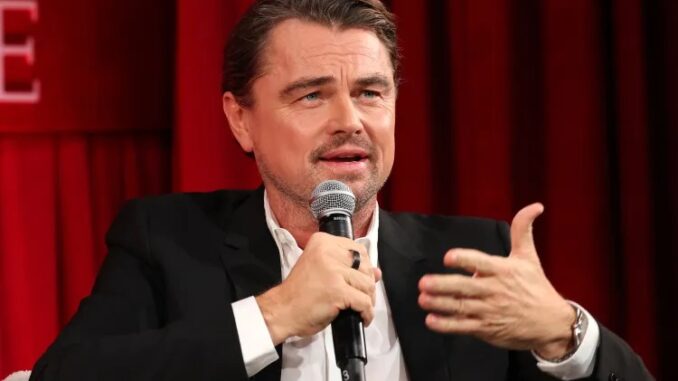
🔦 The Ultimate Power: Why Doesn’t Hollywood’s Greatest Star Direct?
We all know the narrative arc in Hollywood: the superstar actor, having mastered their craft, inevitably decides to step behind the camera. It’s the ultimate expression of control, the final stage of artistic evolution. From George Clooney and Ben Affleck to Angelina Jolie and Clint Eastwood, many of cinema’s biggest names eventually transition into the role of director, eager to shape the entire narrative from concept to final cut.
But there is one towering figure whose directorial debut seems perpetually postponed, a star whose sheer commitment to his current craft is so intense that the idea of taking on the director’s chair seems almost blasphemous: Leonardo DiCaprio.
DiCaprio, a cultural icon and Oscar winner, has collaborated with cinematic titans like Martin Scorsese and Quentin Tarantino for decades. He has witnessed filmmaking at its highest, most rigorous level. Yet, when asked about the possibility of directing a feature film, his answer is a firm, definitive, and profoundly revealing “never want to direct.” We need to break down the sheer, almost overwhelming pressure and responsibility that keeps this cinematic giant dedicated solely to the demanding art of acting.
🧠 The Intellectual Burden: Understanding DiCaprio’s Commitment
DiCaprio’s refusal to direct stems not from a lack of interest in filmmaking, but from a profound respect—perhaps even a slight fear—of the intellectual and administrative burden the role demands.
The 100% Commitment Conundrum
DiCaprio has often spoken about the all-encompassing nature of his job as an actor. When he signs onto a project, he dives in completely, committing to years of research, physical transformation, and complete emotional absorption into the character.
-
Emotional Immersion: For a method-adjacent actor like DiCaprio, who excels at deep, painful emotional immersion (think The Revenant or The Aviator), the focus required is singular. He understands that to truly embody a character, he needs to block out the distractions of logistics, budget, and scheduling.
-
The Director’s Split Focus: Directing, by contrast, requires a terrifying split of focus. The director must be both an artist (managing the tone, the actors’ performances, and the story) and a CEO (managing the budget, the crew of hundreds, and the timeline). DiCaprio has admitted that he sees this split as an impossible task, stating he wouldn’t be able to provide the 100% commitment required for both roles.
H3: A Fear of the Unseen Details
DiCaprio is known for being meticulously prepared as an actor. He knows his lines, his character’s history, and the emotional arc of the entire film. He recognizes that as a director, he would be accountable for thousands of details outside of the performance, things he currently relies on his trusted collaborators to manage.
This responsibility—the need to know the cost of every shot, the logistics of every location, and the morale of every crew member—is the “unseen detail” that seems to genuinely intimidate and dissuade him. Why take on that logistical nightmare when he can focus on delivering an Oscar-worthy performance?
🤝 The Power of Collaboration: Trusting the Auteurs
A key part of DiCaprio’s philosophy is the profound importance of collaboration and his deep relationships with master directors.
The Scorsese Effect: Why Direct When You Have the Best?
DiCaprio’s most defining relationship is his decades-long partnership with Martin Scorsese. This collaboration has yielded some of the greatest films of the 21st century (The Departed, The Wolf of Wall Street, Killers of the Flower Moon).
-
The Visionary Director: Why would you try to build your own cathedral when you are working with the world’s greatest architect? DiCaprio has direct access to the most visionary director working today. He gets to contribute his genius to Scorsese’s towering vision without having to deal with the administrative headache.
-
The Role of the Muse: DiCaprio seems content to operate in the powerful role of the director’s muse—the central instrument through which the director’s vision is channeled. This position is artistically demanding but logistically freeing.
H3: Acknowledging the Unique Director Genius
DiCaprio understands that directing isn’t just about yelling “Action!” It requires a rare, specific type of genius—a skill set separate from acting. He respects the craft too much to simply assume he can master it because he’s good at another part of the process.
He has repeatedly paid homage to the directors he works with, acknowledging the unique visionary energy required to wrangle millions of dollars and thousands of decisions into a cohesive narrative. He sees it as a completely different career path, not a natural progression.
🎬 The Pressure Cooker: The Unrelenting Heat of the Director’s Chair
If DiCaprio were to direct, the pressure would be immediate, immense, and almost impossible to manage.
The Weight of Expectation
-
Guaranteed Scrutiny: Any film directed by Leonardo DiCaprio would instantly be the most scrutinized directorial debut in modern Hollywood history. Critics wouldn’t judge him as a first-time director; they would judge him as a cinematic icon who must deliver instant masterpiece status.
-
The Box Office Burden: His name alone guarantees a massive budget. That budget comes with astronomical expectations for box office success and awards recognition. This pressure would likely stifle the creative freedom he cherishes as an actor.
H4: The Time Commitment Trap
DiCaprio is famous for taking long breaks between projects, dedicating his time to environmental activism and research. Directing would negate this freedom entirely.
-
Years of Development: A director commits years to a project—from securing funding and developing the script to shooting, editing, and promoting. This long-term, non-stop commitment is antithetical to DiCaprio’s current lifestyle, which prioritizes periods of intense work followed by intentional downtime.
🌍 DiCaprio’s True Passion: Environmental Activism
To fully understand why DiCaprio avoids the director’s chair, we must recognize where his other 100% commitment lies: environmental activism.
The Voice of Change
DiCaprio has evolved into one of the world’s most prominent environmental advocates. He uses his platform, his production company (Appian Way), and his influence to fund research, produce documentaries, and raise awareness about climate change.
-
Prioritizing the Planet: Directing a big-budget feature film demands 18-hour days, seven days a week, for months. This time commitment would fundamentally clash with his constant, global engagement with ecological issues. He sees his current role—using his star power to fund and promote necessary change—as a higher calling than directing a fictional narrative.
-
Documentary Directing as a Compromise: It’s notable that while he avoids feature narrative directing, he has been deeply involved in producing and promoting documentaries focused on climate change (like Before the Flood). This niche allows him to blend his filmmaking interest with his true passion, without taking on the administrative and creative burden of a fictional blockbuster.
🌟 A Masterpiece of Focus: The Power of Knowing Your Lane
Ultimately, Leonardo DiCaprio’s refusal to direct is a masterpiece of professional self-awareness and focus. He is confident enough in his talent and his chosen role to understand his strengths and, crucially, his limits.
The Uniqueness of the Actor’s Gift
DiCaprio’s gift is channeling, transforming, and embodying. His work is internal and immediate. Directing requires a massive externalization of vision and control. By dedicating himself wholly to the internal art of performance, he ensures that every role he takes on becomes a career-defining event. He has perfected his lane, and he knows that trying to merge into another would dilute the brilliance of his primary craft.
His dedication is a valuable lesson for every artist: true mastery comes from singular, uncompromising focus. We should celebrate his choice, because it means we continue to receive the best, most focused performances in modern cinema.
Final Conclusion
Leonardo DiCaprio’s definitive statement that he would “never want to direct” a feature film is not a sign of fear, but a testament to his profound respect for the craft and his singular commitment to acting and activism. He recognizes the intellectual, logistical, and time-intensive burden of the director’s chair—a burden that would conflict with his need for deep emotional immersion in his roles and his dedication to global environmental causes. By choosing to remain the ultimate actor, guided by visionary masters like Martin Scorsese, DiCaprio guarantees that every performance is a meticulously researched, fully realized work of art. He knows his lane, and by staying in it, he remains one of Hollywood’s most focused and indispensable stars.
❓ 5 Unique FAQs After The Conclusion
Q1: Has Leonardo DiCaprio ever directed any projects, even short films or documentaries?
A1: While DiCaprio has never directed a feature narrative film, he is a prolific producer of both narrative films and documentaries. He has been closely involved in the creation of several documentaries focused on climate change, such as Before the Flood (2016), but he avoids the primary directorial credit.
Q2: Does DiCaprio’s production company, Appian Way, influence his decision to not direct?
A2: Appian Way, his production company, allows DiCaprio to have creative influence and project control without taking on the director’s logistical duties. He can choose the scripts, select the directors, and shape the film’s tone, achieving many of the rewards of directing while maintaining his focus on acting and activism.
Q3: What specific aspect of directing does DiCaprio claim he could not fully commit to?
A3: DiCaprio specifically points to the requirement of having a split focus. He believes that directing demands too much administrative and logistical oversight, which would prevent him from giving the necessary 100% emotional and psychological commitment required for his immersive acting process.
Q4: Which of Leonardo DiCaprio’s frequent collaborators are known for also directing?
A4: While Martin Scorsese is primarily a director, several actors DiCaprio has worked with frequently are also known for directing, including Clint Eastwood (J. Edgar), George Clooney (The Ides of March), and Ben Affleck (Argo, Gone Baby Gone).
Q5: Is Leonardo DiCaprio known for taking long breaks between acting roles?
A5: Yes. DiCaprio is renowned for being highly selective and often takes long breaks (sometimes 2-3 years) between major feature film roles. This downtime allows him to fully decompress, conduct deep research for his next character, and dedicate substantial time to his environmental advocacy.