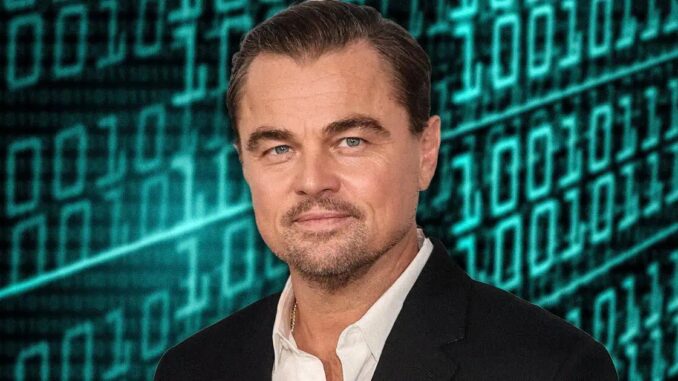
💡 The Age of Automation: A Cinematic View of the Digital Future
We are living through a period of technological revolution, watching as Artificial Intelligence (AI) transitions from a niche academic concept to a dominating force reshaping virtually every industry—from medicine and finance to, perhaps most dramatically, art and entertainment. The promise of AI is boundless: enhanced creativity, unprecedented efficiency, and tools that could fundamentally solve some of humanity’s most complex problems.
But whenever a revolutionary technology emerges, it always brings a necessary and often cynical counterbalance. Who better to offer this kind of insightful skepticism than someone who operates at the apex of human creativity and storytelling? Enter Leonardo DiCaprio.
The Oscar-winning actor recently weighed in on the AI debate, and his perspective is a fascinating blend of respect for the technology’s potential and a stark warning about its inevitable pitfalls. DiCaprio acknowledges that AI can serve as an incredible enhancement tool, accelerating innovation and production. However, he quickly pivots to a powerful caution: left unchecked, AI’s output will eventually degrade into nothing more than “internet junk.” This perspective is the perfect encapsulation of the AI paradox: the power to create infinite possibility carries the inherent risk of creating infinite garbage. We need to dissect this cinematic warning and see how AI’s explosive growth could lead to an ultimate decline in digital quality.
🚀 The Promise: AI as an Enhancement Tool
DiCaprio’s acknowledgment that AI is an “enhancement tool” is crucial. He isn’t dismissing the technology wholesale; he’s recognizing its current and potential value in augmenting human endeavors.
Accelerating Discovery and Production
In the world of science and data, AI is already proving its worth as a powerful assistant.
-
Scientific Breakthroughs: AI can sift through massive datasets to identify patterns that human researchers might miss, dramatically accelerating drug discovery, climate modeling, and astronomical research.
-
Creative Workflow: In filmmaking, AI can enhance post-production by automatically processing visual effects, assist scriptwriters in brainstorming ideas, or create realistic synthetic environments. This dramatically speeds up the mundane, logistical parts of production, allowing human artists to focus on the truly creative elements.
-
Personalized Experience: AI-driven algorithms personalize everything from our streaming queues to our news feeds, making the consumption experience more relevant and efficient.
This is the beautiful side of the AI coin: a hyper-efficient tool that eliminates friction and allows human creativity and intelligence to operate at a higher, faster level. The key word here is augmentation—AI working with us, not for us.
📉 The Peril: Inevitable Degradation into “Internet Junk”
DiCaprio’s concern is rooted in an understanding of human economics and the digital marketplace. When creation becomes effortless, quality often becomes secondary to volume. When production costs zero, the incentive to produce quality disappears.
The Floodgate Effect: Quality vs. Quantity
DiCaprio understands that AI’s greatest strength—its ability to produce content at a relentless, limitless scale—is also its greatest weakness.
-
Digital Pollution: Once AI models reach peak proficiency, every niche, every trend, and every consumer interest will be flooded with instantly generated, derivative content. This is the “internet junk”—mass-produced articles, endless stock images, repetitive music, and formulaic short videos that lack originality, depth, or genuine human insight.
-
Diminishing Signal-to-Noise Ratio: As the volume of easily generated content increases exponentially, the difficulty of finding genuinely valuable, original, and high-quality human work increases dramatically. It’s like pouring an ocean of sludge into a small, clear lake. The lake isn’t polluted by a single source, but by the sheer, overwhelming quantity of the input.
H3: The Homogenization of Creativity
Another layer of the problem is the tendency of AI models to create content based on the data they are trained on. This leads to an alarming homogenization of style.
-
The Average of Averages: AI, by definition, tends to output the most statistically probable next word, image, or plot point. The result is content that is technically flawless but creatively redundant. Everything starts looking, sounding, and feeling like the average of everything that came before it. Where is the burstiness in an algorithmically generated poem? Where is the perplexity in an instantly assembled news story?
-
Erosion of Originality: The unique voice, the unexpected stylistic choice, and the messy, imperfect humanity that defines great art will be buried under a mountain of algorithmically perfect mediocrity.
💰 The Economic Incentive: Why Junk Will Win
DiCaprio, a shrewd observer of the economic forces in Hollywood, knows that volume is profitable, even if quality is not.
The Race to the Bottom
The market rewards speed and volume, especially in the attention economy. If a company can generate 1,000 articles for the cost of one human editor, it will, even if those 1,000 articles are mostly fluff.
-
The Decline of Value: As AI content becomes ubiquitous, its perceived value will drop to zero. We’re already seeing this in industries like basic graphic design and low-level content writing. The consumer market will become oversaturated with disposable digital goods, making it harder for genuine creators to charge fair value for their work.
-
The Subscription Trap: Streamers and digital platforms may use AI to generate endless background content to justify their subscription costs, but this just accelerates the sense of being drowned in content you don’t actually want to consume.
🎭 The Impact on Storytelling and Art
DiCaprio is an artist, and his deepest concern surely lies with the impact on his own field: storytelling.
The Death of Intentionality
Great art requires intentionality—a human being pouring their unique experience, pain, and perspective into a creation. AI lacks this core human element.
-
Emotional Vacuum: While AI can mimic emotional language, it doesn’t understand pain, love, or sacrifice. An AI-written script can hit all the plot points, but it will miss the subtle, messy, contradictory human truths that make a story resonate for decades.
-
The Labor of Love: Part of the value of art is the recognition of the human labor that went into it. When we watch a film, we appreciate the director’s 10-year struggle or the actor’s intense commitment (like Winslet’s commitment to the metal grate). AI removes the struggle, and thus, removes the human investment that makes us care.
🛡️ How Do We Combat the Digital Erosion?
DiCaprio’s warning is not a call to halt AI development; it’s a plea for responsibility and regulation. If we want to prevent the “internet junk” scenario, we must take specific, proactive steps.
H4: Mandating AI Transparency and Labeling
The simplest fix is transparency. Platforms must be legally required to label AI-generated content clearly.
-
The Human Filter: Knowing whether an article, image, or video was created by AI allows the consumer to apply a “human filter,” deciding whether they prioritize efficiency or authenticity.
-
Protecting Human Work: This protects human creators by clearly distinguishing their labor from automated output, allowing quality to still command a premium price.
H4: Prioritizing Curation Over Consumption
Consumers will need to radically shift their habits from unfiltered consumption to active curation.
-
Seeking Verified Sources: We must prioritize platforms, writers, and artists with verifiable human credentials. The market must learn to reward quality and originality again, rather than simply rewarding whatever content is most easily accessible and abundant.
-
The Search for Originality: The new luxury in the digital age will be original, authentic human content. We will pay a premium not just for information, but for the guarantee that a human being struggled, thought, and felt while creating it.
🔮 The Final Paradox: The Tool That Creates Its Own Market
The final paradox of AI is that the very technology creating the “internet junk” will also create the tools needed to navigate it. AI will eventually have to become the chief curator and gatekeeper, using its power to filter out the very garbage it helped create. But will we trust the algorithm to tell us what is truly human and meaningful? DiCaprio’s warning forces us to wrestle with this ethical tightrope: we love the enhancement, but we must fear the avalanche.
Final Conclusion
Leonardo DiCaprio offers a crucial, nuanced perspective on Artificial Intelligence, recognizing its immense potential as an enhancement tool while issuing a sharp warning that its unchecked proliferation will inevitably result in a tidal wave of “internet junk.” This prediction highlights the core AI paradox: its capacity for infinite, instantaneous production will flood the digital ecosystem with derivative, algorithmically homogeneous content, burying the human voice and original art under a mountain of digital pollution. To prevent this degradation, we must prioritize transparency, mandate labeling for AI-generated content, and cultivate a culture where consumers actively seek and reward authentic, high-quality human effort. DiCaprio reminds us that while technology can accelerate creation, only human intentionality can imbue it with lasting value.
❓ 5 Unique FAQs After The Conclusion
Q1: Does Leonardo DiCaprio’s warning specifically apply to AI in the film industry?
A1: While DiCaprio’s career is in film, his warning about “internet junk” applies broadly to all content domains, including journalism, visual art, music, and the internet at large. In film, it relates to the potential for AI to generate formulaic scripts or utilize deepfakes that dilute the emotional authenticity of acting.
Q2: What does DiCaprio suggest is the primary danger of AI-generated content?
A2: The primary danger, according to his comments, is over-saturation and degradation of quality. When creation costs almost nothing and can be done infinitely, the market will choose volume and speed over originality and depth, leading to a digital environment filled with meaningless, repetitive content (“internet junk”).
Q3: What current technology trend is already proving DiCaprio’s “internet junk” prediction correct?
A3: The massive proliferation of low-quality, often plagiarized or thinly rewritten articles generated by large language models (LLMs) and the use of basic image generators to flood stock photography sites with visually similar images are often cited as early examples of digital junk.
Q4: How can human artists compete with AI’s speed and volume, according to this perspective?
A4: Human artists must compete not on speed or volume, but on authenticity, originality, and the explicit inclusion of the human element. Content that is deeply personal, messy, morally complex, and verifiably created through human effort will become the new “premium” content, commanding higher value.
Q5: Has the film industry taken any steps to address the issues of AI content and synthetic media?
A5: Yes. Major industry organizations, including the Screen Actors Guild-American Federation of Television and Radio Artists (SAG-AFTRA), have prioritized negotiating contracts with specific rules and protections regarding the use of AI, digital replicas, and synthetic media to safeguard actors’ likenesses and jobs.