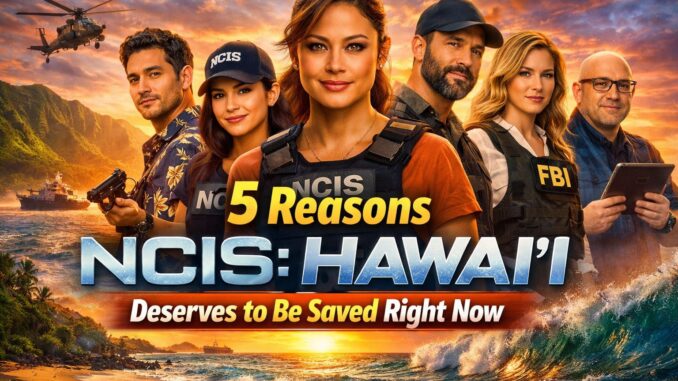
When NCIS: Hawai‘i premiered, it wasn’t just another spin-off riding the coattails of a massive franchise. It was a bold evolution—fresh faces, a stunning new setting, and a tone that blended action, heart, and cultural authenticity. Now, with its future hanging in the balance, fans are asking the same question: Why would CBS walk away from something that’s clearly still working?
Let’s break it down. Not emotionally. Not nostalgically. But logically, strategically, and creatively.
Here are five undeniable reasons NCIS: Hawai‘i deserves to be saved right now—and why canceling it would be a massive missed opportunity.
1. NCIS: Hawai‘i Finally Found Its Identity
A Spin-Off That Stopped Living in the Shadow
Let’s be honest—every NCIS spin-off struggles at first. Comparisons are inevitable. But NCIS: Hawai‘i didn’t just survive those early seasons; it grew into itself.
By Season 2 and especially Season 3, the show stopped trying to prove it belonged. It already knew it did.
The pacing improved. Character dynamics deepened. Story arcs became more confident and emotionally grounded. This wasn’t a rookie show anymore—it was hitting its stride.
Canceling a series after it finds its voice is like pulling the plug just as the engine starts purring.
Growth Like This Is Rare
Most shows don’t get better with time. NCIS: Hawai‘i did. And that alone makes it worth saving.
2. Jane Tennant Is One of the Franchise’s Strongest Leads
Vanessa Lachey Brought Something New to NCIS
Special Agent in Charge Jane Tennant isn’t a copy of Gibbs. She isn’t trying to be.
She’s empathetic without being soft. Strong without being cold. And vulnerable without losing authority. That balance is hard to pull off—and Vanessa Lachey nailed it.
This isn’t just representation for the sake of optics. This is a genuinely compelling lead character who reshaped what leadership looks like in the NCIS universe.
Why Jane Tennant Still Has So Much Story Left
Her past is still unfolding. Her personal struggles are far from resolved. And her relationships—professionally and emotionally—are only getting richer.
Ending her story now would feel unfinished. And audiences can sense that.
3. The Hawai‘i Setting Is a Character, Not a Gimmick
More Than Beaches and Blue Water
Yes, the scenery is stunning. But NCIS: Hawai‘i didn’t use its location as window dressing.
The show leaned into:
-
Military significance of the Pacific
-
Local culture and traditions
-
Jurisdictional complexity unique to the islands
-
Real geopolitical stakes
Hawai‘i isn’t just where the show takes place—it shapes every story.
Authenticity That Other Shows Can’t Replicate
You can fake New York. You can recreate D.C. But Hawai‘i? That authenticity is rare, expensive, and incredibly valuable.
Canceling the show means losing a setting no other procedural is currently doing justice.
4. The Ensemble Cast Has Real Chemistry
A Team That Feels Like a Family
Procedurals live and die by their ensemble. And NCIS: Hawai‘i got this right.
From Lucy and Kate’s emotionally grounded relationship to Ernie’s humor balancing high-stakes tension, the cast feels cohesive—not forced.
You believe these people trust each other. You believe they’d risk their lives together. And most importantly, you care.
Why Chemistry Like This Takes Time
This kind of natural dynamic doesn’t happen overnight. It’s built through seasons of shared stories, inside jokes, and emotional investment.
Canceling now throws all of that away—just when it’s paying off.
5. Canceling NCIS: Hawai‘i Sends the Wrong Message
To Fans Who Showed Up Every Week
Viewers invested time, emotion, and loyalty. They followed crossovers. They stuck through early growing pains.
And now? They’re being told it doesn’t matter.
In an era where audience trust is fragile, that’s a risky move.
To the Future of the NCIS Franchise
NCIS: Hawai‘i proved the franchise can evolve:
-
New leadership styles
-
Broader representation
-
Fresh storytelling approaches
Canceling it signals retreat—not progress.
Why Saving NCIS: Hawai‘i Makes Business Sense
Streaming Longevity and Global Appeal
Procedurals thrive on streaming. They’re bingeable, accessible, and evergreen.
Add in Hawai‘i’s global appeal, and you’ve got a show with serious long-term value—not just live ratings.
A Franchise That Still Has Fuel
NCIS isn’t tired. It’s transforming.
And NCIS: Hawai‘i is proof that reinvention works.
What Happens If NCIS: Hawai‘i Is Saved?
Stronger Story Arcs
Another season allows:
-
Deeper character backstories
-
More serialized storytelling
-
Higher emotional stakes
A More Confident Show Than Ever
This isn’t about giving the show another chance.
It’s about letting it finish what it started.
The Bigger Picture: TV Needs Shows Like This
In a sea of dark, gritty, disposable content, NCIS: Hawai‘i offers something rare:
-
Hope without being cheesy
-
Drama without nihilism
-
Action with heart
That balance matters.
Conclusion: Saying Goodbye Now Would Be a Mistake
NCIS: Hawai‘i isn’t failing. It’s evolving.
It has a strong lead, a cohesive cast, a unique setting, and a loyal fanbase. Canceling it now doesn’t feel strategic—it feels premature.
If CBS—or another network—chooses to save it, they won’t just be reviving a show.
They’ll be honoring storytelling, audience trust, and a franchise that still has plenty to give.
And honestly? That’s worth fighting for.
FAQs
1. Why was NCIS: Hawai‘i at risk of cancellation?
Like many network shows, ratings pressure, budget concerns, and shifting priorities likely played a role—not creative failure.
2. Is NCIS: Hawai‘i connected to other NCIS shows?
Yes, it’s part of the larger NCIS universe and has featured multiple crossover events.
3. Could another network or streamer save NCIS: Hawai‘i?
Absolutely. Procedurals often perform exceptionally well on streaming platforms.
4. What makes NCIS: Hawai‘i different from other NCIS series?
Its Pacific-focused stories, cultural authenticity, and emotionally driven leadership set it apart.
5. Do fans still support NCIS: Hawai‘i?
Yes. Fan campaigns and social media engagement show strong ongoing support.