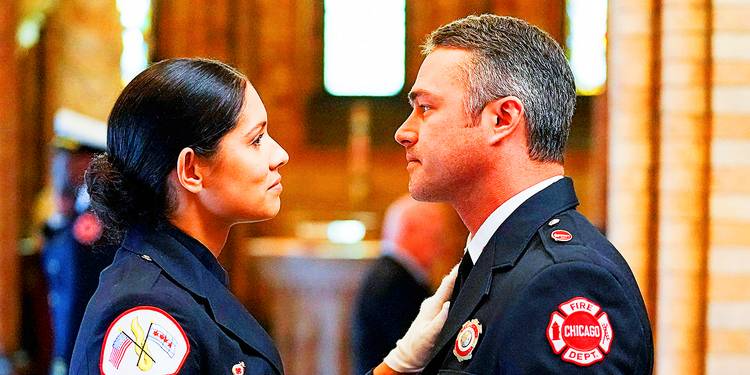
The romantic journey of Kelly Severide and Stella Kidd, affectionately known to fans as “Stellaride,” has always been defined by fire—both the kind they fight and the passion that defines their bond. However, as Chicago Fire marches into 2026, the couple is facing a challenge that cannot be extinguished with a hose or outmaneuvered with a rescue squad’s precision. The reality of parenthood has arrived, and with it comes a “breaking point” that is testing the very foundation of their marriage like never before.
For years, Severide and Kidd operated as a high-octane duo, two adrenaline-seekers who found solace in their shared understanding of the job’s mortal risks. But the transition from a partnership of two to a family of three has fundamentally altered their internal compasses. The central tension of this season stems from the differing ways the two leaders are processing their new roles. For Stella, the maternal instinct has introduced a new, unfamiliar layer of fear. Every time she climbs a ladder or enters a burning structure, she is no longer just risking herself; she is risking her child’s mother. This psychological shift has led to a newfound caution that creates friction on the fire line, especially when she feels Kelly is still operating with his signature “reckless” heroism.
On the other hand, Kelly Severide is grappling with the weight of being the protector of a legacy. While he has matured significantly over fourteen seasons, the arrival of a child has reignited his deepest anxieties about his own father’s shortcomings. The fear of repeating Benny Severide’s mistakes has led Kelly to bury himself in work, often taking on extra shifts or diving into arson investigations as a way to provide, while inadvertently creating an emotional distance at home. When one partner is withdrawing into work and the other is reeling from the overwhelming sensory load of a newborn, the communication that once made them “unbeatable” begins to fracture.
The “reality of parenthood” in Firehouse 51 is also a logistical nightmare. The show has leaned into the grueling nature of the 24-hour shift schedule and how it wreaks havoc on a young family. We are seeing the raw, unglamorous side of Stellaride: the sleep deprivation, the missed milestones, and the “hand-off” parenting at the station apron that leaves little room for romantic connection. The writers are posing a difficult, real-world question: Can two elite first responders both maintain their high-pressure careers while being the parents they want to be? Or will the “breaking point” force one of them to step back from the line of fire?
This domestic strain is further exacerbated by the return of Wallace Boden and the broader leadership shake-up at the station. With the house under intense scrutiny, there is no “easy” time for the couple to navigate their personal crisis. Every argument in the hallway or tense silence in the turnout room is magnified by the high-stakes environment. Fans are watching with bated breath as the couple faces a choice: they must either learn to integrate their new identities as parents into their marriage, or risk becoming another casualty of the CFD’s high divorce rate.
Ultimately, the survival of Severide and Kidd’s marriage depends on their ability to recalibrate their partnership. They are no longer just the “it” couple of the Chicago Fire Department; they are a mother and a father trying to survive the most difficult rescue mission of their lives. The 2026 season is serving as a crucible for Stellaride, proving that while they can survive the most intense backdrafts, the quiet challenges of a nursery can be just as dangerous.
As the season progresses toward its finale, the message is clear: love isn’t just about the heat of the moment; it’s about the endurance to stay when things get cold and complicated. Whether Stellaride can withstand this reality remains to be seen, but their struggle is a testament to the show’s ability to ground its explosive action in the messy, beautiful reality of human life.