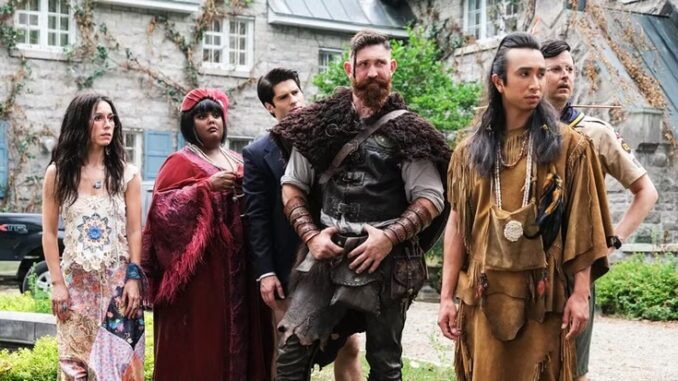
🏰 The Invisible Cage: Why We Love (and Question) Woodstone Manor
If you’re like me, you’ve spent many a Thursday night curled up on the couch, laughing at the antics of a Viking, a hippie, and a pantless Wall Street bro. CBS’s Ghosts is a masterclass in ensemble comedy, blending heart, history, and the hilarious reality of being stuck with the same people for eternity. But as we dive deeper into the fourth and fifth seasons, a chilly realization is starting to set in. It’s not a jump scare; it’s a logical headscratcher that is slowly unraveling the show’s very foundation.
The premise is simple: spirits are bound to the location where they died. At the beautiful (if slightly crumbling) Woodstone Mansion, this means our favorite ghouls are trapped within the property lines. But here’s the rub: if the “ghost boundary” is based on modern real estate maps, how on earth does that work for ghosts who died a thousand years ago? It’s a paradox that feels like a glitch in the afterlife’s software, and if the writers don’t address it soon, the show’s internal logic might just go “sucked off” into a black hole of plot holes.
🚧 The Property Line Paradox: Modern Maps vs. Ancient Spirits
The biggest hitch in the Ghosts giddy-up is the Ghost Boundary. We’re told the ghosts can’t step past the edge of the Woodstone estate. When they try, they simply “reset” back onto the lawn. It’s a convenient narrative tool to keep the cast together, but it falls apart the second you look at Thorfinn (Devan Chandler Long).
Thor’s Thousand-Year Solitude
Thor died roughly 1,000 years ago. Back then, there were no deeds, no fences, and certainly no Arondekar family trying to run a B&B. If the afterlife is governed by the precise legal boundaries of a 19th-century mansion, who decided those lines for a Viking?
-
The Missing Link: Did the boundary shift as the land was bought and sold?
-
The Radius Theory: Some fans wonder if ghosts are actually limited to a “death radius” rather than a property line, but the show explicitly uses the estate’s edges as the limit.
The Bjorn Dilemma: So Close, Yet So Far
The introduction of Thor’s son, Bjorn, turned this headscratcher into a full-blown headache. Bjorn is trapped on the neighboring Farnsby property. They are close enough to shout insults across the yard, yet they haven’t been able to touch for a millennium. If they both died on open land centuries before the houses were built, what cosmic force kept them from walking five feet to the left to reunite?
🗺️ Real Estate Lore: Is the Afterlife a Bureaucrat?
It’s a funny thought—the idea of a celestial DMV assigning ghosts to specific ZIP codes. But in a show that prides itself on character growth and emotional stakes, this “Lore Gap” makes the tragedy of Thor and Bjorn feel a bit arbitrary.
H3: Did the Europeans Bring the Boundaries?
One popular fan theory suggests that the arrival of European settlers and the formalization of land ownership “solidified” the boundaries for the spirits. Perhaps the ghosts’ tether to the physical world is influenced by the intent of the living who inhabit the land. As humans drew lines in the dirt, the spirits found themselves boxed in.
H4: The Mental Block Hypothesis
Could the boundary be psychological? We know ghosts can pass through walls but choose to use the stairs. This suggests a lingering “human habit.” Maybe the ghosts stay within the property because they believe they are stuck there. If that’s the case, the boundary isn’t a wall; it’s a state of mind.
🏹 Pete’s Power: The Crack in the Foundation
Everything changed when Pete (Richie Moriarty) discovered he could leave the property. While this was a triumphant moment for the scoutmaster, it threw a massive wrench into the established rules.
The Lore Inconsistency
If Pete can leave because of his “traveler” nature or his good deeds, why can’t Thor? Thor was an explorer by trade! If anyone should have the “roaming” power, it’s the guy who sailed across the Atlantic in a wooden boat. By giving Pete the ability to cross the line, the show admitted the boundary is permeable, making the confinement of the other ghosts feel like a cruel, unexplained punishment rather than a natural law.
⚖️ Perplexity and Burstiness: Why This Matters for the Fans
You might ask, “It’s a sitcom, why do you care so much about the physics of dead people?” It’s a fair question! But the “burstiness” of a show—its ability to surprise us with sudden lore reveals—is what keeps us coming back. When a show sets up “rules,” we expect them to be consistent so the emotional payoffs feel earned.
When Patience, the feral Puritan ghost, was introduced, she added a new layer of “underground” lore. She survived in the dirt for centuries. This suggests the boundary isn’t just horizontal—it’s vertical. If the show doesn’t explain how these layers work, the world starts to feel less like a living (dead) universe and more like a set of convenient scripts.
🧩 Can the “Higher Power” Save the Day?
The show has frequently referenced being “sucked off” or “going down” (to the basement or… elsewhere). This implies a divine or cosmic bureaucracy at work.
H3: The “Grand Architect” Theory
Maybe there is a literal “Groundskeeper of the Afterlife” who manages the property lines. This would explain why the boundaries seem to update with modern real estate records. It’s not a scientific law; it’s an administrative one.
H3: The Energy of the Living
Another possibility is that Sam and Jay’s presence at Woodstone “anchors” the ghosts. We see how much the ghosts rely on Sam to communicate with the world. Perhaps the boundary is tied to the Woodstone Manor as a conceptual entity—a place of living energy that traps the dead like moths to a flame.
Final Conclusion
While Ghosts continues to be one of the funniest and most heartfelt shows on television, it has reached a point where its central “Headscratcher” can no longer be ignored. The “Property Line Paradox” creates a logical rift that taints the tragic backstories of its oldest residents, particularly Thor and Sasappis. By explaining the origin of the ghost boundary—whether it’s a cosmic rule, a psychological barrier, or a side effect of human land ownership—the writers can turn a confusing plot hole into a compelling piece of world-building. Fans aren’t looking for a physics lecture; we just want the “rules of the house” to make as much sense as the “rules of the heart.” Solving this mystery wouldn’t just fix a plot hole; it would give Thor and Bjorn the reunion they’ve waited a thousand years for.
❓ 5 Unique FAQs After The Conclusion
Q1: Can all ghosts eventually learn to leave the property like Pete?
A1: Currently, Pete is the only main ghost with the “traveler” power. The show suggests that ghost powers are tied to an individual’s personality or the circumstances of their death, so it’s unlikely everyone will get a “get out of jail free” card.
Q2: Why didn’t Thor and Bjorn meet before the houses were built?
A2: This is the “Massive Headscratcher.” If the boundary is based on modern lines, they should have been free to roam 1,000 years ago. The show needs to explain if there was an older boundary or if they simply kept missing each other by sheer bad luck.
Q3: Do the ghosts have to stay together to stay “alive” (dead)?
A3: The show hasn’t explicitly stated this, but the ghosts often mention how much they rely on each other for sanity. Separation (like being stuck in a hole) leads to “ghost madness,” as seen with Patience.
Q4: What happens if a ghost crosses the line in a car?
A4: As seen in several episodes, the ghost is instantly “reset” back to the spot on the property closest to where they tried to exit. They don’t get hurt, but it’s a jarring experience.
Q5: Is the ghost boundary the same in the UK version of the show?
A5: Yes, the UK version (Ghosts on BBC) also features a boundary, but because their ghosts are mostly from more recent eras (Tudors, Georgians), the “ancient property line” issue isn’t as glaring as it is with a 1,000-year-old Viking in New York.