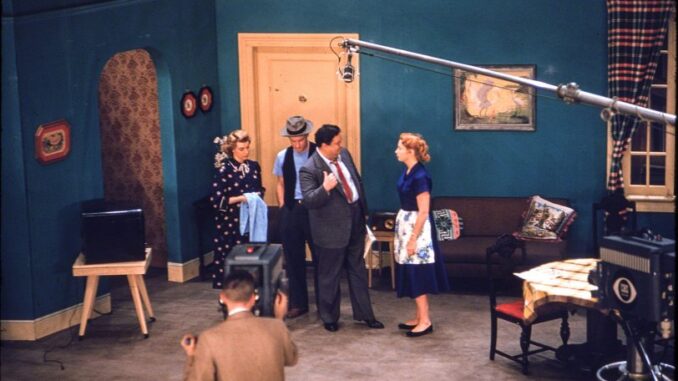
To audiences, The Honeymooners looked effortless. The timing was sharp, the chemistry felt natural, and the laughter seemed to flow without strain. But behind the familiar black-and-white frames was a working environment far more tense than the show ever admitted.
Like many classics, The Honeymooners was built not only on talent—but also on pressure, control, and unresolved conflict.
Jackie Gleason: Genius, Control, and Fear
At the center of everything stood Jackie Gleason. He was not just the star of the show—he was its creative authority. Gleason controlled the tone, the pacing, and often the emotional temperature of the set.
Those who worked with him described a man who:
-
Demanded absolute precision
-
Had little tolerance for improvisation outside his vision
-
Expected others to adjust to his rhythm, not the other way around
Rehearsals were famously intense. Actors knew that a single misstep—missed timing, altered delivery—could earn a sharp look or sudden silence from Gleason. He rarely yelled. He didn’t need to. His presence alone set the rules.
The result? Respect mixed with quiet anxiety.
Art Carney: Protected, but Isolated
Art Carney, who played Ed Norton, had a unique position. He and Gleason had worked together long before The Honeymooners, and that history earned Carney a level of trust no one else enjoyed.
This closeness brought benefits:
-
More freedom in physical comedy
-
Greater tolerance for mistakes
-
Stronger on-screen presence
But it also created distance. Other cast members quietly felt that Carney lived under a different set of rules. While no open resentment was ever confirmed, the imbalance was noticeable.
Carney himself avoided confrontation. Gentle by nature, he chose loyalty over friction—even if it meant standing slightly apart from the rest of the cast.
Audrey Meadows: Intelligence in a Male-Driven World
Audrey Meadows, who played Alice Kramden, faced a different kind of conflict—one rooted in gender and creative recognition.
Alice was sharp, logical, and emotionally grounded. In many ways, she was the smartest person in the room. That strength made the show richer—but also complicated.
Behind the scenes:
-
Female perspectives were often minimized
-
Dialogue leaned heavily toward Ralph’s dominance
-
Meadows had to push for Alice’s realism to remain intact
She reportedly felt that Alice’s role was sometimes treated as a tool to support Ralph’s comedy, rather than a character with equal weight. Meadows remained professional, but the tension between performance and recognition never fully disappeared.
The Pressure of Live Television
One of the biggest sources of conflict wasn’t personal—it was structural.
The Honeymooners was performed live. That meant:
-
No second takes
-
No editing safety net
-
No room for error
Every episode carried the stress of theater and television combined. This relentless pressure magnified small frustrations into lasting fatigue. Even minor disagreements felt heavier when mistakes could echo in real time across millions of homes.
Why No One Talked About It
Unlike modern productions, there was no social media, no gossip columns hungry for backstage drama. Problems were handled quietly—or not at all.
The cast did not feud publicly.
They did not air grievances in interviews.
They simply worked… until the environment became unsustainable.
That silence is why The Honeymooners feels so deceptively warm. The cracks were always there—but hidden behind discipline and professionalism.
A Short Run, Burned Bright
The show’s original run lasted only 39 episodes—a surprisingly small number for something so influential. Many historians believe the intense working conditions played a role.
The conflicts didn’t explode.
They didn’t end in scandal.
They simply wore everyone down.
Final Thoughts
The brilliance of The Honeymooners came at a cost. Behind every perfectly timed argument between Ralph and Alice was a set filled with tension, hierarchy, and creative strain.
And yet—perhaps that friction is exactly what gave the show its edge.
Great comedy often comes from discomfort.
And The Honeymooners may be the clearest proof of that.